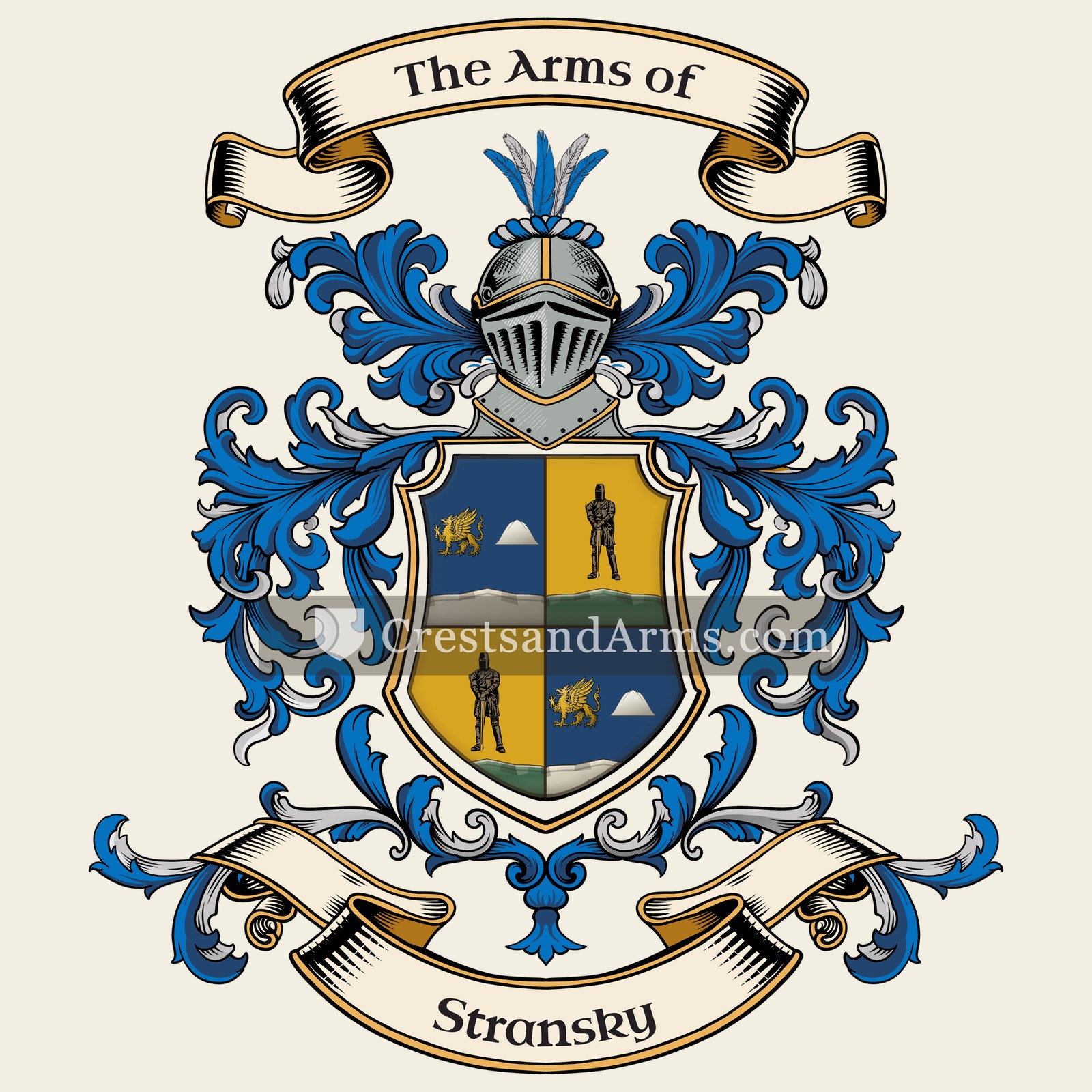
A record of documented arms, meaning and origin, researched for the Stransky family of Austria.
Reg. 8483 · Austrian, T–V
Coat of Arms & Family Crest Details
Symbols on this shield
mountThe ground held, and steadfastness upon it
griffinValour and vigilance, guarding great treasure
knightChivalry and service in arms
Colours
Blue (Azure)Means: Loyalty and truth
Gold (Or)Means: Generosity
Silver (Argent)Means: Peace and sincerity
Green (Vert)Means: Hope
Historical info
Source
J. B. Rietstap, Armorial Général, Gouda: G. B. van Goor Zonen, 1884–87
Blazon (the actual original written record)
“Ec.: aux 1 et 4 d'azur à un griffon d'or, soutenu d'un rocher de deux coupeaux d'arg.; aux 2 et 3 d'or à un chevalier, arm. de toutes pièces, au nat., la visière levée, le casque panaché de gu. et d'arg., posé sur une terrasse de sin. et tenant une épée haute. Cq. cour. C.: un griffon iss. d'or, entre deux prob. d'azur. L. d'or et d'azur.”
BavariaBavaria, c. 1682
Digital archive packCoat of arms PNG, gold border print PDF, vector SVG and the certificate of authenticity. Sent to your email in minutes.
Map of Austria showing where the Stransky arms are recorded
The Stransky arms were recorded in Bavaria, c. 1682.
Bavaria was a country of old landed families and walled market towns. Estates passed down the same line for centuries, and both the landowners and the leading townsmen kept arms, which is why so many Bavarian names sit in the registers.
This is where the arms were entered in the register. Families often moved to other parts of the country, so the same name can turn up in more than one region.
Region
Bavaria
First recorded
1682
Granting Authority for the Stransky Arms
Imperial and Royal chancery
Sodacan · CC BY-SA 3.0
The body that granted and recorded arms in Austria in this period.
Leopold I, Holy Roman Emperor
Sovereign of the period
Leopold I, Holy Roman Emperor
1658–1705
Reigning in Austria when the Stransky arms are first recorded.
How Arms Worked in Austria
Austrian coats of arms were often linked directly to noble titles granted by the Emperor. These symbols belonged to the entire family line rather than just one individual. When a family grew, new branches kept the original design without needing to change it. This system allowed all members of a noble house to share the same identity across many generations.
Granting authority
The Imperial and Royal chancery managed all heraldic matters and controlled the official granting of arms throughout the Austrian lands.
How they got arms
Families typically received their arms through a formal imperial decree that often accompanied the elevation of a person to noble status.
Where arms were recorded
Official records of these grants were kept in the Imperial Register of Nobility which began its formal documentation process in 1453.
The family's standing
Recorded among the armigerous families of Bavaria.
Origin & History of the Stransky Family in Austria
The surname Stransky originates from the Slavic word "strana," which translates to "side" or "direction." Historically, this name was often used as a topographic descriptor for people who lived on the outskirts of a village or near a specific landmark. By the late 17th century, the family had established a notable presence in the Bavarian region, particularly around the year 1682. During this period, Bavaria served as a crossroads for various cultural movements, and families with this name were likely involved in local agriculture or trade. As the family settled into these German-speaking territories, the name adapted to local phonetic styles while retaining its original linguistic roots. This migration pattern reflects the broader movement of people across Central Europe during the early modern era, where families often sought new opportunities in growing provincial towns.
Related Branches & Arms
Root word
strana
A Slavic term referring to a side, direction, or country.
This name
StranskyA topographic name for someone who lived on the side of a hill or in a specific region.
also spelled
Stransky
Documented Sources
J. B. Rietstap, Armorial Général, Gouda: G. B. van Goor Zonen, 1884–87
Bahlow, Hans, Deutsches Namenlexikon: Familien- und Vornamen nach Ursprung und Sinn erklärt, 1967
Heintze, Albert, Die deutschen Familiennamen: geschichtlich, geographisch, sprachlich, 1903


 mountThe ground held, and steadfastness upon it
 griffinValour and vigilance, guarding great treasure
 knightChivalry and service in arms
 mountThe ground held, and steadfastness upon it
 griffinValour and vigilance, guarding great treasure
 knightChivalry and service in arms