A record of documented arms, meaning and origin, researched for the Strap family lines. Documented in 2 countries.
Reg. 1295 · German, T–V
Coat of Arms & Family Crest Details
Symbols on this shield
chiefAuthority, wisdom and dominion
bombOne who has faced a great siege
swordJustice, and military honour
Colours
Gold (Or)Means: Generosity
Red (Gules)Means: Military strength
Black (Sable)Means: Constancy
Silver (Argent)Means: Peace and sincerity
Historical info
Source
J. B. Rietstap, Armorial Général, Gouda: G. B. van Goor Zonen, 1884–87
Blazon (the actual original written record)
“D'or à trois grenades de guerre de sa., allumées de gu.; au chef de gu., ch. de deux épées d'arg., garnies d'or, passées en saut. C.: une tête et col de lion d'azur. L. d'or et d'azur. D.: DÜPPEL, 18 AVRIL 1864.”
Germanyc. 1864
Digital archive packCoat of arms PNG, gold border print PDF, vector SVG and the certificate of authenticity. Sent to your email in minutes.
Map of Germany showing where the Strap arms are recorded
The Strap arms were recorded in Germany, c. 1864.
Arms such as these were typically recorded in Bavaria.
Bavaria was a country of old landed families and walled market towns. Estates passed down the same line for centuries, and both the landowners and the leading townsmen kept arms, which is why so many Bavarian names sit in the registers.
This is where the arms were entered in the register. Families often moved to other parts of the country, so the same name can turn up in more than one region.
The body that granted and recorded arms in Germany in this period.
Wilhelm I
Sovereign of the period
Wilhelm I
1861–1888
Reigning in Germany when the Strap arms are first recorded.
How Arms Worked in Germany
Prussian heraldry was strictly tied to social rank and noble status rather than being a free choice for every citizen. These symbols were treated as permanent family property that moved through the generations to all legitimate heirs. If a family branch wanted to change their design to stand out, they had to apply for official permission to alter their specific version of the shield.
Granting authority
The Prussian Heroldsamt acted as the central state office that managed and strictly controlled all noble titles and coats of arms.
How they got arms
Families usually obtained their arms through formal royal grants or by proving their long-standing noble status to the state authorities.
Where arms were recorded
All official coats of arms were kept in the rolls of the Prussian Heroldsamt, which functioned from 1706 until 1918.
The family's standing
Recorded among the armigerous families of Germany.
Origin & History of the Strap Family in Germany
The family name Strap traces its roots to the southern regions of Germany, where its presence was firmly established in Bavaria by the mid-nineteenth century. During this era, the name was likely associated with the professional or trade-based naming conventions common in rural German communities. Families living in Bavaria in 1864 often derived their surnames from the specific tools they used or the tasks they performed in their daily labor. As the region underwent significant social and economic shifts during the 1860s, families like the Straps were part of a broader movement of people transitioning from traditional agrarian lifestyles toward the industrial growth of the German states. This period marked a time of increased record-keeping in local parish and civil registries, which helped solidify the spelling and documentation of the name as the family navigated the changing political landscape of the German Confederation.
Coat of Arms & Family Crest Details
Symbols on this shield
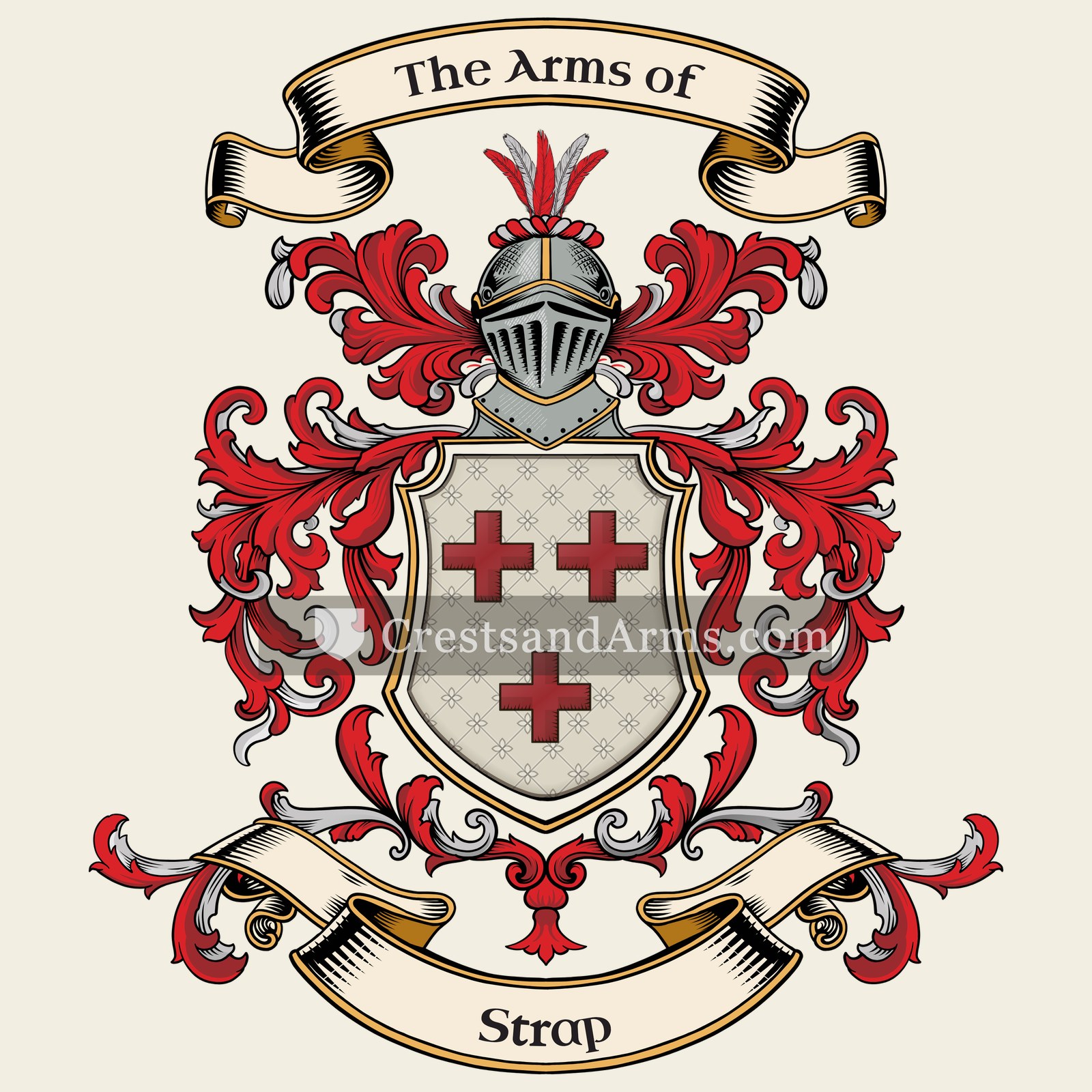
cross symbolChristian faith and service
Colours
Silver (Argent)Means: Peace and sincerity
Red (Gules)Means: Military strength
Historical info
Source
Sir Bernard Burke, The General Armory of England, Scotland, Ireland and Wales, London: Harrison & Sons, 1884
Blazon (the actual original written record)
“Ar. three crosses formée gu”
Englandc. 1620
Digital archive packCoat of arms PNG, gold border print PDF, vector SVG and the certificate of authenticity. Sent to your email in minutes.
Map of England showing where the Strap arms are recorded
The Strap arms were recorded in England, c. 1620.
Arms such as these were typically recorded in York.
Yorkshire is the largest of the English counties, and it held more gentry families than any other. Land there was split among a great many households rather than a few, so a great many of them carried arms.
This is where the arms were entered in the register. Families often moved to other parts of the country, so the same name can turn up in more than one region.
The body that granted and recorded arms in England in this period.
James VI and I
Sovereign of the period
James VI and I
1603–1625
Reigning in Germany when the Strap arms are first recorded.
How Arms Worked in England
English heraldry allowed arms to be shared by all legitimate descendants of the original owner. These symbols were treated as personal property that moved through the generations to all children. While the eldest son kept the original design, other family members could use the same shield without needing to change it or register their own unique versions.
Granting authority
The College of Arms in London has regulated the use of coats of arms throughout England and Wales since 1484.
How they got arms
Families typically obtained their coats of arms through a formal grant from the Crown or by proving their ancient right to them.
Where arms were recorded
All official coats of arms are recorded in the registers kept at the College of Arms, which date back to the fifteenth century.
The family's standing
Recorded among the armigerous families of England.
Origin & History of the Strap Family in England
The family name Strap emerged in England as a descriptive occupational surname, likely originating from the trade of a leather worker or a maker of straps. By the year 1620, historical records place members of the family in the city of York, a major northern hub that was then a center for trade and craftsmanship. During this period, families often settled in areas where their specific skills were in high demand, and the presence of the Strap name in York suggests they were integrated into the local economy of the seventeenth century. As the family lived through the social and political shifts of the Stuart era, they remained part of the fabric of northern English life. Their history reflects the common experience of families who built their identity around the essential tools and goods required for daily work in a growing urban center.
Related Branches & Arms
Root word
Stropp
A Middle Low German term for a rope or a noose.
This name
StrapAn occupational name for a rope maker or a nickname for a slender person.
Documented Sources
J. B. Rietstap, Armorial Général, Gouda: G. B. van Goor Zonen, 1884–87
Bavarian State Archives (Bayerisches Hauptstaatsarchiv), General-Landes-Archivalien
Hehl, Ulrich von, Geschichte Bayerns, 2017
Klueting, Harm, Geschichte der deutschen Länder, 2005
Digital archive packCoat of arms PNG, gold border print PDF, vector SVG and the certificate of authenticity. Sent to your email in minutes.


 chiefAuthority, wisdom and dominion
 bombOne who has faced a great siege
 swordJustice, and military honour
 chiefAuthority, wisdom and dominion
 bombOne who has faced a great siege
 swordJustice, and military honour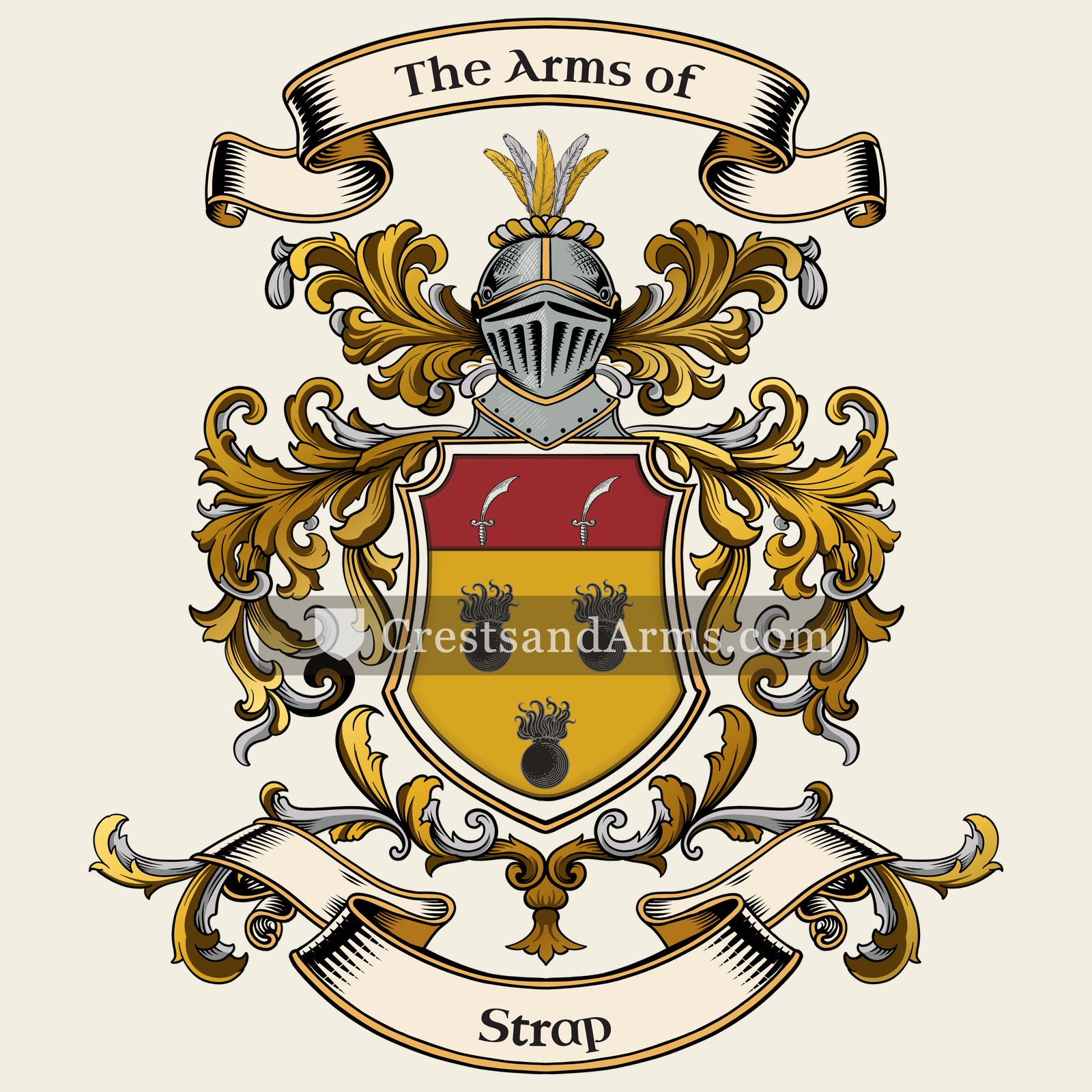


 cross symbolChristian faith and service