Map of Germany showing where the Strauss arms are recorded
The Strauss arms were recorded in Bavaria, c. 1484.
Bavaria was a country of old landed families and walled market towns. Estates passed down the same line for centuries, and both the landowners and the leading townsmen kept arms, which is why so many Bavarian names sit in the registers.
This is where the arms were entered in the register. Families often moved to other parts of the country, so the same name can turn up in more than one region.
The body that granted and recorded arms in Germany in this period.
Frederick III, Holy Roman Emperor
Sovereign of the period
Frederick III, Holy Roman Emperor
1440–1493
Reigning in Germany when the Strauss arms are first recorded.
How Arms Worked in Germany
In the Holy Roman Empire, coats of arms were often granted to individuals by the Emperor or his representatives. These arms were then passed down through the generations to all legitimate descendants of the original holder. Younger branches of a family usually kept the same shield design without needing to change it, as the arms belonged to the entire lineage.
Granting authority
The Holy Roman Emperor held the sole power to grant new coats of arms throughout his vast imperial territories.
How they got arms
Families typically obtained their coats of arms through a formal imperial grant or by proving their noble status to the authorities.
Where arms were recorded
These grants were officially recorded in the Imperial Chancery registers, which began keeping formal records of such honors during the Middle Ages.
The family's standing
Recorded among the armigerous families of Bavaria.
Origin & History of the Strauss Family in Germany
The surname Strauss emerged in the German-speaking lands as a descriptive name, likely originating from the Middle High German word for an ostrich or a bouquet of flowers. By the late 15th century, the family had established a notable presence in the region of Bavaria, with records confirming their residence there as early as 1484. During this era, surnames were becoming increasingly necessary for tax collection and legal identification as populations grew in towns and villages. The Strauss family likely belonged to the emerging middle class of artisans or landowners who helped shape the local economy of southern Germany. As the family moved through the centuries, they integrated into the social fabric of the Holy Roman Empire, often settling in areas where trade routes connected Bavaria to the wider German territories. Their history reflects the broader patterns of migration and settlement that defined the German states during the transition from the late Middle Ages to the early modern period.
Meaning of the Strauss family crest colors & symbols
Symbols on this shield
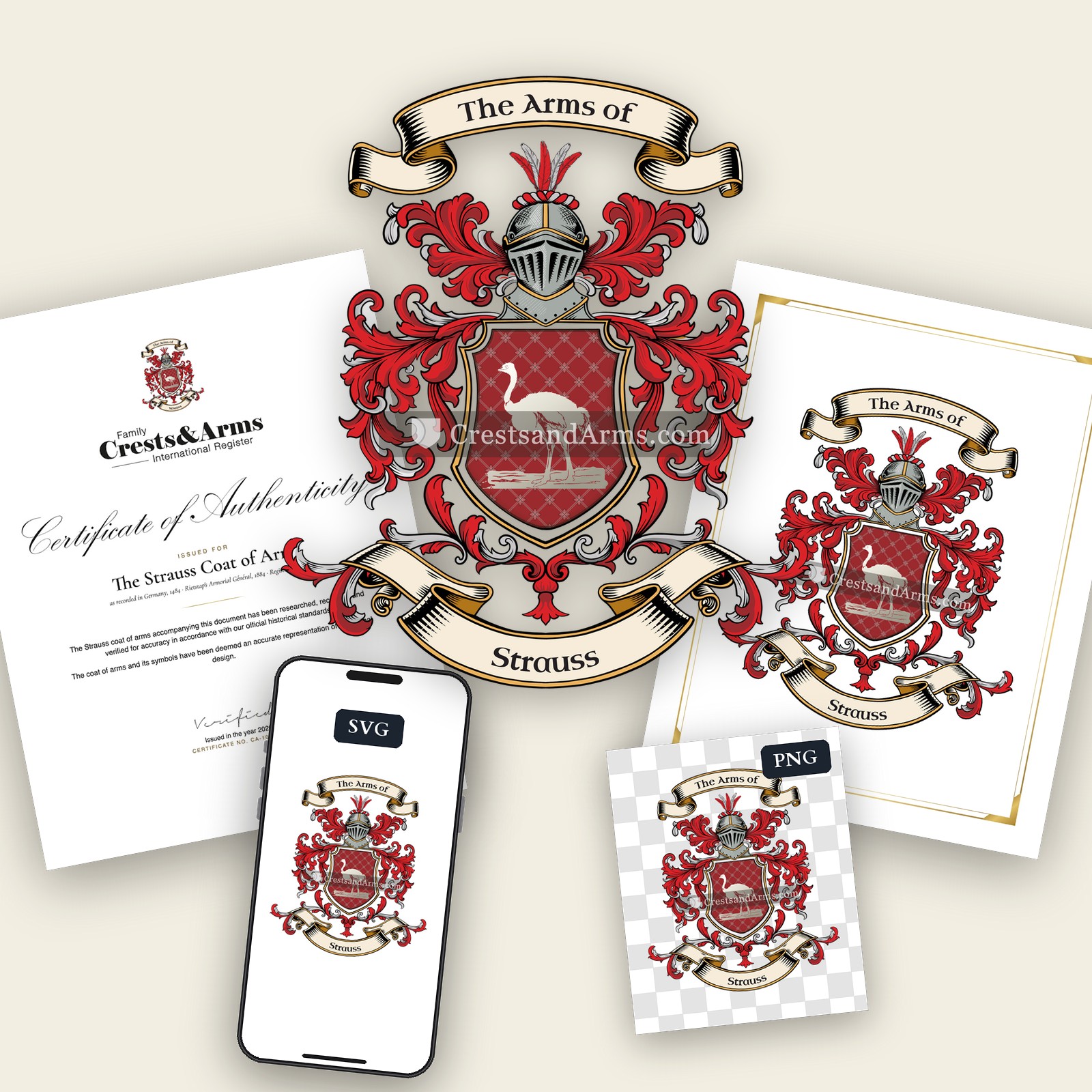
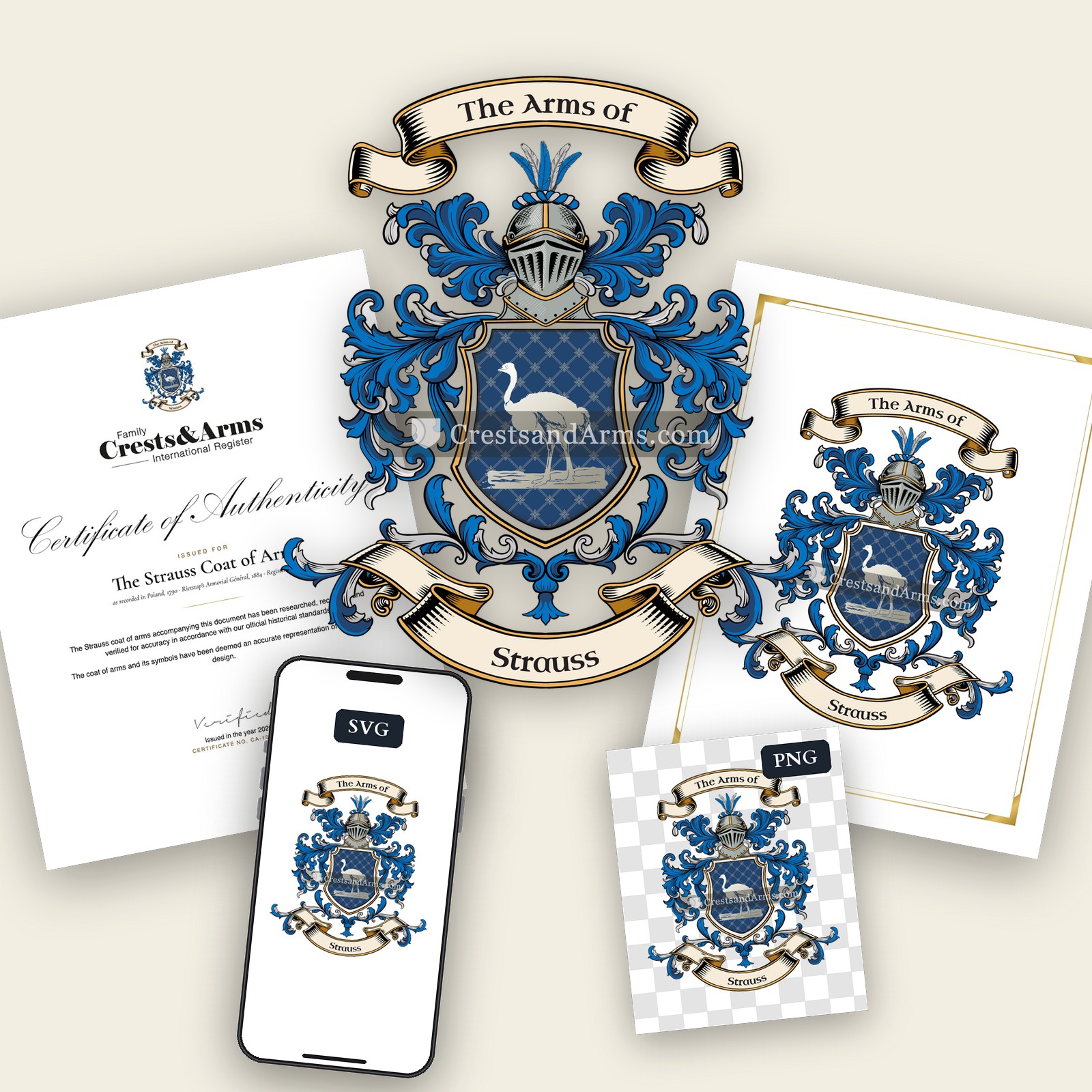
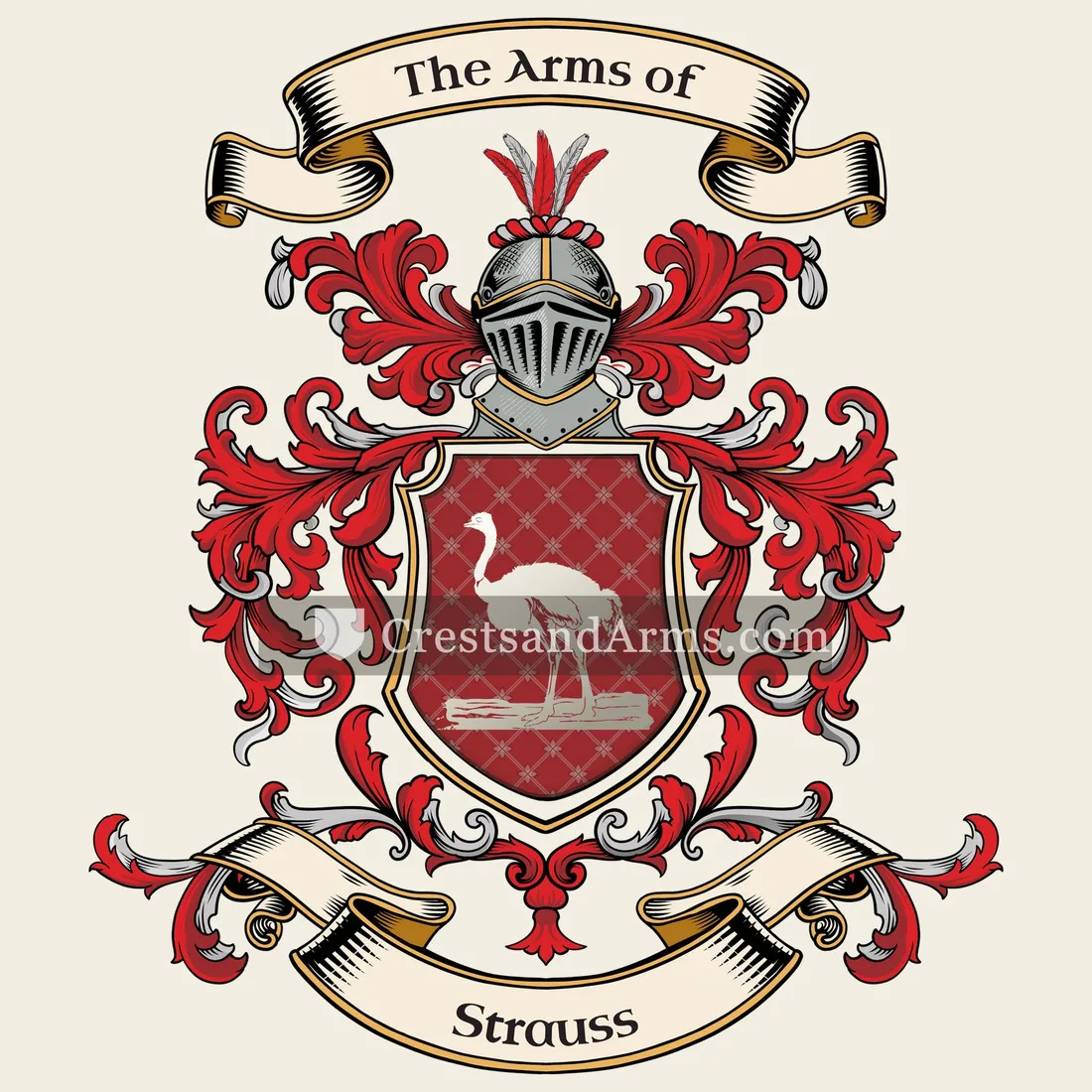
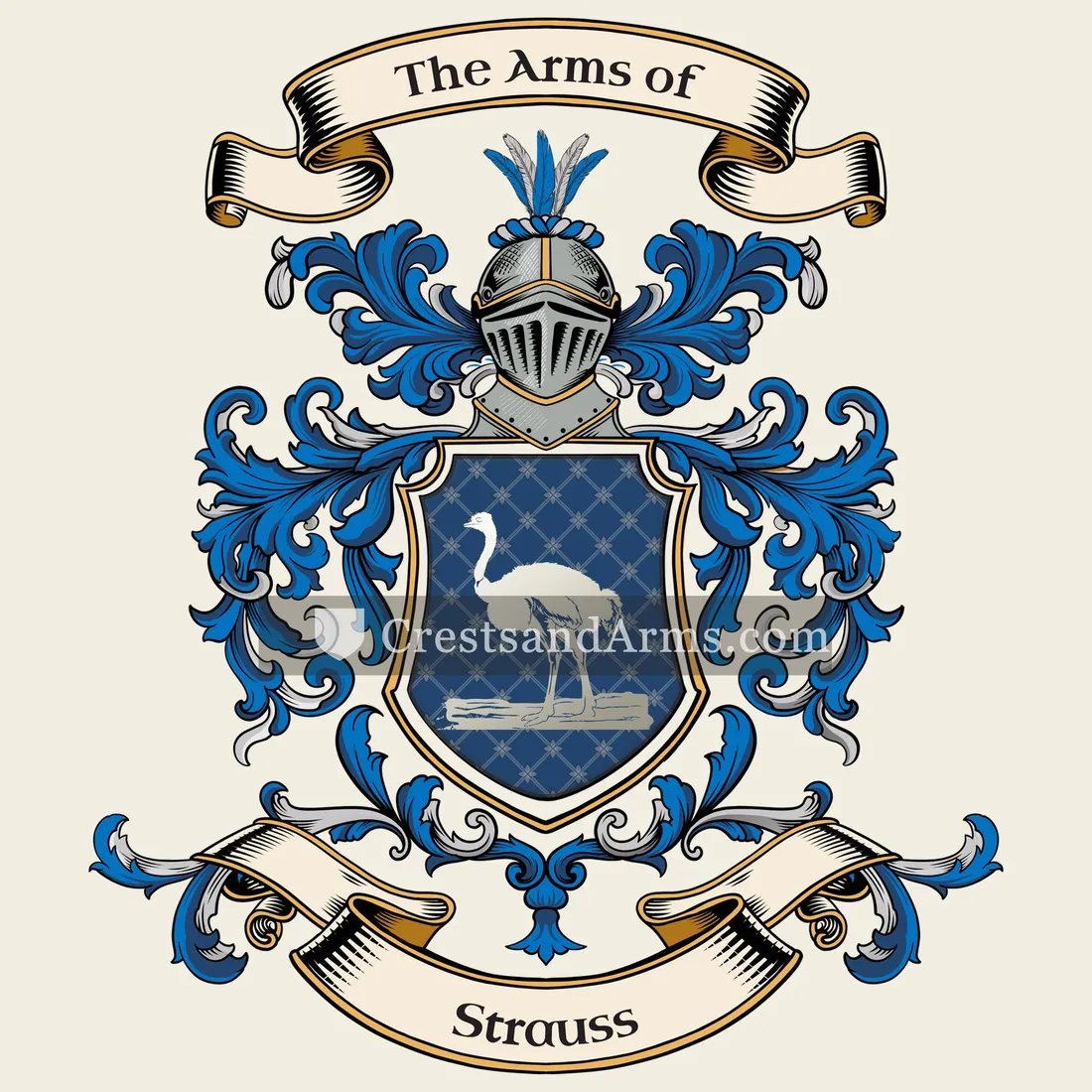
ostrichWilling obedience and serious thought
Colours
Blue (Azure)Means: Loyalty and truth
Silver (Argent)Means: Peace and sincerity
Historical info
Source
J. B. Rietstap, Armorial Général, Gouda: G. B. van Goor Zonen, 1884–87
Blazon (the actual original written record)
“D'azur à une autruche d'arg., tenant en son bec un fer-à-cheval du même, les bouts en bas. Cq. cour. C.: l'autruche.”
PolandPosnanie, c. 1790
Digital archive packCoat of arms PNG, gold border print PDF, vector SVG and the certificate of authenticity. Sent to your email in minutes.
Map of Poland showing where the Strauss arms are recorded
The Strauss arms were recorded in Posnanie, c. 1790.
This is where the arms were entered in the register. Families often moved to other parts of the country, so the same name can turn up in more than one region.
Region
Posnanie
Town
Posnanie
First recorded
1790
Granting Authority for the Strauss Arms
Ennoblement by the Sejm
Author: Olek Remesz · CC BY-SA 3.0
The body that granted and recorded arms in Poland in this period.
Stanisław August Poniatowski
Sovereign of the period
Stanisław August Poniatowski
1764–1795
Reigning in Germany when the Strauss arms are first recorded.
How Arms Worked in Poland
Polish noble families shared a single coat of arms across many different surnames, creating large clans rather than individual designs. These symbols were held collectively by all members of the clan regardless of their specific family name. When a new family joined the nobility, they were adopted into an existing clan and began using that group's established shield.
Granting authority
The Sejm, which was the Polish parliament, held the power to grant noble status and the right to bear arms.
How they got arms
Families typically received their coat of arms through a formal act of ennoblement granted by the Sejm for distinguished service.
Where arms were recorded
These grants were officially recorded in the Crown Metrica, which served as the central archive for state documents starting in the sixteenth century.
The family's standing
Recorded among the armigerous families of Poland.
Origin & History of the Strauss Family in Poland
The surname Strauss has deep roots in the region of Posnanie, where records confirm family members were living as early as 1790. In the German language, the name translates to ostrich, but it was often used as a descriptive nickname for a person who was tall, proud, or perhaps walked with a distinct posture. During the late 18th century, Posnanie was a crossroads of cultures and languages, meaning the family likely navigated a society where German, Polish, and Yiddish influences blended together. Families with this name in the region were often involved in trade or craftsmanship, which allowed them to establish roots in the growing urban centers of the province. By the time the family appears in the 1790 records, they were already part of a long-standing tradition of migration and settlement that defined the history of western Poland. This early presence suggests that the family was well-integrated into the local economy and social life of the area long before the major political shifts of the 19th century.
Meaning of the Strauss family crest colors & symbols
Symbols on this shield
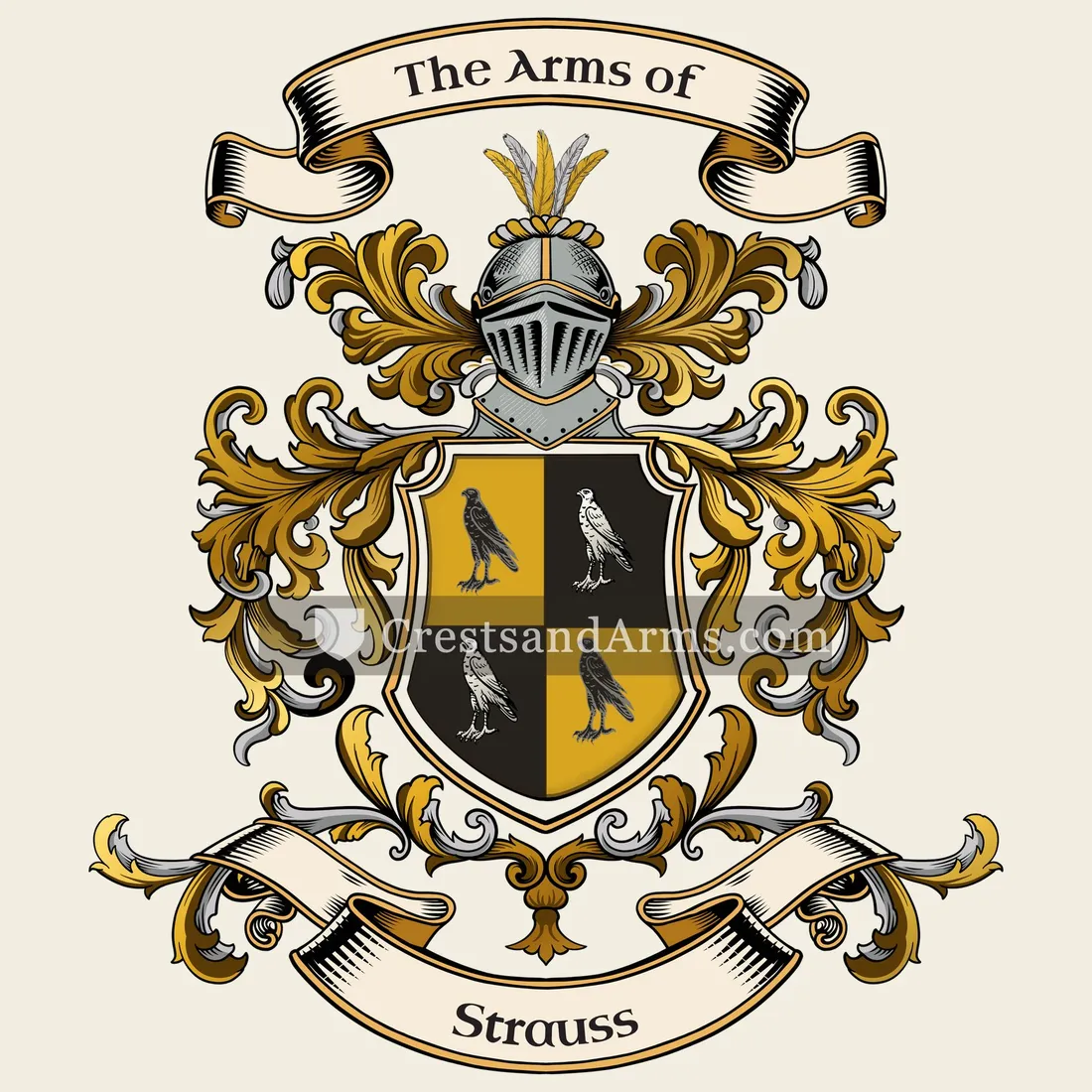
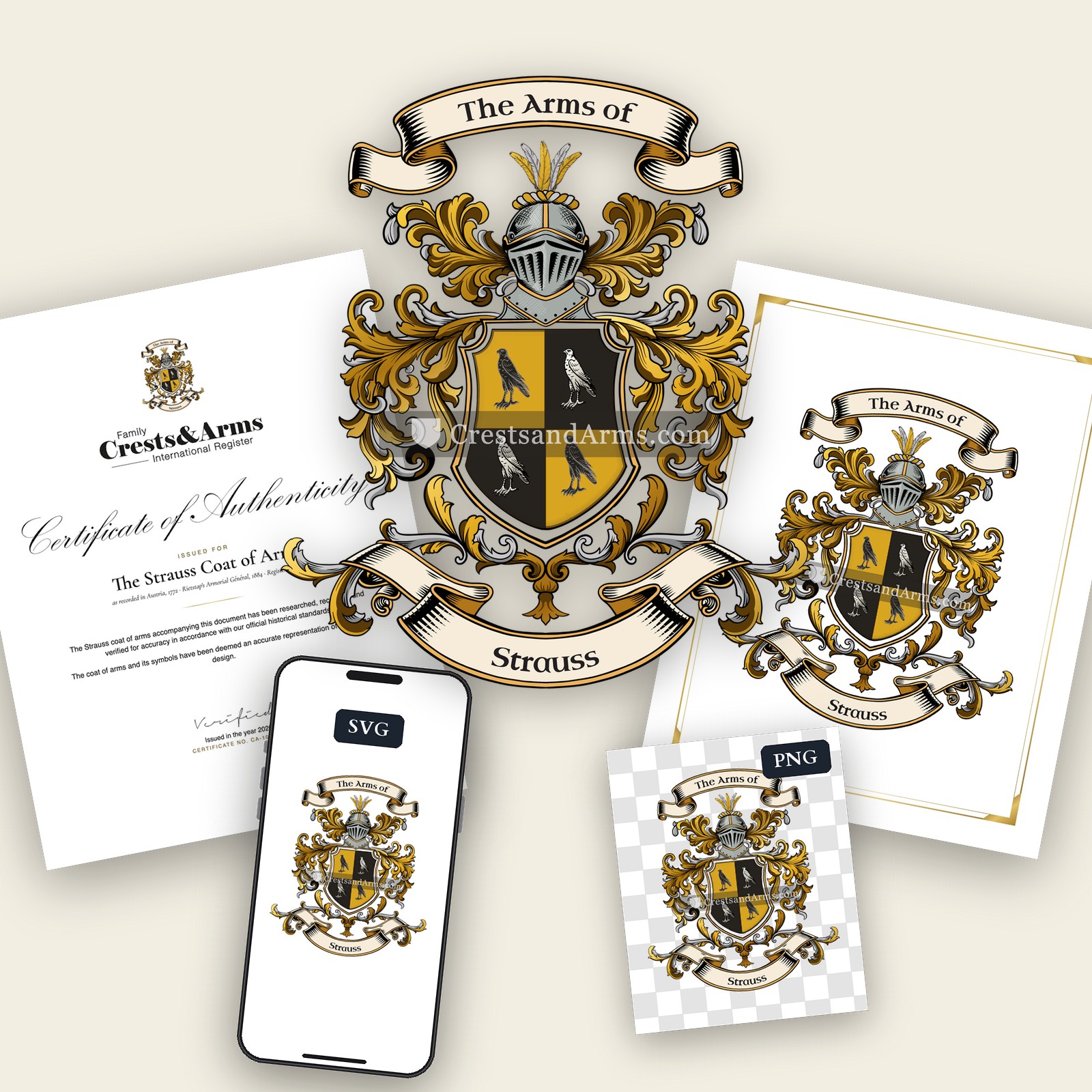
falconOne eager and quick in pursuit
Colours
Gold (Or)Means: Generosity
Black (Sable)Means: Constancy
Silver (Argent)Means: Peace and sincerity
Historical info
Source
J. B. Rietstap, Armorial Général, Gouda: G. B. van Goor Zonen, 1884–87
Blazon (the actual original written record)
“Ec.: aux 1 et 4 tranché d'or sur azur; à un vautour de sa., br. sur le tranché et tenant de sa patte dextre levée une hallebarde de sa. en pal; aux 2 et 3 de sa à un vautour d'arg., le vol levé, celui du 3 cont. Deux cq. cour. C.: 1º le vautour du 3; 1. d'or et de sa.; 2º sept pl. d'aut., alt. de sa. et d'or; l. de sa. et d'azur.”
Austriac. 1772
Digital archive packCoat of arms PNG, gold border print PDF, vector SVG and the certificate of authenticity. Sent to your email in minutes.
Map of Austria showing where the Strauss arms are recorded
The Strauss arms were recorded in Austria, c. 1772.
Arms such as these were typically recorded in Tyrol.
Tyrol was mountain country in western Austria, where the valleys were held by families who had been there a very long time. Old tenure counted for more than money, and old families carried arms.
This is where the arms were entered in the register. Families often moved to other parts of the country, so the same name can turn up in more than one region.
Region
Tyrol
First recorded
1772
Granting Authority for the Strauss Arms
Imperial and Royal chancery
Sodacan · CC BY-SA 3.0
The body that granted and recorded arms in Austria in this period.
Joseph II, Holy Roman Emperor
Sovereign of the period
Joseph II, Holy Roman Emperor
1765–1790
Reigning in Germany when the Strauss arms are first recorded.
How Arms Worked in Austria
Austrian coats of arms were often linked directly to noble titles granted by the Emperor. These symbols belonged to the entire family line rather than just one individual. When a family grew, new branches kept the original design without needing to change it. This system allowed all members of a noble house to share the same identity across many generations.
Granting authority
The Imperial and Royal chancery managed all heraldic matters and controlled the official granting of arms throughout the Austrian lands.
How they got arms
Families typically received their arms through a formal imperial decree that often accompanied the elevation of a person to noble status.
Where arms were recorded
Official records of these grants were kept in the Imperial Register of Nobility which began its formal documentation process in 1453.
The family's standing
Recorded among the armigerous families of Austria.
Origin & History of the Strauss Family in Austria
The surname Strauss has deep roots in the Alpine regions of Austria, where it emerged as a descriptive name rooted in the German language. Historically, the word refers to a bouquet of flowers or, in some dialects, a bold or unruly person. By the late 18th century, the family was well-established in the rugged landscape of Tyrol, a province known for its isolated mountain communities and strong local traditions. Records from 1772 confirm that members of the family were living in these high-altitude villages during a time when the region was undergoing significant administrative changes under the Habsburg monarchy. Life in Tyrol during this period was defined by agriculture and trade along mountain passes, which likely influenced how the family integrated into their local society. As the name spread from these mountain origins, it became a fixture of Austrian cultural life, eventually becoming synonymous with the musical legacy that would define the family name in the centuries to follow.
Strauss Meaning & Related Branches
Root word
Strūz
A Middle High German term referring to a bouquet or ostrich.
This name
StraussOriginally a nickname for a person with a flamboyant personality or an ostrich-like appearance.
also spelled
Strouss
Straus
Strous
Related arms
van der Meyesame arms
Dietzsimilar arms
Dollingersimilar arms
Düringsfeldsimilar arms
Documented Sources
J. B. Rietstap, Armorial Général, Gouda: G. B. van Goor Zonen, 1884–87
Bahlow, Hans, Deutsches Namenlexikon: Familien- und Vornamen nach Ursprung und Sinn erklärt, 1967
Heintze, Albert, Die deutschen Familiennamen: geschichtlich, geographisch, sprachlich, 1903
Bayerisches Hauptstaatsarchiv, Bayerische Gerichtsakten und Steuerlisten, 1484
Digital archive packCoat of arms PNG, gold border print PDF, vector SVG and the certificate of authenticity. Sent to your email in minutes.


 ostrichWilling obedience and serious thought
 ostrichWilling obedience and serious thought




 falconOne eager and quick in pursuit