Map of Germany showing where the Streitberg arms are recorded
The Streitberg arms were recorded in Franconia, c. 1765.
Franconia was a patchwork of small territories in central Germany, full of minor landowners and prosperous market towns. So many separate households held land there that the region produced a great many coats of arms.
This is where the arms were entered in the register. Families often moved to other parts of the country, so the same name can turn up in more than one region.
The body that granted and recorded arms in Germany in this period.
Francis I, Holy Roman Emperor
Sovereign of the period
Francis I, Holy Roman Emperor
1745–1765
Reigning in Germany when the Streitberg arms are first recorded.
How Arms Worked in Germany
In the Holy Roman Empire, coats of arms were often granted to individuals by the Emperor or his representatives. These arms were then passed down through the generations to all legitimate descendants of the original holder. Younger branches of a family usually kept the same shield design without needing to change it, as the arms belonged to the entire lineage.
Granting authority
The Holy Roman Emperor held the sole power to grant new coats of arms throughout his vast imperial territories.
How they got arms
Families typically obtained their coats of arms through a formal imperial grant or by proving their noble status to the authorities.
Where arms were recorded
These grants were officially recorded in the Imperial Chancery registers, which began keeping formal records of such honors during the Middle Ages.
The family's standing
Recorded among the armigerous families of Franconia.
Origin & History of the Streitberg Family in Germany
The family name Streitberg originates from the historical region of Franconia in modern-day Germany. The name is locational, meaning it was likely adopted by individuals who lived near or originated from the area surrounding the Streitburg castle ruins in the Wiesent valley. By the year 1765, records confirm that family members were well-established within this landscape, living as part of the local agrarian and village communities. During this period, the social structure of Franconia was deeply tied to the land and the local nobility, which influenced how families identified themselves and recorded their movements. The name serves as a direct link to the geography of the region, reflecting a time when a person’s identity was often defined by their proximity to prominent landmarks or specific settlements.
Related Branches & Arms
Root word
Streit and Berg
Conflict or struggle and a mountain or hill.
This name
StreitbergRefers to a person living near a hill associated with a historical dispute or battle.
also spelled
Streitburg
Striteberg
Documented Sources
J. B. Rietstap, Armorial Général, Gouda: G. B. van Goor Zonen, 1884–87


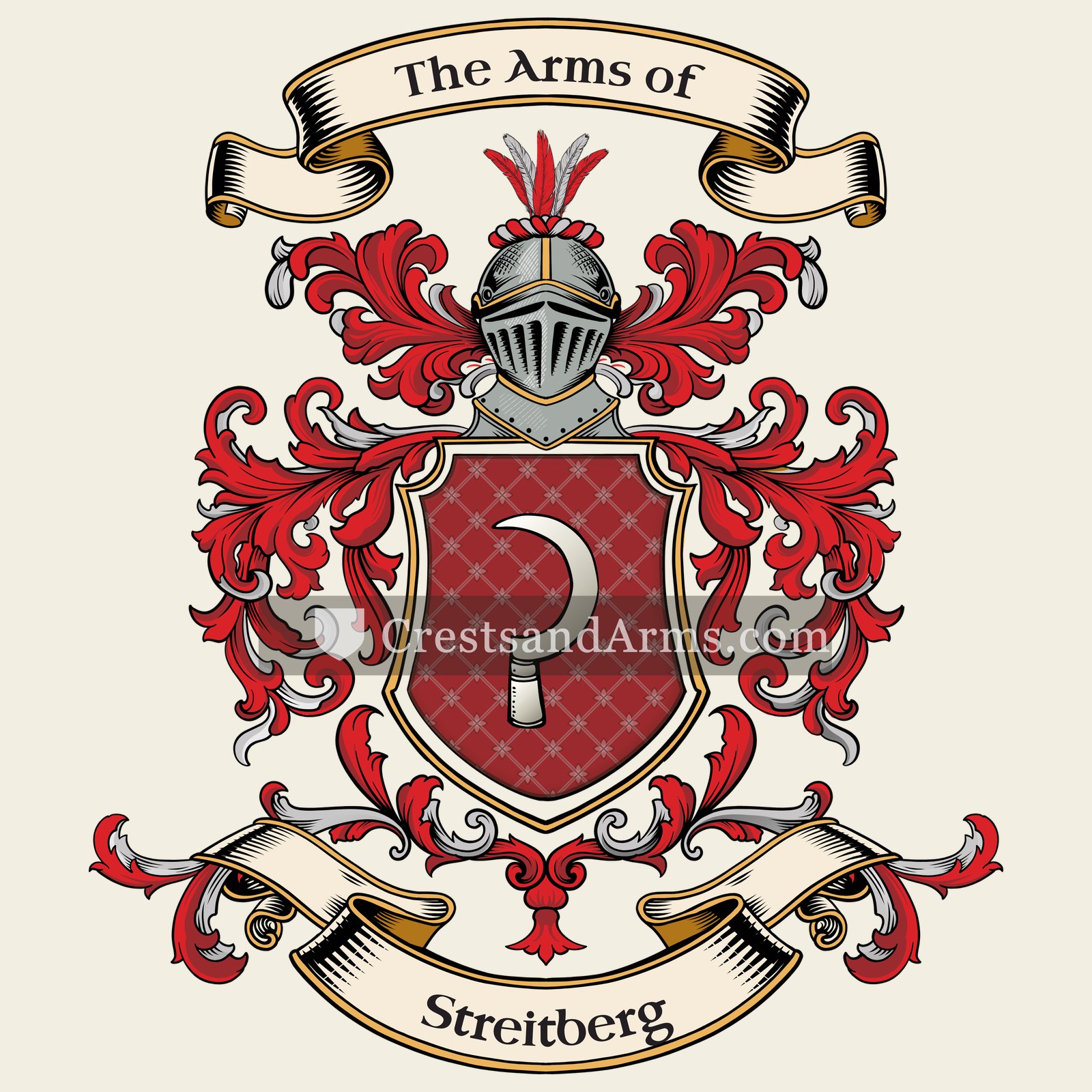
 sickleThe harvest, and the reaping of what was sown
 sickleThe harvest, and the reaping of what was sown