Map of Germany showing where the Stroka arms are recorded
The Stroka arms were recorded in Hesse, c. 1821.
Hesse was central German country, divided among a large number of small landowners and prosperous towns. So many separate households held ground there that the region produced an unusual number of coats of arms.
This is where the arms were entered in the register. Families often moved to other parts of the country, so the same name can turn up in more than one region.
The body that granted and recorded arms in Germany in this period.
Frederick William III of Prussia
Sovereign of the period
Frederick William III of Prussia
1797–1840
Reigning in Germany when the Stroka arms are first recorded.
How Arms Worked in Germany
Prussian heraldry was strictly tied to social rank and noble status rather than being a free choice for every citizen. These symbols were treated as permanent family property that moved through the generations to all legitimate heirs. If a family branch wanted to change their design to stand out, they had to apply for official permission to alter their specific version of the shield.
Granting authority
The Prussian Heroldsamt acted as the central state office that managed and strictly controlled all noble titles and coats of arms.
How they got arms
Families usually obtained their arms through formal royal grants or by proving their long-standing noble status to the state authorities.
Where arms were recorded
All official coats of arms were kept in the rolls of the Prussian Heroldsamt, which functioned from 1706 until 1918.
The family's standing
Recorded among the armigerous families of Hesse.
Origin & History of the Stroka Family in Germany
The surname Stroka is deeply rooted in the historical landscape of Hesse, Germany, where records confirm the family presence by 1821. The name likely originated as a descriptive term or a nickname derived from local dialects, which was a common practice for identifying families in rural German communities during the early nineteenth century. During this period, the region of Hesse was undergoing significant social and administrative changes following the Napoleonic Wars. Families like the Stroka line were often tied to the land as farmers or skilled laborers, contributing to the local economy and the steady growth of village life. As the family settled into their community, their name became a permanent marker of their heritage, reflecting the linguistic traditions and the agricultural focus of the Hessian people during that transformative era.
Stroka Meaning & Related Branches
Root word
Stroh
German word for straw or dried stalks of grain.
This name
StrokaAn occupational name for a straw dealer, thatcher, or someone living near a straw field.
also spelled
Strakka
Strakah
Strakas
Documented Sources
J. B. Rietstap, Armorial Général, Gouda: G. B. van Goor Zonen, 1884–87
Hessisches Staatsarchiv Marburg, Kirchenbücher (Church Records) of the Electorate of Hesse, 1821
Knapp, Hermann, Die Bauernbefreiung und der Ursprung der Landarbeiter in den älteren Teilen Preußens, 1903
Zimmermann, Wilhelm, Die Geschichte des deutschen Volkes, 1873
Digital archive packCoat of arms PNG, gold border print PDF, vector SVG and the certificate of authenticity. Sent to your email in minutes.


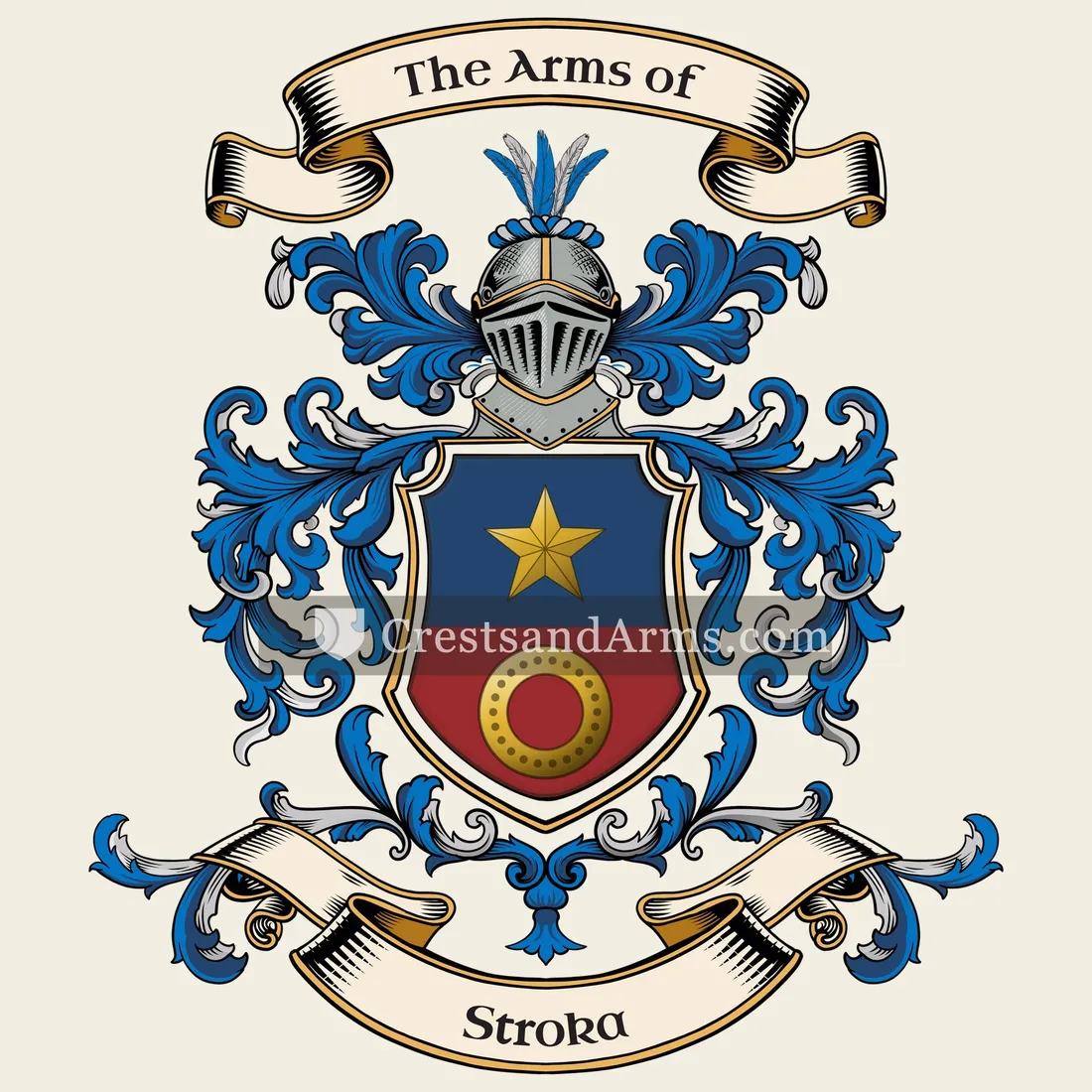
 mulletThe third son, and a divine quality from above
 ringFidelity, and a promise kept
 mulletThe third son, and a divine quality from above
 ringFidelity, and a promise kept