A record of documented arms, meaning and origin, researched for the Stromberg family lines. Documented in 2 countries.
Reg. 6100 · Swedish, T–V
Meaning of the Stromberg family crest colors & symbols
Symbols on this shield
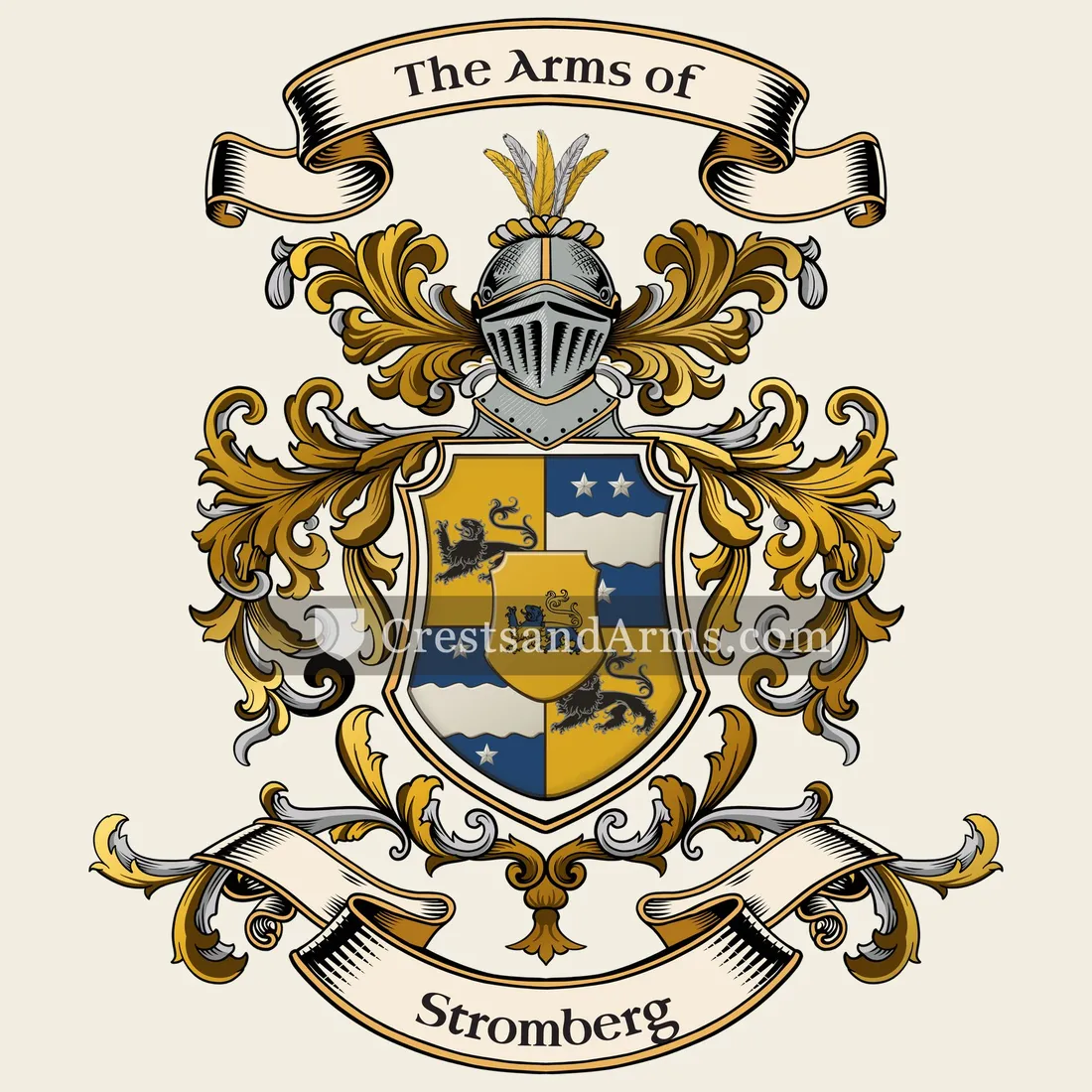
fessThe military belt, and readiness to serve
lionCourage, strength and royalty
mulletThe third son, and a divine quality from above
Colours
Gold (Or)Means: Generosity
Blue (Azure)Means: Loyalty and truth
Silver (Argent)Means: Peace and sincerity
Red (Gules)Means: Military strength
Black (Sable)Means: Constancy
Historical info
Source
J. B. Rietstap, Armorial Général, Gouda: G. B. van Goor Zonen, 1884–87
Blazon (the actual original written record)
“Ec.: aux 1 et 4 taillé de sa. sur or; au lion de l'un en l'autre; aux 2 et 3 d'azur à la fasce ondée d'arg., acc. de trois molettes du même. Sur le tout de Stromberg qui est coupé: a. d'or au lion de gu.; b. d'azur à trois fasces ondées d'arg. Deux cq. cour. C.: 1° un vol, de gu. et d'arg.; 2° un bâton de maréchal d'azur, embouté d'or, entre deux petites bannières, d'arg. frangé du même, et d'azur frangé d'arg., br. sur deux bannières plus grandes, d'azur et d'arg., sans franges.”
Swedenc. 1699
Digital archive packCoat of arms PNG, gold border print PDF, vector SVG and the certificate of authenticity. Sent to your email in minutes.
Map of Sweden showing where the Stromberg arms are recorded
The Stromberg arms were recorded in Sweden, c. 1699.
Arms such as these were typically recorded in Stockholm.
Stockholm held the Swedish court and the House of Nobility, where every noble family's arms were entered and kept. Families ennobled for service registered there, which is why so many are recorded around the city.
This is where the arms were entered in the register. Families often moved to other parts of the country, so the same name can turn up in more than one region.
The body that granted and recorded arms in Sweden in this period.
Carl XII of Sweden
Sovereign of the period
Carl XII of Sweden
1697–1718
Reigning in Sweden when the Stromberg arms are first recorded.
How Arms Worked in Sweden
In Sweden, a coat of arms belonged to a noble family as a whole rather than just one individual. These arms were passed down through the generations to all legitimate descendants. Younger branches of the family used the same shield without needing to change it. This system ensured that the entire lineage shared the same identity and status under the law.
Granting authority
The Riddarhuset, or House of Nobility, regulated all noble coats of arms in Sweden under royal authority.
How they got arms
Families received their coats of arms through royal grants of nobility which were then officially registered with the House.
Where arms were recorded
Coats of arms were officially recorded in the Swedish House of Nobility register starting in the year 1626.
The family's standing
Recorded among the armigerous families of Sweden.
Origin & History of the Stromberg Family in Sweden
The name Stromberg is a classic example of the ornamental surnames that became popular in Sweden during the late seventeenth century. The name is composed of two Swedish words, "ström" meaning stream or river and "berg" meaning mountain or hill. By 1699, records place members of the family in Stockholm, which was a time when the city was rapidly expanding as the heart of the Swedish Empire. During this era, many families began adopting double-barreled names that referenced nature to distinguish themselves from the common naming patterns based on patronymics, such as ending a name in "son." Because the family was established in the capital by the end of the 1600s, they were likely part of the growing class of merchants, craftsmen, or civil servants who helped manage the city's trade and administration. This transition to fixed surnames helped create a more stable identity for families as they moved away from traditional rural naming customs and integrated into the urban life of Stockholm.
Meaning of the Stromberg family crest colors & symbols
Symbols on this shield
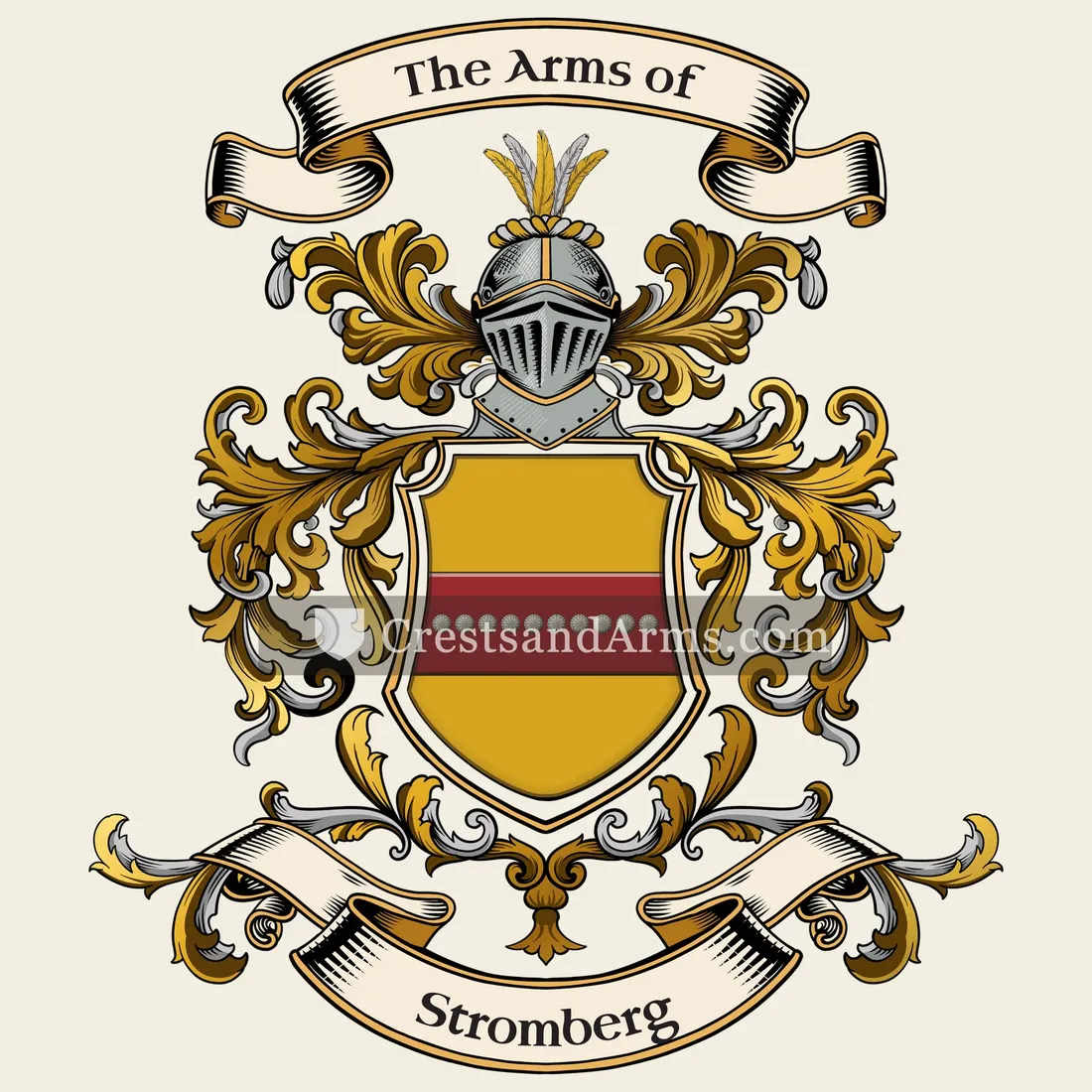
fessThe military belt, and readiness to serve
roundelA coin, and one who has been to the crusades
Colours
Gold (Or)Means: Generosity
Red (Gules)Means: Military strength
Silver (Argent)Means: Peace and sincerity
Historical info
Source
J. B. Rietstap, Armorial Général, Gouda: G. B. van Goor Zonen, 1884–87
Blazon (the actual original written record)
“D'or à la fasce de gu., ch. de dix bes. d'arg., 5 et 5. C.: deux cornes de buffle aux armes de l'écu, chacune ch. de quatre bes., 2 et 2.”
WestphaliaWestphalia, c. 1765
Digital archive packCoat of arms PNG, gold border print PDF, vector SVG and the certificate of authenticity. Sent to your email in minutes.
Map of Germany showing where the Stromberg arms are recorded
The Stromberg arms were recorded in Westphalia, c. 1765.
Westphalia was a land of small estates and fortified farmhouses in western Germany. Its families were numerous and not especially rich, but each held its own ground, and holding ground was what brought arms.
This is where the arms were entered in the register. Families often moved to other parts of the country, so the same name can turn up in more than one region.
The body that granted and recorded arms in Germany in this period.
Francis I, Holy Roman Emperor
Sovereign of the period
Francis I, Holy Roman Emperor
1745–1765
Reigning in Sweden when the Stromberg arms are first recorded.
How Arms Worked in Germany
In the Holy Roman Empire, coats of arms were often granted to individuals by the Emperor or his representatives. These arms were then passed down through the generations to all legitimate descendants of the original holder. Younger branches of a family usually kept the same shield design without needing to change it, as the arms belonged to the entire lineage.
Granting authority
The Holy Roman Emperor held the sole power to grant new coats of arms throughout his vast imperial territories.
How they got arms
Families typically obtained their coats of arms through a formal imperial grant or by proving their noble status to the authorities.
Where arms were recorded
These grants were officially recorded in the Imperial Chancery registers, which began keeping formal records of such honors during the Middle Ages.
The family's standing
Recorded among the armigerous families of Westphalia.
Origin & History of the Stromberg Family in Germany
The surname Stromberg is a topographical name, meaning it was originally used to describe people who lived near a specific geographical feature. In German, the name combines "Strom," which refers to a large river or current, and "Berg," which means a hill or mountain. This suggests that the earliest ancestors of the family likely settled on high ground overlooking a major river valley. By 1765, records confirm that the family was well-established in the Westphalia region of Germany. During this period, Westphalia was a landscape defined by dense forests and winding waterways, making it a logical place for a family with this name to thrive. Life for the Strombergs in the eighteenth century was deeply tied to the local agricultural economy and the social structures of the Holy Roman Empire. As the family grew, they became part of the rural fabric of the region, living in small communities that relied on the fertile land near the riverbanks.
Stromberg Meaning & Related Branches
Root word
ström and berg
stream or current and mountain or hill
This name
Stromberga topographic name referring to someone living near a mountain stream or river
also spelled
Stromburg
Related arms
Laicharding von Eichsberg und Lüzlgnadsimilar arms
Strömfeltsimilar arms
Documented Sources
J. B. Rietstap, Armorial Général, Gouda: G. B. van Goor Zonen, 1884–87
Otterbjörk, Roland. Svenska förnamn: Kortfattat namnlexikon. 1964
Brylla, Eva. Förnamn i Sverige: Kortfattad namnlexikon. 2004
Riksarkivet (National Archives of Sweden), Stockholms stadsarkiv (Stockholm City Archives), Mantalslängder (Tax Census Records), 1699
Digital archive packCoat of arms PNG, gold border print PDF, vector SVG and the certificate of authenticity. Sent to your email in minutes.


 fessThe military belt, and readiness to serve
 lionCourage, strength and royalty
 mulletThe third son, and a divine quality from above
 fessThe military belt, and readiness to serve
 lionCourage, strength and royalty
 mulletThe third son, and a divine quality from above


 roundelA coin, and one who has been to the crusades