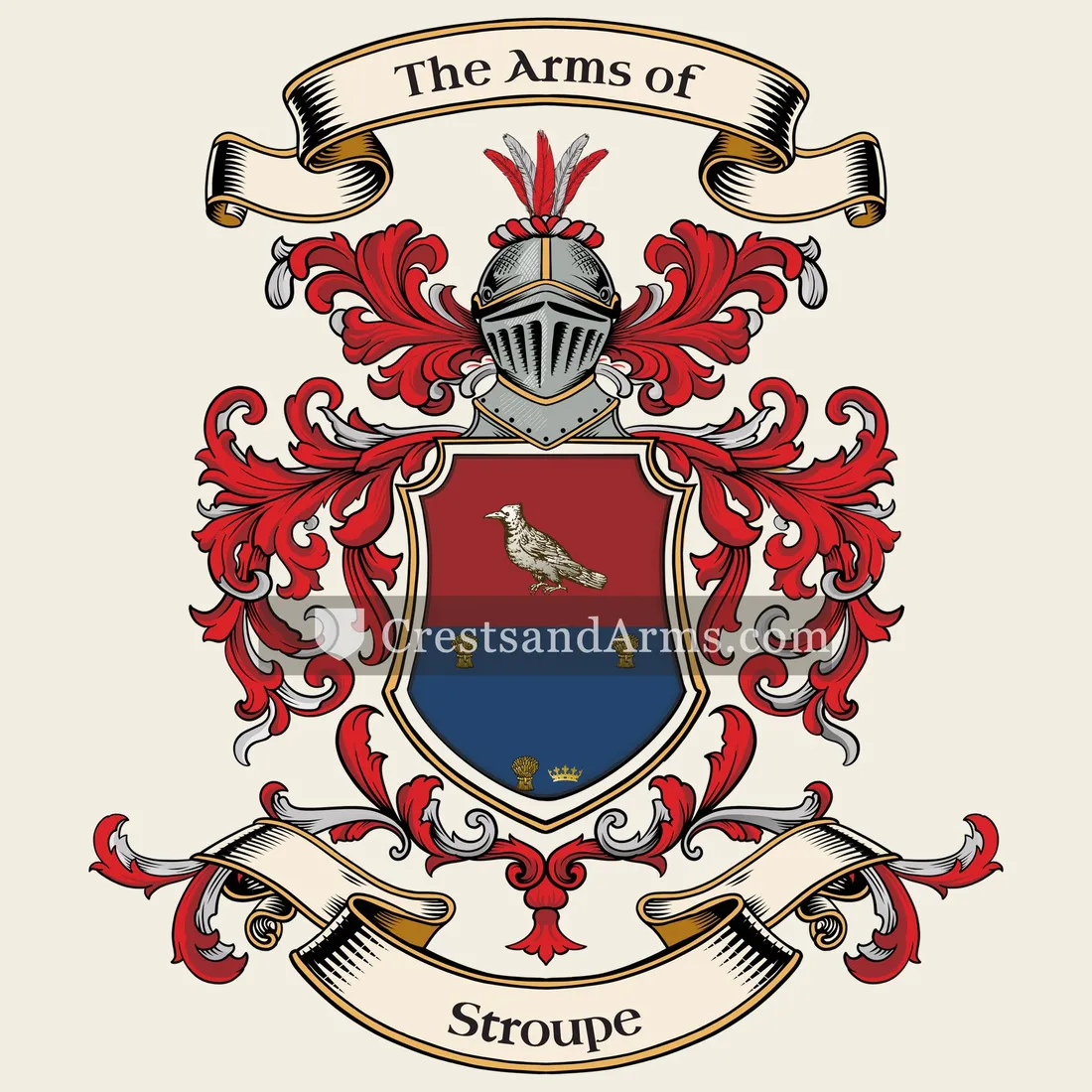
A record of documented arms, meaning and origin, researched for the Stroupe family of Germany.
Reg. 6148 · German, T–V
Meaning of the Stroupe family crest colors & symbols
Symbols on this shield
dovePeace, love and the Holy Spirit
wheatsheafPlenty, and the harvest of one's own labour
crownSovereignty, authority and just reward
Colours
Red (Gules)Means: Military strength
Blue (Azure)Means: Loyalty and truth
Silver (Argent)Means: Peace and sincerity
Gold (Or)Means: Generosity
Historical info
Source
J. B. Rietstap, Armorial Général, Gouda: G. B. van Goor Zonen, 1884–87
Blazon (the actual original written record)
“Coupé: au 1 de gu. à une colombe d'arg., coll. d'une couronne d'or; au 2 d'azur à un faisceau de trois épis effeuillés d'or, passé dans une couronne du même. C.: deux prob. coupées alt. de gu. et d'azur, passées ensemble d'une couronne d'or.”
HolsteinHolstein, c. 1750
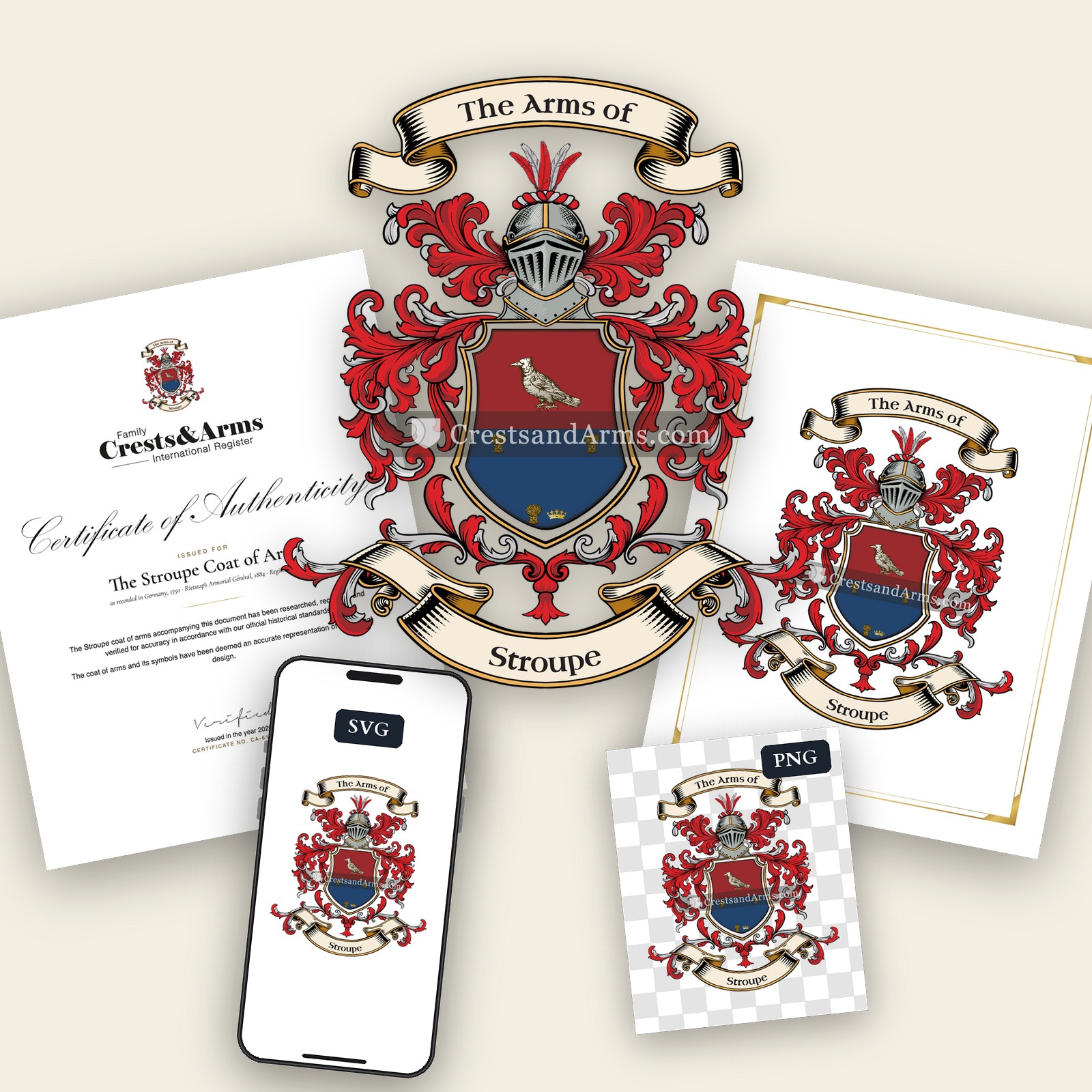
Digital archive packCoat of arms PNG, gold border print PDF, vector SVG and the certificate of authenticity. Sent to your email in minutes.
Map of Germany showing where the Stroupe arms are recorded
The Stroupe arms were recorded in Holstein, c. 1750.
Holstein was farming country between the North Sea and the Baltic, held in large estates. The same families kept the same land for generations, and generations of holding is what fills a register.
This is where the arms were entered in the register. Families often moved to other parts of the country, so the same name can turn up in more than one region.
The body that granted and recorded arms in Germany in this period.
Francis I, Holy Roman Emperor
Sovereign of the period
Francis I, Holy Roman Emperor
1745–1765
Reigning in Germany when the Stroupe arms are first recorded.
How Arms Worked in Germany
In the Holy Roman Empire, coats of arms were often granted to individuals by the Emperor or his representatives. These arms were then passed down through the generations to all legitimate descendants of the original holder. Younger branches of a family usually kept the same shield design without needing to change it, as the arms belonged to the entire lineage.
Granting authority
The Holy Roman Emperor held the sole power to grant new coats of arms throughout his vast imperial territories.
How they got arms
Families typically obtained their coats of arms through a formal imperial grant or by proving their noble status to the authorities.
Where arms were recorded
These grants were officially recorded in the Imperial Chancery registers, which began keeping formal records of such honors during the Middle Ages.
The family's standing
Recorded among the armigerous families of Holstein.
Origin & History of the Stroupe Family in Germany
The family name Stroupe is a variation of the German surname Straub, which originally served as a descriptive nickname for a person with messy or unruly hair. By the middle of the 18th century, members of the family were well-established in the region of Holstein. During this period, many families from German-speaking lands began moving toward the American colonies to seek new opportunities and escape the political instability of Europe. When these immigrants arrived at ports in places like Philadelphia, colonial officials often recorded their names phonetically based on how they sounded in English. This process of anglicizing names led to the transition from the original German spelling to the modern form of Stroupe. These early settlers played a vital role in the expansion of the American frontier, often moving from coastal cities into the interior valleys where they established farms and helped build new communities.
Stroupe Meaning & Related Branches
Root word
Strub
A Middle High German term referring to rough, shaggy, or unkempt hair.
This name
StroupeA descriptive nickname for an individual with wild, messy, or bristly hair.
also spelled
Stuerup
Stuerrup
Documented Sources
J. B. Rietstap, Armorial Général, Gouda: G. B. van Goor Zonen, 1884–87
Bahlow, Hans. Deutsches Namenlexikon: Familien- und Vornamen nach Ursprung und Sinn erklärt. 1967
Strassburger, Ralph Beaver and Hinke, William John. Pennsylvania German Pioneers: A Publication of the Original Lists of Arrivals in the Port of Philadelphia from 1727 to 1808. 1934
National Archives and Records Administration, Record Group 36: Records of the U.S. Customs Service, Passenger Arrival Lists
Digital archive packCoat of arms PNG, gold border print PDF, vector SVG and the certificate of authenticity. Sent to your email in minutes.


 dovePeace, love and the Holy Spirit
 wheatsheafPlenty, and the harvest of one's own labour
 crownSovereignty, authority and just reward
 dovePeace, love and the Holy Spirit
 wheatsheafPlenty, and the harvest of one's own labour
 crownSovereignty, authority and just reward