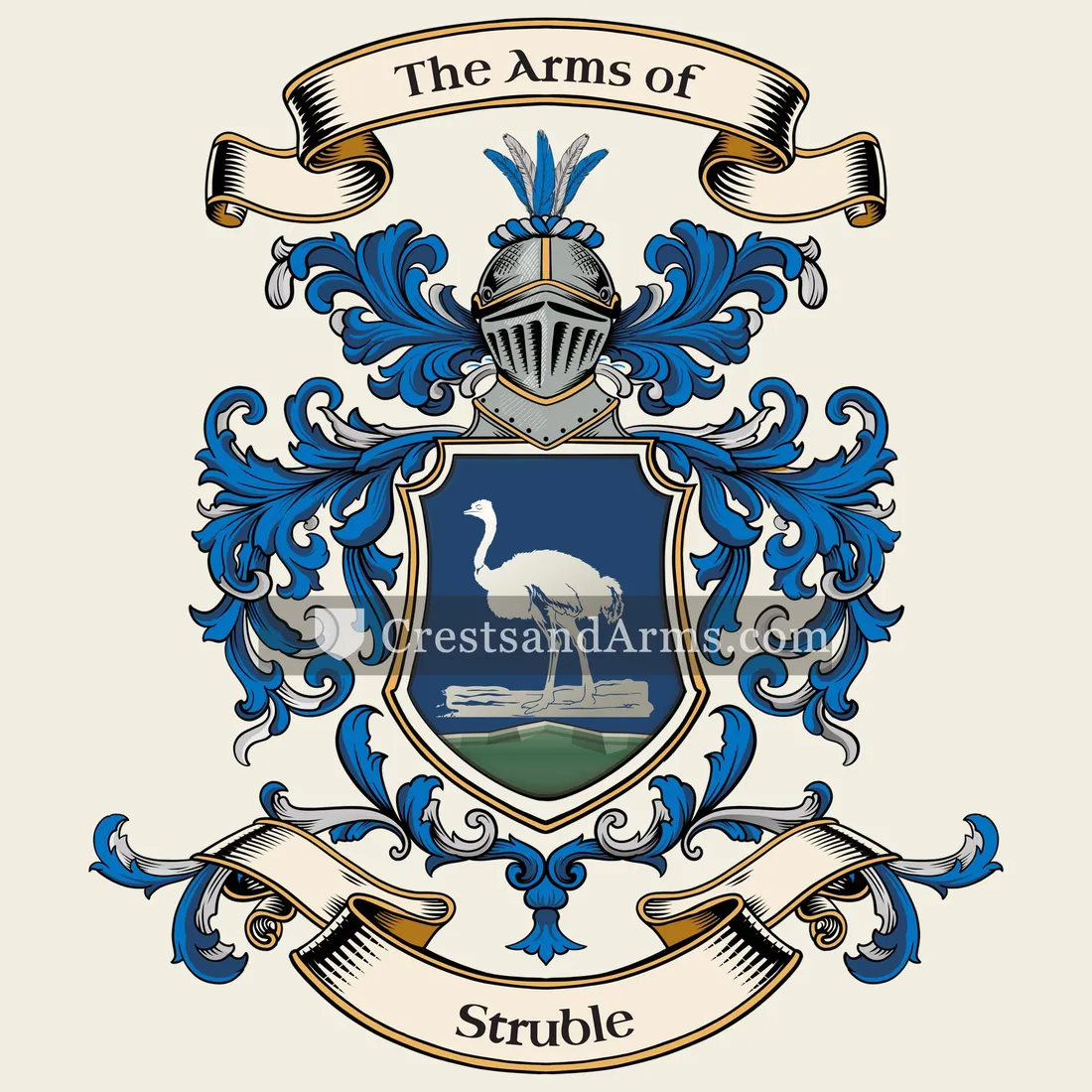
A record of documented arms, meaning and origin, researched for the Struble family of Germany.
Reg. 7491 · German, T–V
Meaning of the Struble family crest colors & symbols
Symbols on this shield
mountThe ground held, and steadfastness upon it
ostrichWilling obedience and serious thought
Colours
Blue (Azure)Means: Loyalty and truth
Green (Vert)Means: Hope
Silver (Argent)Means: Peace and sincerity
Historical info
Source
J. B. Rietstap, Armorial Général, Gouda: G. B. van Goor Zonen, 1884–87
Blazon (the actual original written record)
“D'azur à une autruche d'arg., posée sur une terrasse de sin., tenant en son bec une clé de sa., le panneton à dextre en bas. C.: 1° la tête et col de l'autruche, cont.; le panneton de la clé à dextre en haut; 2° un bras arm. en pal, le poing fermé et revêtu d'un gantelet de fer, entre deux pl. d'aut. d'arg. L.: d'arg. et de sa.”
Germanyc. 1765
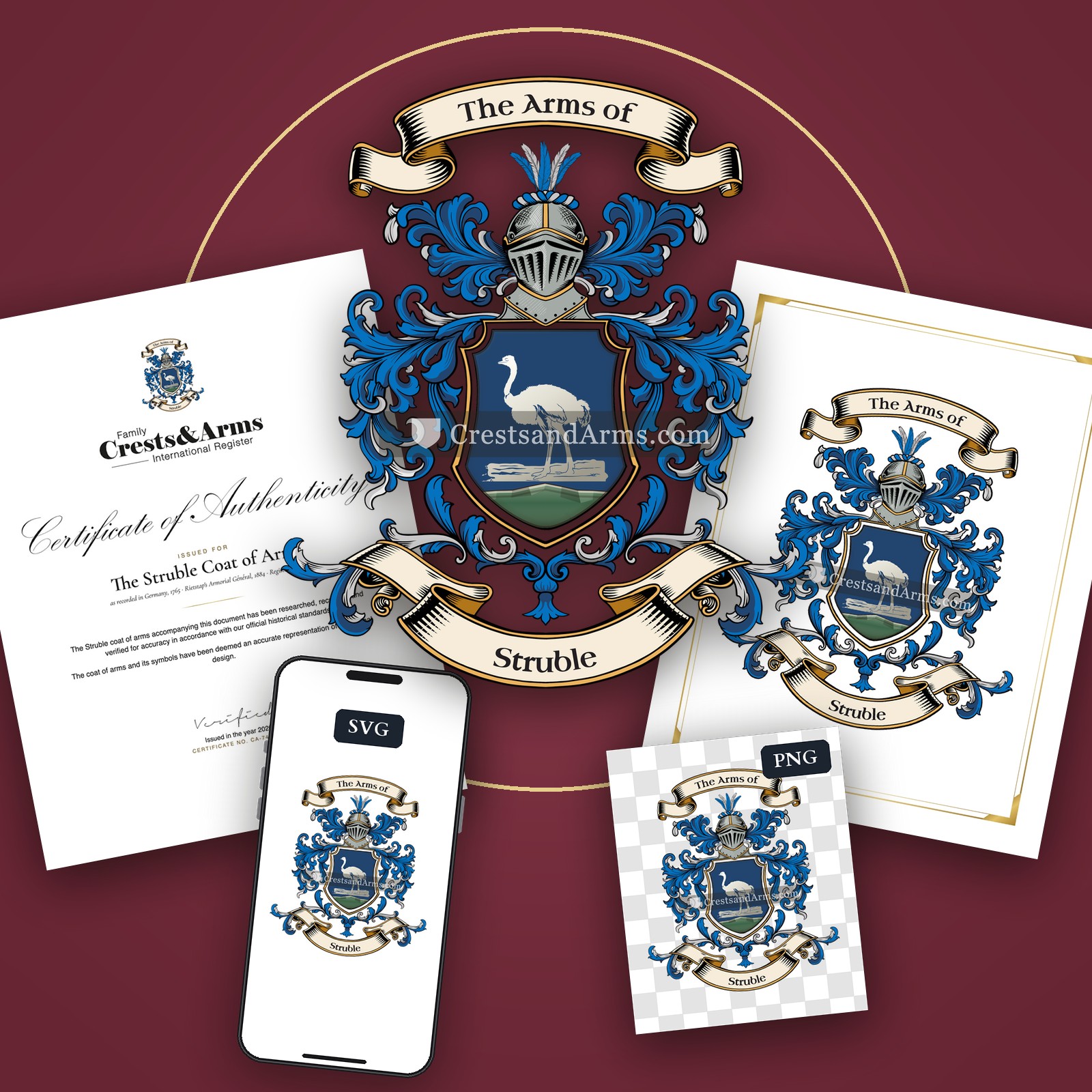
Digital archive packCoat of arms PNG, gold border print PDF, vector SVG and the certificate of authenticity. Sent to your email in minutes.
Map of Germany showing where the Struble arms are recorded
The Struble arms were recorded in Germany, c. 1765.
Arms such as these were typically recorded in Bavaria.
Bavaria was a country of old landed families and walled market towns. Estates passed down the same line for centuries, and both the landowners and the leading townsmen kept arms, which is why so many Bavarian names sit in the registers.
This is where the arms were entered in the register. Families often moved to other parts of the country, so the same name can turn up in more than one region.
The body that granted and recorded arms in Germany in this period.
Francis I, Holy Roman Emperor
Sovereign of the period
Francis I, Holy Roman Emperor
1745–1765
Reigning in Germany when the Struble arms are first recorded.
How Arms Worked in Germany
In the Holy Roman Empire, coats of arms were often granted to individuals by the Emperor or his representatives. These arms were then passed down through the generations to all legitimate descendants of the original holder. Younger branches of a family usually kept the same shield design without needing to change it, as the arms belonged to the entire lineage.
Granting authority
The Holy Roman Emperor held the sole power to grant new coats of arms throughout his vast imperial territories.
How they got arms
Families typically obtained their coats of arms through a formal imperial grant or by proving their noble status to the authorities.
Where arms were recorded
These grants were officially recorded in the Imperial Chancery registers, which began keeping formal records of such honors during the Middle Ages.
The family's standing
Recorded among the armigerous families of Germany.
Origin & History of the Struble Family in Germany
The surname Struble is rooted in the Germanic linguistic tradition, where it likely originated as a descriptive nickname. In Middle High German, the term *strubel* referred to someone with messy, tousled, or curly hair. By the time members of the family were documented in Bavaria in 1765, the name had become a stable identifier for households living in the southern German regions. During this era, families with this name were often part of the agrarian society that defined the Bavarian landscape. They likely lived in small village communities where they worked as farmers or skilled tradespeople. As the population moved and evolved, the name remained tied to these regional roots, eventually spreading as family members sought new opportunities beyond their ancestral homes.
Struble Meaning & Related Branches
Root word
strub
a rough or disheveled person with unkempt hair
This name
Strublea descriptive nickname for someone with messy, bristly, or unruly hair
also spelled
Strub
Strubbe
Documented Sources
J. B. Rietstap, Armorial Général, Gouda: G. B. van Goor Zonen, 1884–87
Bahlow, Hans, Deutsches Namenlexikon: Familien- und Vornamen nach Ursprung und Sinn erklärt, 1967


 mountThe ground held, and steadfastness upon it
 ostrichWilling obedience and serious thought
 mountThe ground held, and steadfastness upon it
 ostrichWilling obedience and serious thought