Map of Austria showing where the Stryjewski arms are recorded
The Stryjewski arms were recorded in Austria, c. 1772.
Arms such as these were typically recorded in Tyrol.
Tyrol was mountain country in western Austria, where the valleys were held by families who had been there a very long time. Old tenure counted for more than money, and old families carried arms.
This is where the arms were entered in the register. Families often moved to other parts of the country, so the same name can turn up in more than one region.
Region
Tyrol
First recorded
1772
Granting Authority for the Stryjewski Arms
Imperial and Royal chancery
Sodacan · CC BY-SA 3.0
The body that granted and recorded arms in Austria in this period.
Joseph II, Holy Roman Emperor
Sovereign of the period
Joseph II, Holy Roman Emperor
1765–1790
Reigning in Austria when the Stryjewski arms are first recorded.
How Arms Worked in Austria
Austrian coats of arms were often linked directly to noble titles granted by the Emperor. These symbols belonged to the entire family line rather than just one individual. When a family grew, new branches kept the original design without needing to change it. This system allowed all members of a noble house to share the same identity across many generations.
Granting authority
The Imperial and Royal chancery managed all heraldic matters and controlled the official granting of arms throughout the Austrian lands.
How they got arms
Families typically received their arms through a formal imperial decree that often accompanied the elevation of a person to noble status.
Where arms were recorded
Official records of these grants were kept in the Imperial Register of Nobility which began its formal documentation process in 1453.
The family's standing
Recorded among the armigerous families of Austria.
Origin & History of the Stryjewski Family in Austria
The family name Stryjewski is rooted in the linguistic traditions of Central and Eastern Europe, often associated with locations that feature the root word "stryj," which refers to a paternal uncle in several Slavic languages. While the name is frequently linked to regions in modern-day Poland, historical records confirm that members of the family were established in the Tyrol region by 1772. During the late eighteenth century, Tyrol was a significant crossroads within the Habsburg Monarchy, serving as a vital link between the German-speaking lands and the Italian peninsula. Families living in this mountainous territory often moved along established trade routes, which explains how a name with Slavic linguistic origins appeared in the heart of the Alps. These early Stryjewski ancestors likely integrated into the local agrarian or mercantile communities of the region, adapting to the unique cultural and administrative landscape of the Austrian Empire during a time of great social change.
Stryjewski Meaning & Related Branches
Root word
stryj
Old Polish term for a father's brother or paternal uncle.
This name
StryjewskiA topographic or habitational name referring to someone who lived near or originated from a paternal uncle's estate.
also spelled
Streske
Stresck
Documented Sources
J. B. Rietstap, Armorial Général, Gouda: G. B. van Goor Zonen, 1884–87
Tiroler Landesarchiv, Tiroler Steuerkataster 1772
Österreichisches Staatsarchiv, Adels- und Familienarchiv
Kohl, Johann Georg, Reisen in den österreichischen Alpen, 1842
Wenzel, Walter, Studien zur Verbreitung der slawischen Familiennamen in Mitteleuropa, 1980
Digital archive packCoat of arms PNG, gold border print PDF, vector SVG and the certificate of authenticity. Sent to your email in minutes.


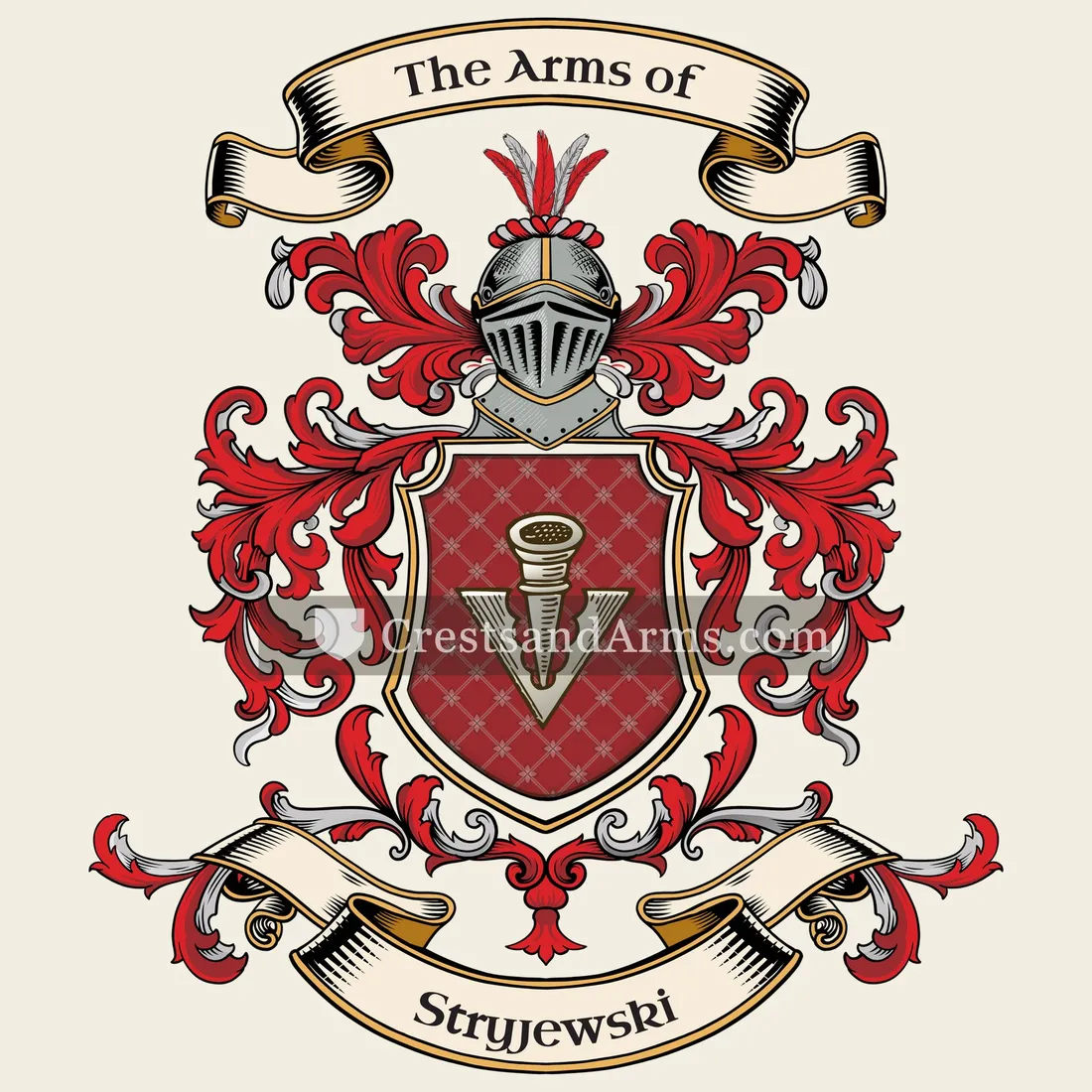
 arms pheon arrowheadReadiness for battle, and the broad arrow of the sovereign
 arms pheon arrowheadReadiness for battle, and the broad arrow of the sovereign