Map of Denmark showing where the Stubbe arms are recorded
The Stubbe arms were recorded in Denmark, c. 1722.
Arms such as these were typically recorded in Sjaælland.
Zealand held the Danish court, the crown's offices and Copenhagen itself. Families who served the king kept estates within reach of it, and royal service was the ordinary route to a coat of arms.
This is where the arms were entered in the register. Families often moved to other parts of the country, so the same name can turn up in more than one region.
The body that granted and recorded arms in Denmark in this period.
Frederik IV of Denmark
Sovereign of the period
Frederik IV of Denmark
1699–1730
Reigning in Denmark when the Stubbe arms are first recorded.
How Arms Worked in Denmark
Danish heraldry during this period was closely tied to noble status and royal favor rather than being open to all citizens. Arms were typically granted by the monarch to individuals, and these symbols were then shared by all members of the noble house. If a family line died out, the right to use those specific arms ended with them.
Granting authority
The Danish royal chancery held the power to issue and regulate official coats of arms for the kingdom.
How they got arms
Families usually received their arms through a formal royal grant that confirmed their noble status and rights.
Where arms were recorded
These grants were officially recorded in the Danish Royal Chancery records starting in the sixteenth century.
The family's standing
Recorded among the armigerous families of Denmark.
Origin & History of the Stubbe Family in Denmark
The family name Stubbe has deep roots in the Danish landscape, particularly within the island of Sjælland where members of the family were documented as early as 1722. In the Danish language, the word "stub" refers to a tree stump, suggesting that the name likely originated as a topographic descriptor for ancestors who lived near cleared land or a forest edge. During the early 18th century, surnames in rural Denmark were often fluid and tied to one’s specific farm or local geography rather than being passed down as hereditary labels. As the family established itself in Sjælland, they likely transitioned from using patronymics, such as a father’s first name followed by "sen," to adopting the fixed name Stubbe as a way to distinguish their household. This shift reflects the broader social changes occurring in Denmark at the time, as families began to settle into more permanent identities within their local parish communities.
Meaning of the Stubbe family crest colors & symbols
Symbols on this shield
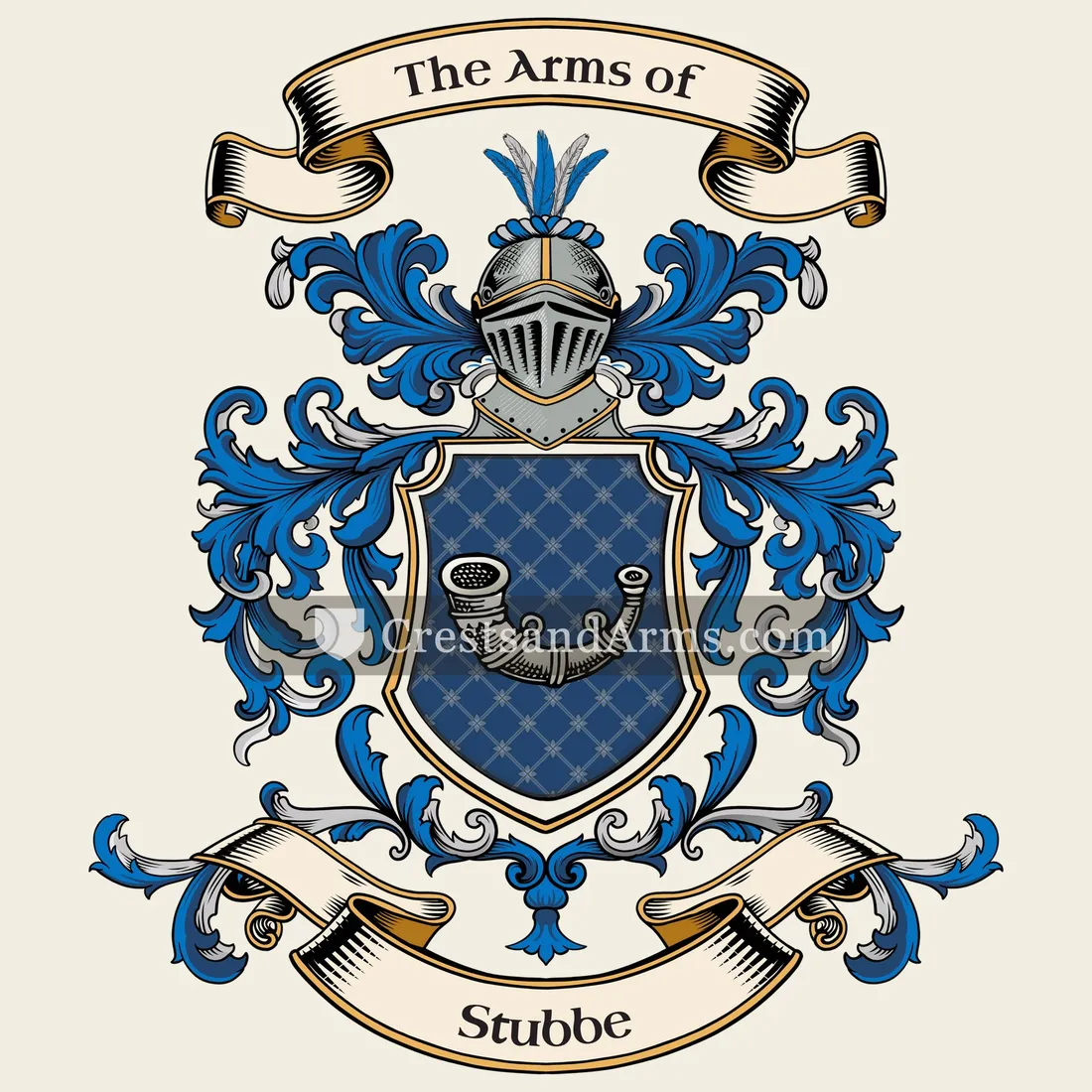
hunting horn stringedOne who delights in the chase
Colours
Blue (Azure)Means: Loyalty and truth
Silver (Argent)Means: Peace and sincerity
Historical info
Source
J. B. Rietstap, Armorial Général, Gouda: G. B. van Goor Zonen, 1884–87
Blazon (the actual original written record)
“D'azur à une corne de bouquetin d'arg., en pal. C.: un chicot au nat., en pal.”
Swedenc. 1700
Digital archive packCoat of arms PNG, gold border print PDF, vector SVG and the certificate of authenticity. Sent to your email in minutes.
Map of Sweden showing where the Stubbe arms are recorded
The Stubbe arms were recorded in Sweden, c. 1700.
Arms such as these were typically recorded in Stockholm.
Stockholm held the Swedish court and the House of Nobility, where every noble family's arms were entered and kept. Families ennobled for service registered there, which is why so many are recorded around the city.
This is where the arms were entered in the register. Families often moved to other parts of the country, so the same name can turn up in more than one region.
The body that granted and recorded arms in Sweden in this period.
Carl XII of Sweden
Sovereign of the period
Carl XII of Sweden
1697–1718
Reigning in Denmark when the Stubbe arms are first recorded.
How Arms Worked in Sweden
In Sweden, a coat of arms belonged to a noble family as a whole rather than just one individual. These arms were passed down through the generations to all legitimate descendants. Younger branches of the family used the same shield without needing to change it. This system ensured that the entire lineage shared the same identity and status under the law.
Granting authority
The Riddarhuset, or House of Nobility, regulated all noble coats of arms in Sweden under royal authority.
How they got arms
Families received their coats of arms through royal grants of nobility which were then officially registered with the House.
Where arms were recorded
Coats of arms were officially recorded in the Swedish House of Nobility register starting in the year 1626.
The family's standing
Recorded among the armigerous families of Sweden.
Origin & History of the Stubbe Family in Sweden
The family name Stubbe has roots that reach back into the urban landscape of early eighteenth-century Stockholm. During this period, the name was often associated with individuals who navigated the growing professional and merchant classes of the Swedish capital. The word itself carries an old Germanic meaning related to a tree stump, which was a common way to describe someone who lived near a specific landmark or held a sturdy, grounded character. By 1700, members of the Stubbe family were already established within the city, participating in the daily life and trade that defined Stockholm as a rising power in Northern Europe. These early ancestors likely worked as craftsmen or tradesmen, helping to build the infrastructure of a city that was rapidly modernizing. Their presence in the historical records of the time highlights how families of that era helped shape the social and economic fabric of Sweden through steady labor and community involvement.
Meaning of the Stubbe family crest colors & symbols
Symbols on this shield
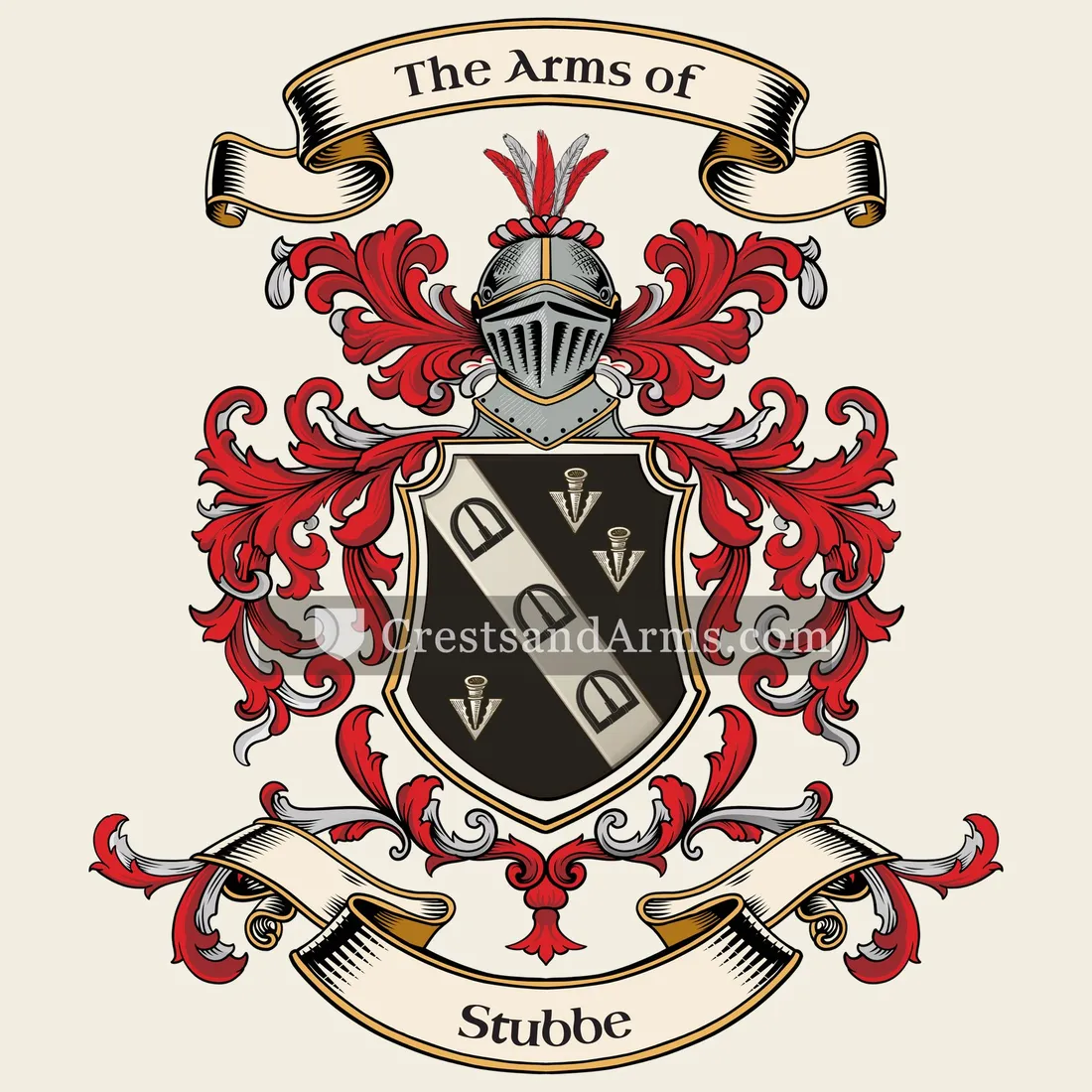
bendDefence, and the scarf of a commander
arms pheon arrowheadReadiness for battle, and the broad arrow of the sovereign
buckleFidelity, and a bond firmly held
Colours
Black (Sable)Means: Constancy
Silver (Argent)Means: Peace and sincerity
Historical info
Source
Sir Bernard Burke, The General Armory of England, Scotland, Ireland and Wales, London: Harrison & Sons, 1884
Blazon (the actual original written record)
“Sa. on a bend betw. three pheons ar. as many round buckles of the first”
SuffolkLaxfield · Suffolk, c. 1620
Digital archive packCoat of arms PNG, gold border print PDF, vector SVG and the certificate of authenticity. Sent to your email in minutes.
Map of England showing where the Stubbe arms are recorded
The Stubbe arms were recorded in Suffolk, c. 1620.
Suffolk was wool country, and its cloth towns were among the wealthiest in England. Clothier families bought manors with their profits, and holding a manor was the ordinary route to a coat of arms.
This is where the arms were entered in the register. Families often moved to other parts of the country, so the same name can turn up in more than one region.
The body that granted and recorded arms in England in this period.
James VI and I
Sovereign of the period
James VI and I
1603–1625
Reigning in Denmark when the Stubbe arms are first recorded.
How Arms Worked in England
English heraldry allowed arms to be shared by all legitimate descendants of the original owner. These symbols were treated as personal property that moved through the generations to all children. While the eldest son kept the original design, other family members could use the same shield without needing to change it or register their own unique versions.
Granting authority
The College of Arms in London has regulated the use of coats of arms throughout England and Wales since 1484.
How they got arms
Families typically obtained their coats of arms through a formal grant from the Crown or by proving their ancient right to them.
Where arms were recorded
All official coats of arms are recorded in the registers kept at the College of Arms, which date back to the fifteenth century.
The family's standing
Recorded among the armigerous families of Suffolk.
Origin & History of the Stubbe Family in England
The family name Stubbe has deep roots in the English county of Suffolk, where records confirm members of the family were living by the year 1620. The name itself is derived from the Old English word "stub," which referred to the stump of a tree left in the ground after felling. In medieval times, such names were often given to people who lived near a prominent tree stump or who worked in land clearing. Because Suffolk was a heavily forested region during the Middle Ages, many families adopted surnames based on the local landscape. By the early 17th century, the Stubbe family had established themselves as part of the local community, likely working in agriculture or trade. Their presence in Suffolk during this era reflects the common practice of families staying in one region for generations, helping to shape the social and economic character of the English countryside.
Stubbe Meaning & Related Branches
Root word
Stub
A short, thick, or blunt object such as a tree stump.
This name
StubbeA topographic name for someone who lived near a tree stump or a nickname for a short person.
also spelled
Stube
Stub
Stubbs
Stubs
Related arms
Stubbsvariant spelling
Stubsvariant spelling
Lovellrecorded with Stubbe, same area
Documented Sources
J. B. Rietstap, Armorial Général, Gouda: G. B. van Goor Zonen, 1884–87
Rigsarkivet (The Danish National Archives), Kirkebøger (Parish Registers), Sjælland Stift
Rigsarkivet (The Danish National Archives), Folketællinger (Census Records), 1787
Kruken, Kristoffer and Stemshaug, Ola, Norsk Personnamnleksikon, 1995
Nielsen, Oluf, Olddanske Personnavne, 1883
Digital archive packCoat of arms PNG, gold border print PDF, vector SVG and the certificate of authenticity. Sent to your email in minutes.


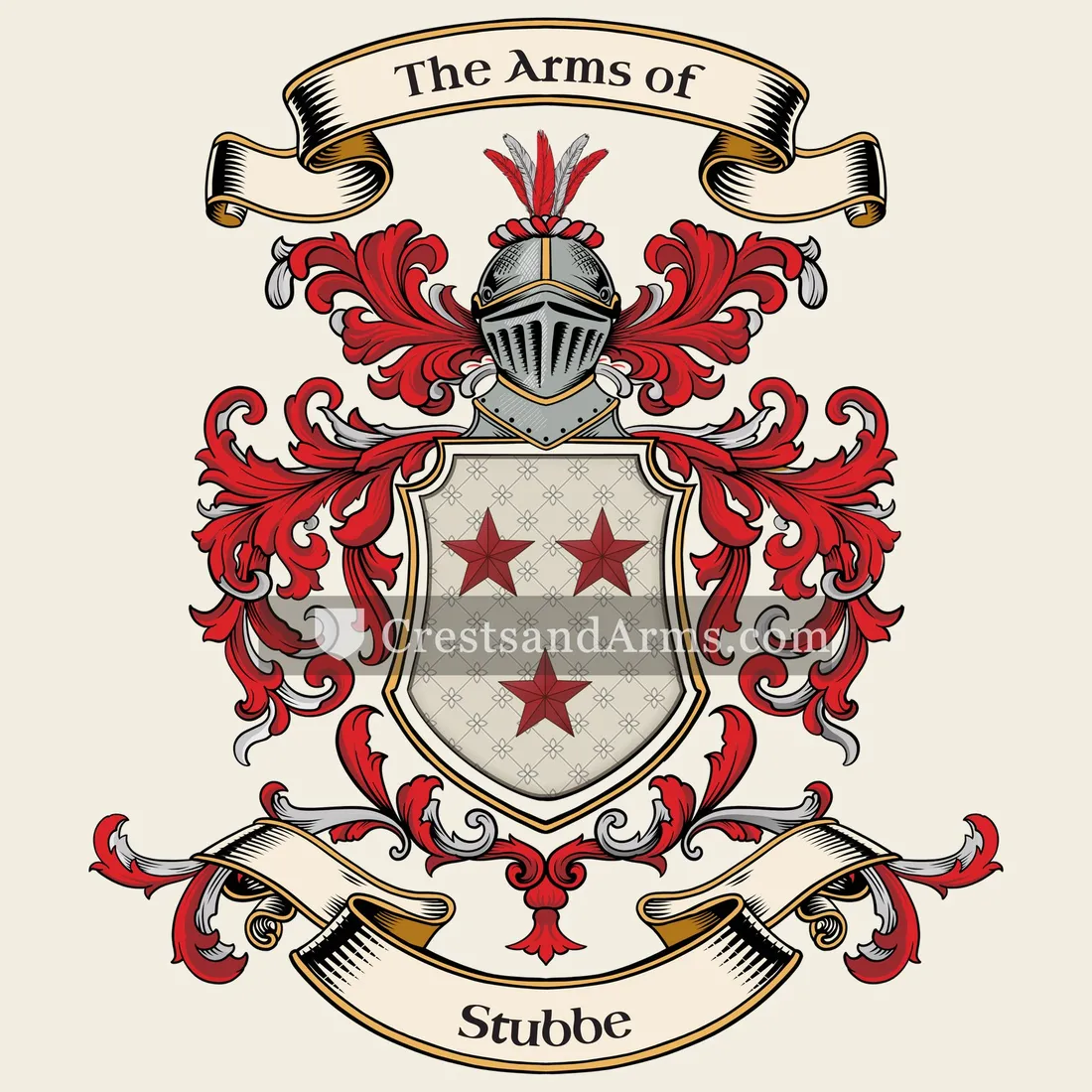
 mulletThe third son, and a divine quality from above
 mulletThe third son, and a divine quality from above


 hunting horn stringedOne who delights in the chase


 bendDefence, and the scarf of a commander
 arms pheon arrowheadReadiness for battle, and the broad arrow of the sovereign
 buckleFidelity, and a bond firmly held