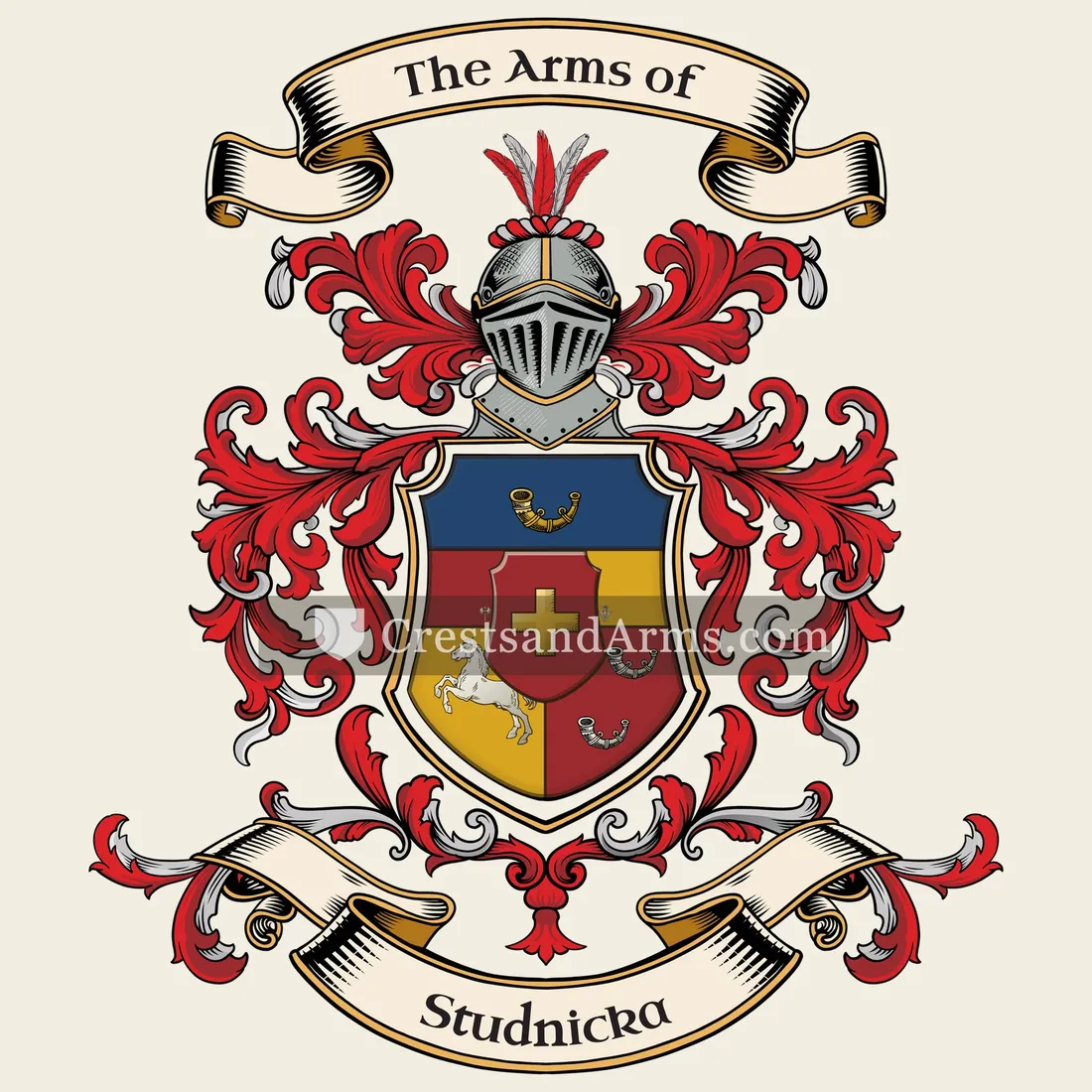
A record of documented arms, meaning and origin, researched for the Studnicka family of Austria.
Reg. 0635 · Austrian, T–V
Meaning of the Studnicka family crest colors & symbols
Symbols on this shield
chiefAuthority, wisdom and dominion
cross symbolChristian faith and service
hunting horn stringedOne who delights in the chase
axeThe execution of military duty
arms pheon arrowheadReadiness for battle, and the broad arrow of the sovereign
horseReadiness to serve king and country
Colours
Red (Gules)Means: Military strength
Gold (Or)Means: Generosity
Blue (Azure)Means: Loyalty and truth
Silver (Argent)Means: Peace and sincerity
Historical info
Source
J. B. Rietstap, Armorial Général, Gouda: G. B. van Goor Zonen, 1884–87
Blazon (the actual original written record)
“Ec.: au 1 de gu. à une hache d'arg., emm. d'or; au 2 coupé de gu. sur or, à un fer de flèche coupé d'arg. sur le gu. et de sa. sur l'or, le pied orné en forme de la queue d'une aigle héraldique; au 3 de gu. à un cheval pass. d'arg., sanglé de sa.; au 4 d'arg. à trois cors-de-chasse aussi d'arg., liés de sa., vir. d'or, posés en pairle, les embouchures s'entretouchant en abîme. Au chef de l'écu d'azur, br. sur l'écartelé et ch. d'un grêlier d'or, l'embouchure à dextre. Sur le tout de gu. à la bande ondée alésée d'arg., sommée d'une croisette d'or. Trois cq. cour. C.: 1° la hache, mise en barre, posée sur le tranchant; 2° un lion d'arg., assis de front, accosté de deux huchets de gu., pavillonnés et eng. d'or, chacun orné à l'ext. de six boules du même, posés en pals sur leur embouchure; 3° quatre pl. d'aut.: d'or, de gu., d'arg. et de sa. L.: à dextre d'arg. et de gu., à sen. d'or et de gu. S.: deux tigres au nat.”
Austriac. 1783
Digital archive packCoat of arms PNG, gold border print PDF, vector SVG and the certificate of authenticity. Sent to your email in minutes.
Map of Austria showing where the Studnicka arms are recorded
The Studnicka arms were recorded in Austria, c. 1783.
Arms such as these were typically recorded in Tyrol.
Tyrol was mountain country in western Austria, where the valleys were held by families who had been there a very long time. Old tenure counted for more than money, and old families carried arms.
This is where the arms were entered in the register. Families often moved to other parts of the country, so the same name can turn up in more than one region.
Region
Tyrol
First recorded
1783
Granting Authority for the Studnicka Arms
Imperial and Royal chancery
Sodacan · CC BY-SA 3.0
The body that granted and recorded arms in Austria in this period.
Joseph II, Holy Roman Emperor
Sovereign of the period
Joseph II, Holy Roman Emperor
1765–1790
Reigning in Austria when the Studnicka arms are first recorded.
How Arms Worked in Austria
Austrian coats of arms were often linked directly to noble titles granted by the Emperor. These symbols belonged to the entire family line rather than just one individual. When a family grew, new branches kept the original design without needing to change it. This system allowed all members of a noble house to share the same identity across many generations.
Granting authority
The Imperial and Royal chancery managed all heraldic matters and controlled the official granting of arms throughout the Austrian lands.
How they got arms
Families typically received their arms through a formal imperial decree that often accompanied the elevation of a person to noble status.
Where arms were recorded
Official records of these grants were kept in the Imperial Register of Nobility which began its formal documentation process in 1453.
The family's standing
Recorded among the armigerous families of Austria.
Origin & History of the Studnicka Family in Austria
The surname Studnicka is rooted in the Slavic linguistic tradition, specifically originating from the Czech word studna, which translates to well or spring. Historically, this name likely served as a topographic identifier for a family that lived near a prominent water source or a well in their local village. By 1783, records confirm that members of the family were established in the Tyrol region, a mountainous area known for its complex history of migration between Germanic and Slavic populations. During this period, families often moved across borders to seek better farmland or to work in the regional mining industries that defined the Alpine economy. As the family settled into the Tyrolean landscape, they adapted to the local culture while maintaining a name that reflected their ancestral connection to the land and its natural resources.
Studnicka Meaning & Related Branches
Root word
studna
A Slavic term referring to a well or a water source.
This name
StudnickaA topographic name for someone who lived near a well or a spring.
also spelled
Stadnicky
Stadnickie
Documented Sources
J. B. Rietstap, Armorial Général, Gouda: G. B. van Goor Zonen, 1884–87
Kohlheim, Rosa and Kohlheim, Volker, Duden Familiennamen: Herkunft und Bedeutung von 20.000 Nachnamen, 2005
Moldanová, Dobrava, Naše příjmení, 2010
Tiroler Landesarchiv, Tauf- und Heiratsbücher der Pfarreien in Tirol, 1783
Digital archive packCoat of arms PNG, gold border print PDF, vector SVG and the certificate of authenticity. Sent to your email in minutes.


 chiefAuthority, wisdom and dominion
 cross symbolChristian faith and service
 hunting horn stringedOne who delights in the chase
 axeThe execution of military duty
 arms pheon arrowheadReadiness for battle, and the broad arrow of the sovereign
 horseReadiness to serve king and country