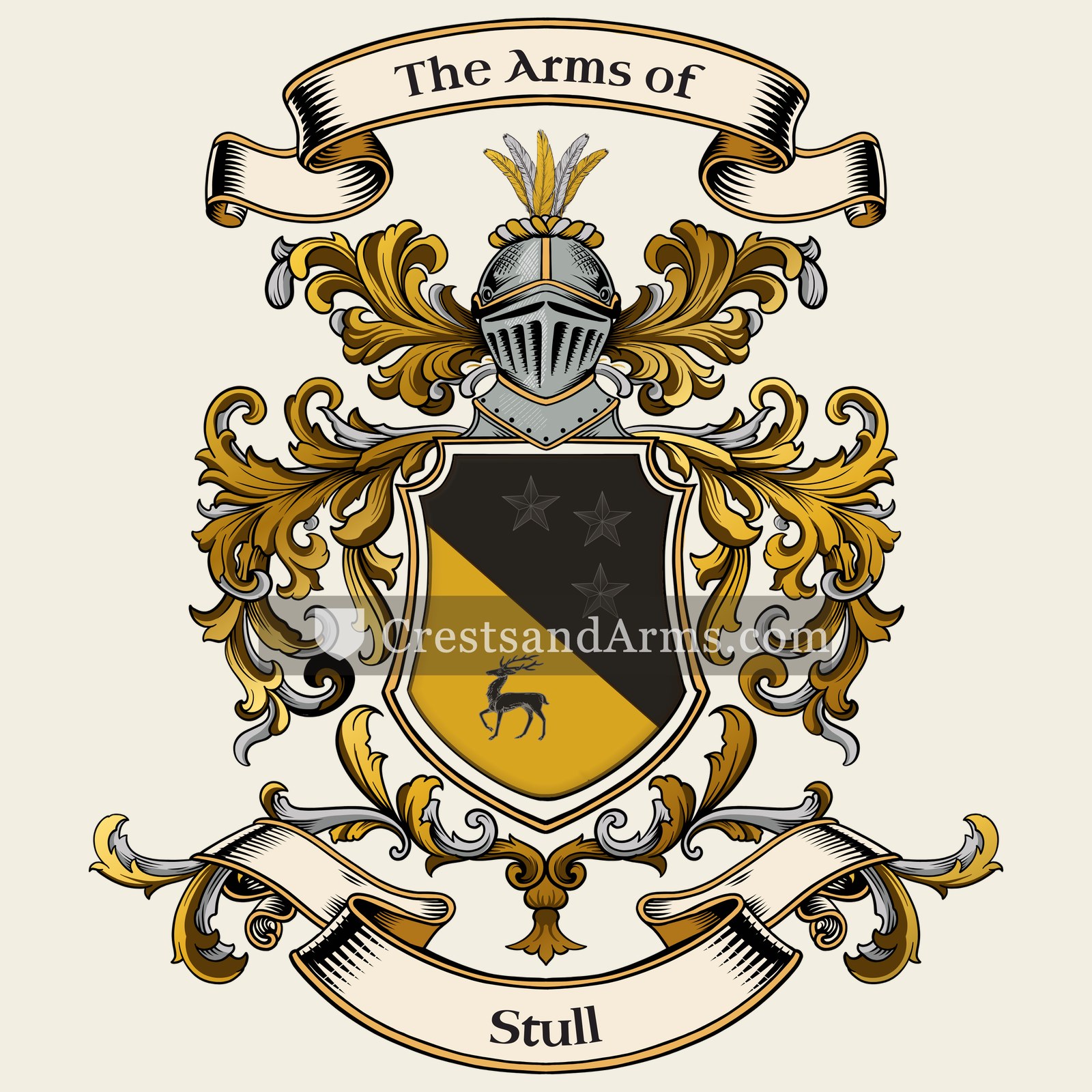
A record of documented arms, meaning and origin, researched for the Stull family of Switzerland.
Reg. 3202 · Swiss, T–V
Coat of Arms & Family Crest Details
Symbols on this shield
stagPeace and harmony, and one who will not fight unprovoked
mulletThe third son, and a divine quality from above
Colours
Gold (Or)Means: Generosity
Black (Sable)Means: Constancy
Historical info
Source
J. B. Rietstap, Armorial Général, Gouda: G. B. van Goor Zonen, 1884–87
Blazon (the actual original written record)
“Taillé: au 1 d'or à la demi-ramure de cerf de sa., posé en barre; au 2 de sa. à trois étoiles d'or, posées en demi-orle. C.: un bonnet de sa., retr. d'or, sommé d'une étoile du même.”
SwitzerlandWinterthur, c. 1725
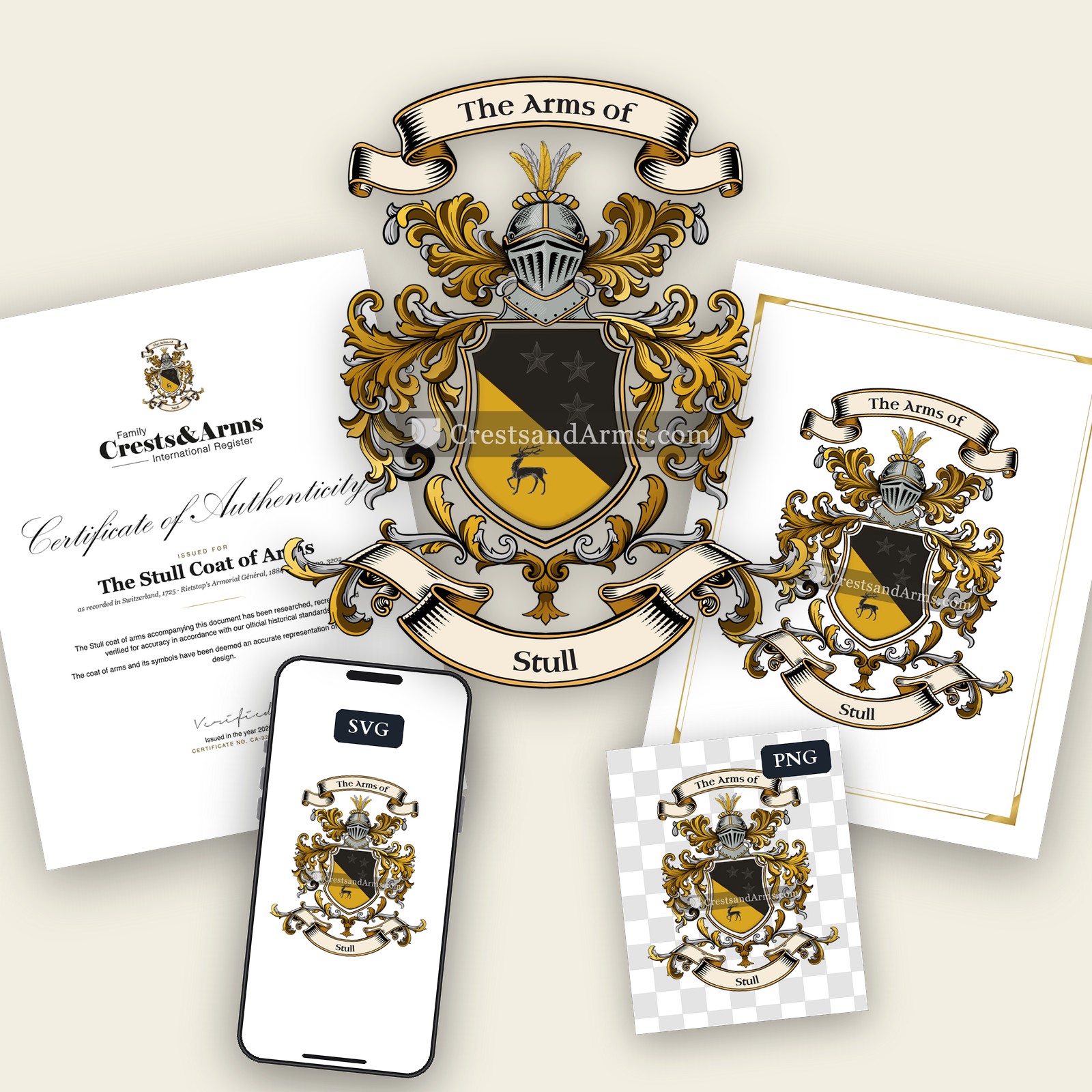
Digital archive packCoat of arms PNG, gold border print PDF, vector SVG and the certificate of authenticity. Sent to your email in minutes.
Map of Switzerland showing where the Stull arms are recorded
The Stull arms were recorded in Winterthur, c. 1725.
This is where the arms were entered in the register. Families often moved to other parts of the country, so the same name can turn up in more than one region.
The body that granted and recorded arms in Switzerland in this period.
How Arms Worked in Switzerland
In Switzerland, coats of arms were not restricted to the nobility and were often adopted by common citizens and families. These symbols were passed down through generations to show family identity. When branches of a family grew, they often changed small details of the design to distinguish their own line from the original group.
Granting authority
Cantonal and civic authorities managed the use of coats of arms within their specific regions and local jurisdictions.
How they got arms
Families typically assumed their own coats of arms based on local custom rather than receiving them from a central monarch.
Where arms were recorded
Arms were recorded in various cantonal and civic registers starting from the fourteenth century throughout the Swiss region.
The family's standing
Recorded among the armigerous families of Switzerland.
Origin & History of the Stull Family in Switzerland
The Stull family name has deep roots in the region surrounding Winterthur, Switzerland, where records confirm their presence as early as 1725. The name is generally categorized as a topographic or habitational surname, likely originating from the German word "Stuhl," which translates to chair or seat. Historically, this term was often used to describe someone who lived near a prominent landmark or a specific seat of local authority. During the early 18th century, families in the Winterthur area were often tied to the land through agriculture or skilled craftsmanship, contributing to the local economy of the Swiss cantons. As these families grew, members began to migrate across Europe and eventually toward the Americas, carrying the name and their ancestral traditions with them. This period of history was marked by significant social changes, and the Stull family was part of the broader movement of people seeking new opportunities in growing communities.
Stull Meaning & Related Branches
Root word
Stul
Middle High German term for a stool, seat, or chair.
This name
StullAn occupational name for a maker of stools or a topographic name for someone living near a prominent seat.
also spelled
Stolle
Documented Sources
J. B. Rietstap, Armorial Général, Gouda: G. B. van Goor Zonen, 1884–87
Staatsarchiv des Kantons Zürich, Kirchenbücher der Gemeinde Winterthur, 1725
Bahlow, Hans, Deutsches Namenlexikon: Familien- und Vornamen nach Ursprung und Sinn erklärt, 1967
Zürcher, Ueli, Die Bevölkerung von Winterthur im 18. Jahrhundert, 1988
Digital archive packCoat of arms PNG, gold border print PDF, vector SVG and the certificate of authenticity. Sent to your email in minutes.


 stagPeace and harmony, and one who will not fight unprovoked
 mulletThe third son, and a divine quality from above
 stagPeace and harmony, and one who will not fight unprovoked
 mulletThe third son, and a divine quality from above