Map of England showing where the Stumpo arms are recorded
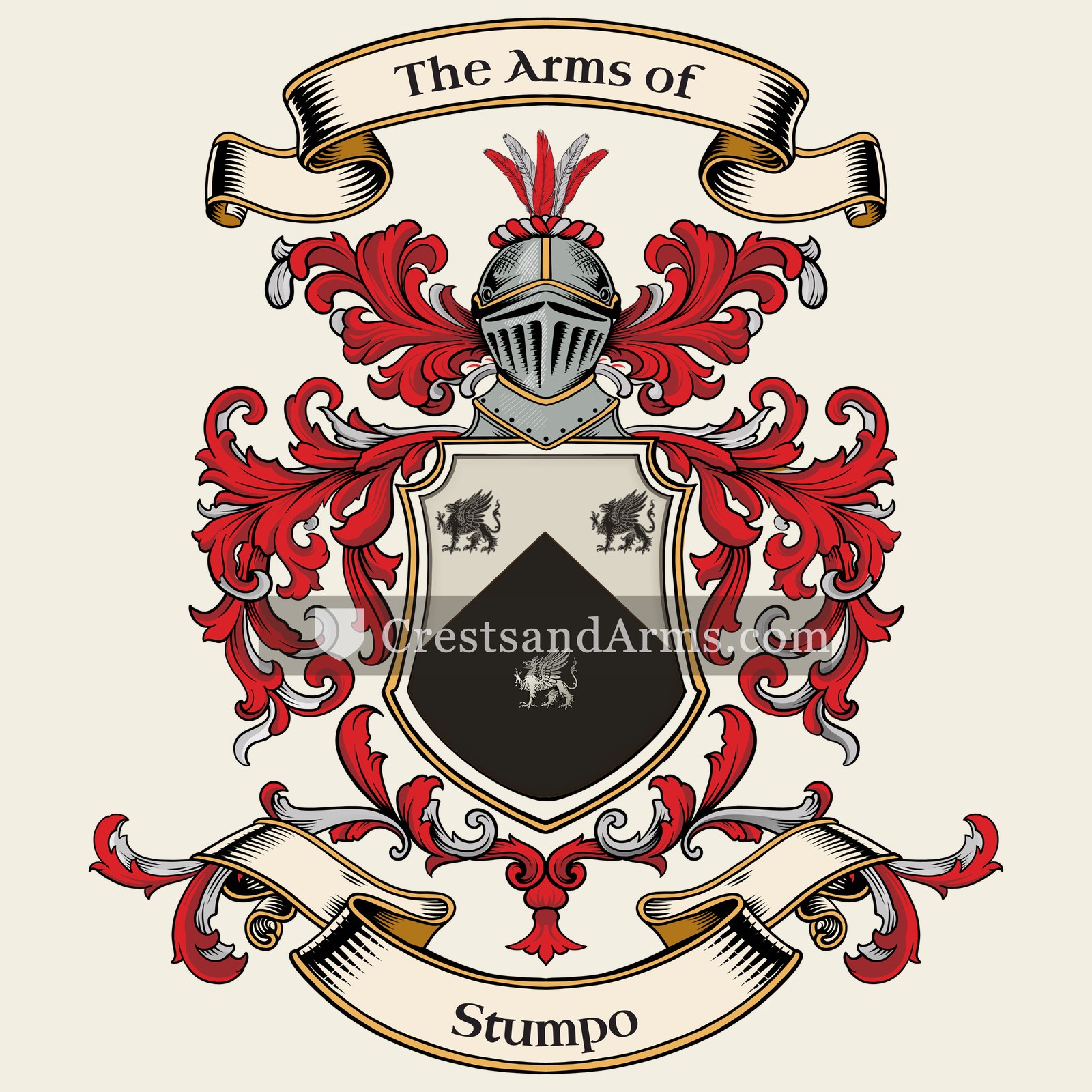
The Stumpo arms were recorded in Wilts, c. 1620.
Wiltshire was sheep country, and wool made money steadily for hundreds of years. Families who made it bought manors on the downs, and holding a manor was the usual reason to take arms.
This is where the arms were entered in the register. Families often moved to other parts of the country, so the same name can turn up in more than one region.
The body that granted and recorded arms in England in this period.
James VI and I
Sovereign of the period
James VI and I
1603–1625
Reigning in England when the Stumpo arms are first recorded.
How Arms Worked in England
English heraldry allowed arms to be shared by all legitimate descendants of the original owner. These symbols were treated as personal property that moved through the generations to all children. While the eldest son kept the original design, other family members could use the same shield without needing to change it or register their own unique versions.
Granting authority
The College of Arms in London has regulated the use of coats of arms throughout England and Wales since 1484.
How they got arms
Families typically obtained their coats of arms through a formal grant from the Crown or by proving their ancient right to them.
Where arms were recorded
All official coats of arms are recorded in the registers kept at the College of Arms, which date back to the fifteenth century.
The family's standing
Recorded among the armigerous families of Wilts.
Origin & History of the Stumpo Family in England
The family name Stumpo is rooted in the linguistic traditions of southern Europe, where it likely evolved as a descriptive nickname. In Italian, the term *stumpo* or *stumpa* often referred to someone who was short in stature or perhaps someone who had suffered a physical injury resulting in a shortened limb. While the name is distinctly Mediterranean in its origin, the presence of the family in Wiltshire, England, by 1620 suggests a fascinating history of migration. During the early seventeenth century, England saw an increase in movement from the continent as merchants, craftspeople, and religious refugees sought new opportunities across the English Channel. By settling in the rural landscapes of Wiltshire, the early members of the family integrated into the local community, likely transitioning from their original cultural background to the agrarian lifestyle that defined the region at the time. This transition marks the family as part of a broader pattern of European mobility that helped shape the diverse social fabric of early modern England.
Related Branches & Arms
Root word
Stump
A tree trunk or the base of a severed limb.
This name
StumpoA topographic name for someone who lived near a prominent tree stump.
Documented Sources
Sir Bernard Burke, The General Armory of England, Scotland, Ireland and Wales, London: Harrison & Sons, 1884
Bardsley, Charles Wareing, A Dictionary of English and Welsh Surnames, 1901
Wiltshire and Swindon History Centre, Wiltshire Parish Registers, 1620
De Felice, Emidio, Dizionario dei cognomi italiani, 1978
Digital archive packCoat of arms PNG, gold border print PDF, vector SVG and the certificate of authenticity. Sent to your email in minutes.


 griffinValour and vigilance, guarding great treasure
 griffinValour and vigilance, guarding great treasure