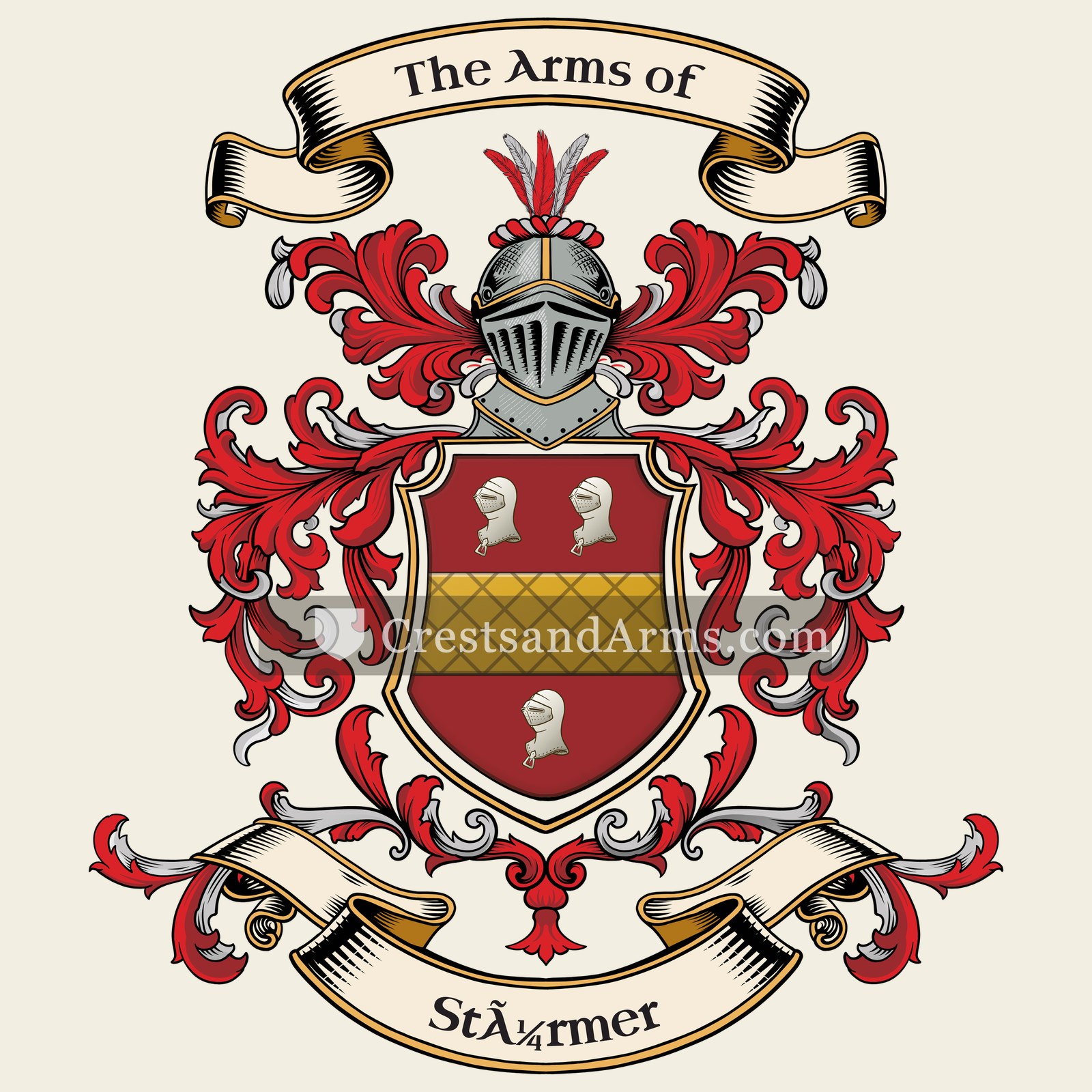
A record of documented arms, meaning and origin, researched for the Stürmer family of Austria.
Reg. 9032 · Austrian, T–V
Coat of Arms & Family Crest Details
Symbols on this shield
fessThe military belt, and readiness to serve
helmetWisdom and security in defence
Colours
Red (Gules)Means: Military strength
Gold (Or)Means: Generosity
Silver (Argent)Means: Peace and sincerity
Historical info
Source
J. B. Rietstap, Armorial Général, Gouda: G. B. van Goor Zonen, 1884–87
Blazon (the actual original written record)
“De gu. à la fasce d'or, acc. de trois casques tarés de trois quarts d'arg., grillés et lisérés du sec., doublés de gu. Cinq cq. cour. C.: 1° un croiss. figuré d'arg., portant une boule d'or sommée de huit plumes de héron; 2° une aigle cont. de sa. cour. d'or; 3° un roc d'échiquier de sa.; 4° un lion iss. d'or; 5° un fez turc d'azur, retr. de gu., houppé d'azur et orné d'un panache de plumes de héron comme celui du 1 cimier. T.: deux hommes d'armes, la visière levée, le casque panaché de gu., la main libre appuyée sur la hanche. Manteau de gu., frangé d'or, doublé d'herm. [Les barons du nom, éteints le 2 déc. 1829, portaient les mêmes armes. Trois cq. cour. C.: 1° un lion iss. et cont. d'or; 2° une aigle iss. de sa.; 3° un croiss. figuré d'or, supp. deux aigrettes soutenues d'un diamant. L. d'or et de gu. Mêmes tenants.]”
Austriac. 1801
Digital archive packCoat of arms PNG, gold border print PDF, vector SVG and the certificate of authenticity. Sent to your email in minutes.
Map of Austria showing where the Stürmer arms are recorded
The Stürmer arms were recorded in Austria, c. 1801.
Arms such as these were typically recorded in Tyrol.
Tyrol was mountain country in western Austria, where the valleys were held by families who had been there a very long time. Old tenure counted for more than money, and old families carried arms.
This is where the arms were entered in the register. Families often moved to other parts of the country, so the same name can turn up in more than one region.
Region
Tyrol
First recorded
1801
Granting Authority for the Stürmer Arms
Imperial and Royal chancery
Sodacan · CC BY-SA 3.0
The body that granted and recorded arms in Austria in this period.
Francis II, Holy Roman Emperor
Sovereign of the period
Francis II, Holy Roman Emperor
1792–1806
Reigning in Austria when the Stürmer arms are first recorded.
How Arms Worked in Austria
Austrian coats of arms were often linked directly to noble titles granted by the Emperor. These symbols belonged to the entire family line rather than just one individual. When a family grew, new branches kept the original design without needing to change it. This system allowed all members of a noble house to share the same identity across many generations.
Granting authority
The Imperial and Royal chancery managed all heraldic matters and controlled the official granting of arms throughout the Austrian lands.
How they got arms
Families typically received their arms through a formal imperial decree that often accompanied the elevation of a person to noble status.
Where arms were recorded
Official records of these grants were kept in the Imperial Register of Nobility which began its formal documentation process in 1453.
The family's standing
Recorded among the armigerous families of Austria.
Origin & History of the Stürmer Family in Austria
The surname Stürmer is a descriptive name that originated in the German-speaking regions of Europe, likely emerging from the Middle High German word "stürmer," which translates to someone who is a stormer or a fierce fighter. This name was often given as a nickname to individuals known for their bold, aggressive, or energetic nature in battle or daily life. By the early 19th century, records confirm that members of the Stürmer family were well-established in the Tyrol region, a mountainous area in the Alps that spans parts of modern-day Austria and Italy. Living in this rugged landscape, the family was likely involved in the traditional trades of the region, such as farming, forestry, or local craftsmanship. As the name spread through the German territories, it became a marker of a family lineage defined by a spirited and determined character that persisted through generations of life in the Alpine valleys.
Stürmer Meaning & Related Branches
Root word
Sturm
A violent disturbance, tempest, or storm in nature.
This name
StürmerAn occupational or descriptive term for a boisterous, impetuous, or aggressive person.
also spelled
Stuermer
Documented Sources
J. B. Rietstap, Armorial Général, Gouda: G. B. van Goor Zonen, 1884–87
Bahlow, Hans, Deutsches Namenlexikon: Familien- und Vornamen nach Ursprung und Sinn erklärt, 1967
Heintze, Albert, Die deutschen Familien-Namen: geschichtlich, geographisch, sprachlich, 1903
Tiroler Landesarchiv, Standesbücher der Pfarreien in Tirol, 1801
Digital archive packCoat of arms PNG, gold border print PDF, vector SVG and the certificate of authenticity. Sent to your email in minutes.


 fessThe military belt, and readiness to serve
 helmetWisdom and security in defence