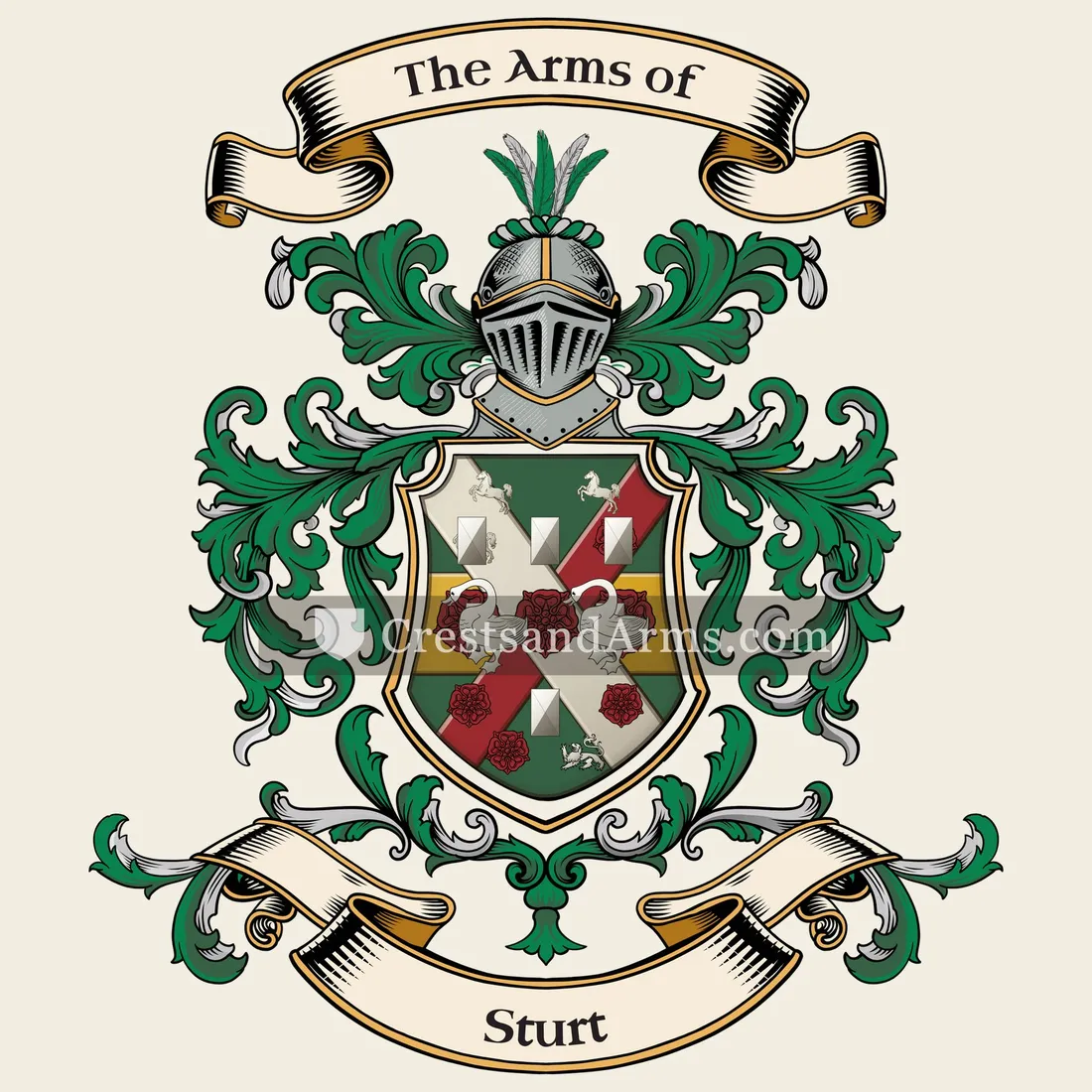
A record of documented arms, meaning and origin, researched for the Sturt family lines. Documented in 2 countries.
Reg. 1393 · French, T–V
Meaning of the Sturt family crest colors & symbols
Symbols on this shield
fessThe military belt, and readiness to serve
saltireResolution, and St Andrew's cross
bendDefence, and the scarf of a commander
roseThe seventh son, and beauty with grace
horseReadiness to serve king and country
lionCourage, strength and royalty
billetThe sealed letter, and a message delivered
Colours
Green (Vert)Means: Hope
Silver (Argent)Means: Peace and sincerity
Gold (Or)Means: Generosity
Red (Gules)Means: Military strength
Historical info
Source
J. B. Rietstap, Armorial Général, Gouda: G. B. van Goor Zonen, 1884–87
Blazon (the actual original written record)
“Coupé d'un trait, parti de deux autres, qui font six quartiers: aux 1 et 6 de sin. à la fasce d'or, ch. de trois roses de gu. et acc. de trois poulains courants d'arg. (Sturt); au 2 d'arg. au saut. de gu., cant. de quatre roses du même (Napier); au 3 éc., d'azur au lion d'arg., cour. d'or, et d'arg. au saut. de gu. (Gerard); au 4 de sa. à la bande engr. d'arg., acc. de six bill. du même, rangées en orle (Alington); au 5 d'azur à la bande de engr. d'arg., acc. de deux cygnes du même, coll. de couronnes d'or, enchainées du même, la chaine passée sur leur dos (Pitfield). C.: un lion iss. de gu., tenant une bannière de gu. frangée d'or et ch. d'une rose d'arg., la hampe d'or. S.: deux bouledogues d'arg. semés de bill. de sa., tenant chacun entre ses dents une rose de gu., tigée et feuillée de sin. D.: EN DIEU EST TOUT.”
Francec. 1876
Digital archive packCoat of arms PNG, gold border print PDF, vector SVG and the certificate of authenticity. Sent to your email in minutes.
Map of France showing where the Sturt arms are recorded
The Sturt arms were recorded in France, c. 1876.
Arms such as these were typically recorded in Bretagne.
More families held coats of arms in Bretagne than anywhere else in France. The land was divided into many small estates rather than a few large ones, so far more households counted as gentry, and each needed a shield of its own to be told apart.
This is where the arms were entered in the register. Families often moved to other parts of the country, so the same name can turn up in more than one region.
The body that granted and recorded arms in France in this period.
How Arms Worked in France
In France, a coat of arms was a mark of honor that passed down through the male line to all legitimate descendants. Families often used the same shield without changes to show their shared heritage. If a branch wanted to stand out, they could add a small mark to their shield to show their specific place in the family tree.
Granting authority
The Juge d'armes de France acted as the official authority that regulated and verified coats of arms across the country.
How they got arms
Families typically inherited their arms from ancestors, though they could also receive them through royal grants or by proving their noble status.
Where arms were recorded
Coats of arms were officially recorded in the Armorial Général de France, which began its main collection in the year 1696.
The family's standing
Recorded among the armigerous families of France.
Origin & History of the Sturt Family in France
The history of the Sturt family name in France is deeply rooted in the rugged landscape of Bretagne. By the late nineteenth century, records confirm that family members were well-established within this northwestern region. The name likely evolved from local linguistic traditions, reflecting the specific dialects spoken in the coastal towns of Brittany during that era. Families in this area often lived in close-knit agricultural or maritime communities, which helped preserve their unique identity over many generations. While the name may have roots that stretch back even further into the history of the French countryside, the presence of the Sturt family in 1876 serves as a clear starting point for their documented journey in the region. Their lives were shaped by the distinct culture and traditions of the Breton people, marking them as a part of the long and complex social fabric of France.
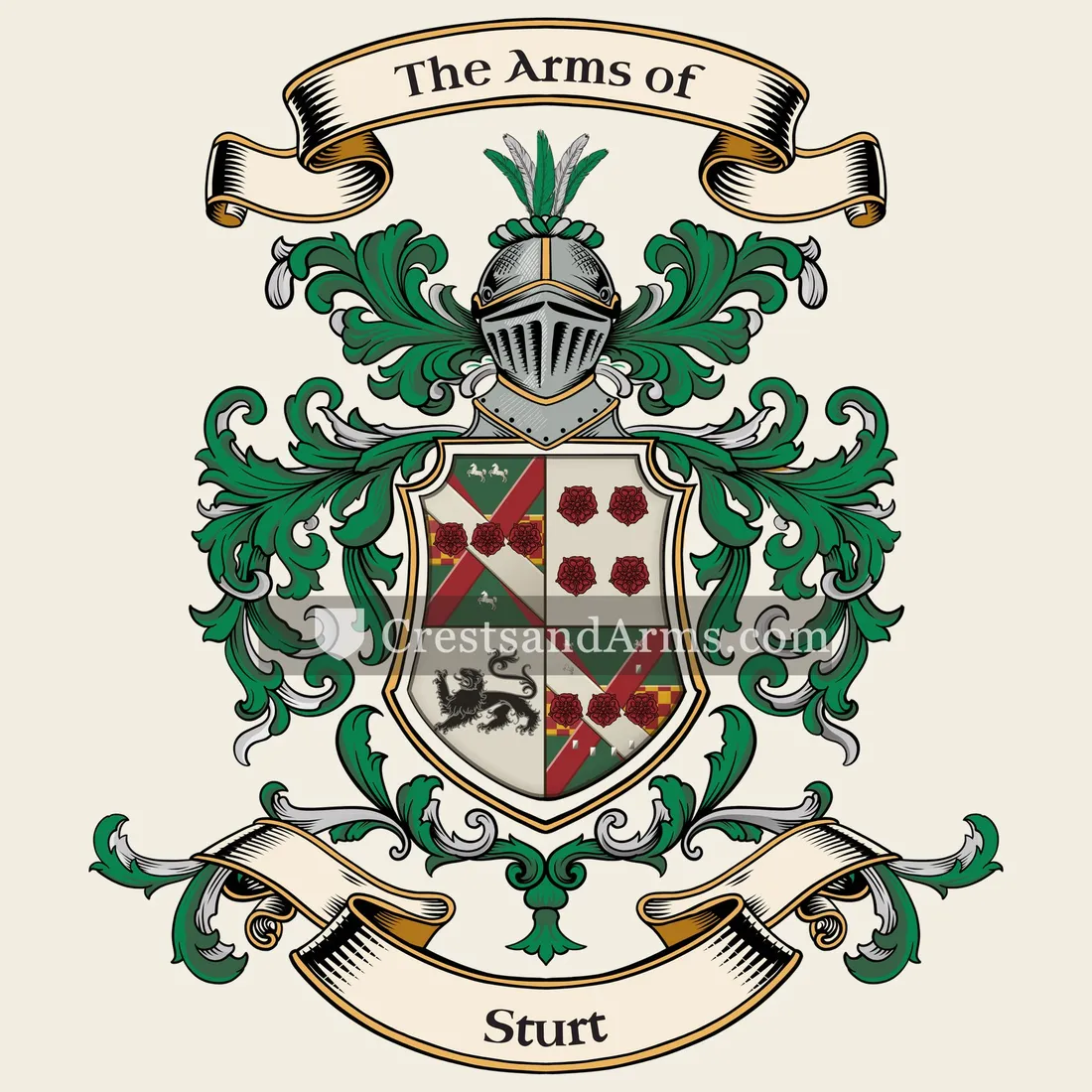
Meaning of the Sturt family crest colors & symbols
Symbols on this shield
fessThe military belt, and readiness to serve
saltireResolution, and St Andrew's cross
bendDefence, and the scarf of a commander
horseReadiness to serve king and country
roseThe seventh son, and beauty with grace
lionCourage, strength and royalty
billetThe sealed letter, and a message delivered
swanGrace, light and the poet's art
Colours
Green (Vert)Means: Hope
Gold (Or)Means: Generosity
Silver (Argent)Means: Peace and sincerity
Red (Gules)Means: Military strength
Historical info
Source
Sir Bernard Burke, The General Armory of England, Scotland, Ireland and Wales, London: Harrison & Sons, 1884
Blazon (the actual original written record)
“Quarterly of six, 1st and 6th, STURT, vert on a fess or, betw. three colts current ar. as many roses gu.; 2nd, NAPIER, ar. a saltire engr. betw. four roses gu.; 3rd, GERARD, quarterly, 1st and 4th, az. a lion ramp. ar. ducally crowned or, 2nd and 3rd, ar. a saltire gu.; 4th, ALINGTON, sa. a bend engr. betw. six billets ar.; 5th, PITFIELD, az. a bend engr. ar. betw. two swans of the last, ducally gorged with chain reflexed over the back or”
Englandc. 1620
Digital archive packCoat of arms PNG, gold border print PDF, vector SVG and the certificate of authenticity. Sent to your email in minutes.
Map of England showing where the Sturt arms are recorded
The Sturt arms were recorded in England, c. 1620.
Arms such as these were typically recorded in York.
Yorkshire is the largest of the English counties, and it held more gentry families than any other. Land there was split among a great many households rather than a few, so a great many of them carried arms.
This is where the arms were entered in the register. Families often moved to other parts of the country, so the same name can turn up in more than one region.
The body that granted and recorded arms in England in this period.
James VI and I
Sovereign of the period
James VI and I
1603–1625
Reigning in France when the Sturt arms are first recorded.
How Arms Worked in England
English heraldry allowed arms to be shared by all legitimate descendants of the original owner. These symbols were treated as personal property that moved through the generations to all children. While the eldest son kept the original design, other family members could use the same shield without needing to change it or register their own unique versions.
Granting authority
The College of Arms in London has regulated the use of coats of arms throughout England and Wales since 1484.
How they got arms
Families typically obtained their coats of arms through a formal grant from the Crown or by proving their ancient right to them.
Where arms were recorded
All official coats of arms are recorded in the registers kept at the College of Arms, which date back to the fifteenth century.
The family's standing
Recorded among the armigerous families of England.
Origin & History of the Sturt Family in England
The surname Sturt is rooted in the landscape of medieval England, likely originating as a topographical name for someone who lived near a prominent piece of land or a projecting ridge. The word itself is derived from the Old English term *steort*, which describes a tail or a sharp point of earth. By the early 17th century, the family had established a notable presence in the northern city of York. Records from 1620 confirm that members of the Sturt family were active within this historic urban center, participating in the local community during a time of significant social and political change. While the name began as a simple way to identify a person by their surroundings, it evolved into a lasting family identity that reflects the long history of migration and settlement across the English countryside.
Sturt Meaning & Related Branches
Root word
Stur
Old Germanic term referring to a disturbance, tumult, or violent struggle.
This name
SturtDerived from a nickname for a boisterous, restless, or turbulent individual.
also spelled
Sturte
Sturtt
Sturtz
Stort
Documented Sources
J. B. Rietstap, Armorial Général, Gouda: G. B. van Goor Zonen, 1884–87
Archives départementales du Finistère, État civil de Bretagne
Galliou, Patrick, Histoire de la Bretagne et des Bretons, 2005
Le Dû, Jean, Nouvel atlas linguistique de la Basse-Bretagne, 2001
Digital archive packCoat of arms PNG, gold border print PDF, vector SVG and the certificate of authenticity. Sent to your email in minutes.


 fessThe military belt, and readiness to serve
 saltireResolution, and St Andrew's cross
 bendDefence, and the scarf of a commander
 roseThe seventh son, and beauty with grace
 horseReadiness to serve king and country
 lionCourage, strength and royalty
 billetThe sealed letter, and a message delivered

 swanGrace, light and the poet's art