Map of Spain showing where the Suarez arms are recorded
The Suarez arms were recorded in Spain, c. 1722.
Arms such as these were typically recorded in Castile.
Castile was the heart of Spain and the source of most of its noble families. Land won in the long wars against the Moors was granted out to fighting men, and a man granted land was granted arms along with it.
This is where the arms were entered in the register. Families often moved to other parts of the country, so the same name can turn up in more than one region.
The body that granted and recorded arms in Spain in this period.
Philip V of Spain
Sovereign of the period
Philip V of Spain
1714–1724
Reigning in Spain when the Suarez arms are first recorded.
How Arms Worked in Spain
In Spain, a coat of arms was considered a form of property that belonged to the entire family line. These arms were passed down from a father to all his children equally. Younger branches of the family usually kept the original design without needing to add any special marks to distinguish their specific line.
Granting authority
The Cronista Rey de Armas was the official body that regulated and granted coats of arms throughout Spain.
How they got arms
Families often obtained their arms through royal grants or by proving their noble status to the official heraldic authority.
Where arms were recorded
Coats of arms were officially recorded in the registers of the Cronista Rey de Armas starting in 1496.
The family's standing
Recorded among the armigerous families of Spain.
Origin & History of the Suarez Family in Spain
The surname Suarez is a patronymic name, which means it originated as a way to identify a person as the son of someone named Suero. The name Suero itself is a medieval Spanish variation of the ancient Germanic name Sigher, which combines words meaning victory and army. By the time the family was firmly established in the region of Castile in 1722, the name had been in use for several centuries across the Iberian Peninsula. Families bearing this name were often part of the landed gentry or local administrative classes who helped settle and develop the central Spanish plains. Because the name was tied to a common given name, it spread naturally through different social levels as people moved between towns and cities. This history reflects the broader patterns of migration and social organization that shaped the population of Castile during the early modern period.
Suarez Meaning & Related Branches
Root word
Suero
Derived from the Germanic name Sigihar meaning victory army.
This name
SuarezA patronymic surname indicating son of Suero, originating from medieval Spanish naming traditions.
also spelled
Suares
Swarez
Documented Sources
J. B. Rietstap, Armorial Général, Gouda: G. B. van Goor Zonen, 1884–87
Moll, Francesc de B., Els llinatges catalans, 1959
Pescador del Hoyo, María del Carmen, Apellidos en España, 1996
Archivo General de Simancas, Registro del Sello de Corte
Digital archive packCoat of arms PNG, gold border print PDF, vector SVG and the certificate of authenticity. Sent to your email in minutes.


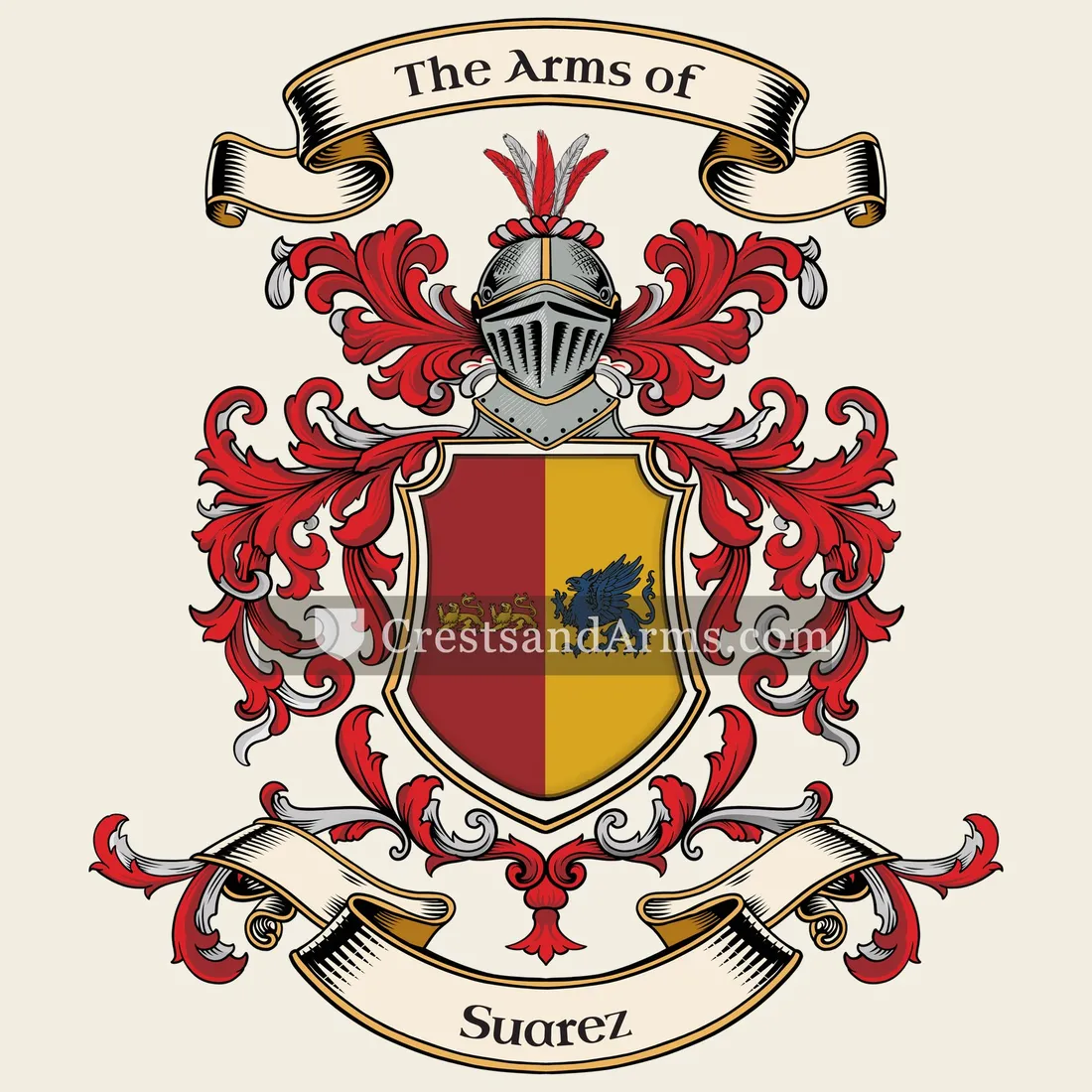
 lionCourage, strength and royalty
 griffinValour and vigilance, guarding great treasure
 lionCourage, strength and royalty
 griffinValour and vigilance, guarding great treasure