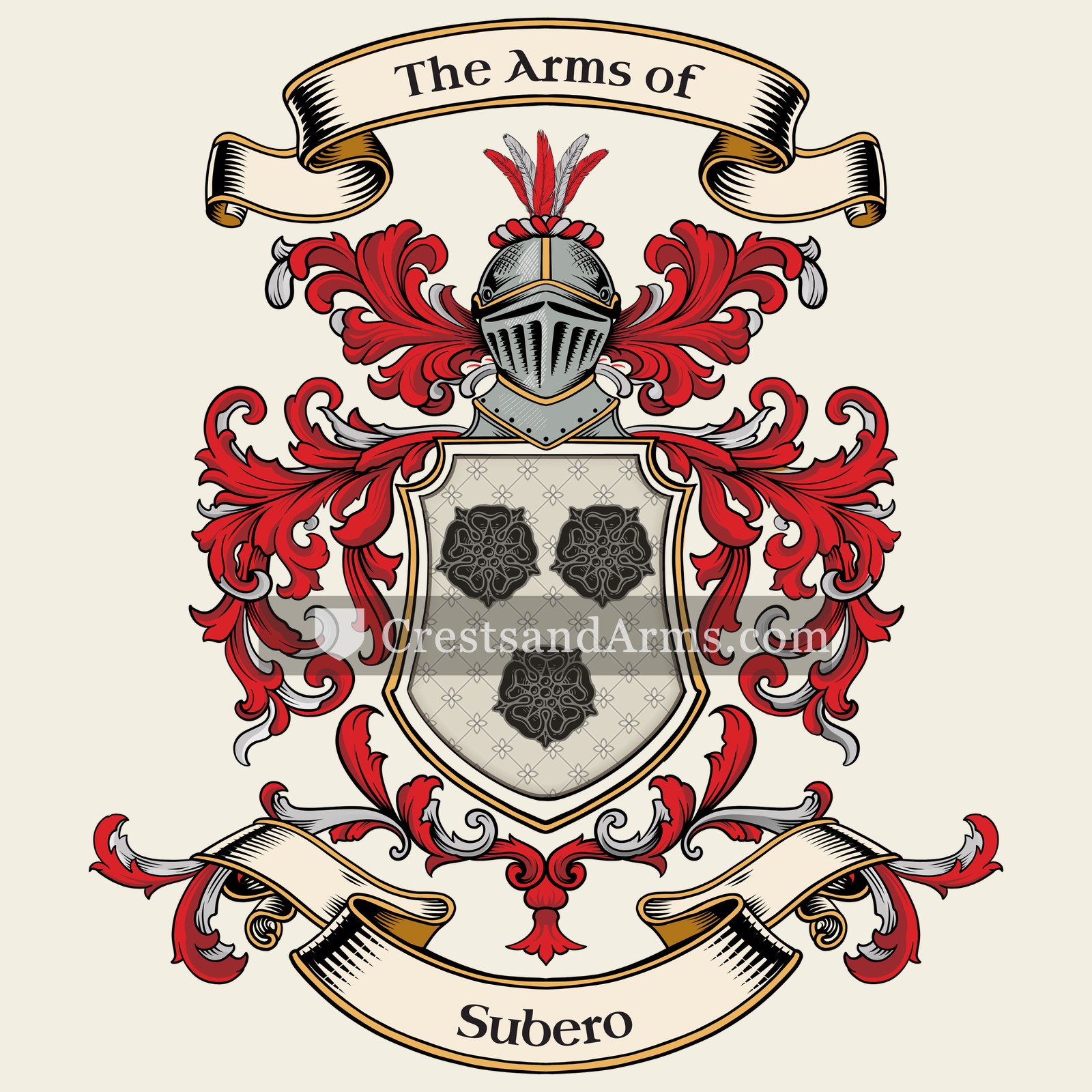
A record of documented arms, meaning and origin, researched for the Subero family of Germany.
Reg. 5651 · German, T–V
Coat of Arms & Family Crest Details
Symbols on this shield
roseThe seventh son, and beauty with grace
Colours
Silver (Argent)Means: Peace and sincerity
Black (Sable)Means: Constancy
Historical info
Source
J. B. Rietstap, Armorial Général, Gouda: G. B. van Goor Zonen, 1884–87
Blazon (the actual original written record)
“D'arg. à trois roses de sa., bout. d'or. C.: une femme iss., hab. de sa., au fichu d'arg., chevelée d'or, les cheveux épars, portant sur sa tête une rose de gu. et supp. de chaque main une rose de l'écu.”
GermanyRothenburg, c. 1765
Digital archive packCoat of arms PNG, gold border print PDF, vector SVG and the certificate of authenticity. Sent to your email in minutes.
Map of Germany showing where the Subero arms are recorded
The Subero arms were recorded in Rothenburg, c. 1765.
This is where the arms were entered in the register. Families often moved to other parts of the country, so the same name can turn up in more than one region.
The body that granted and recorded arms in Germany in this period.
Francis I, Holy Roman Emperor
Sovereign of the period
Francis I, Holy Roman Emperor
1745–1765
Reigning in Germany when the Subero arms are first recorded.
How Arms Worked in Germany
In the Holy Roman Empire, coats of arms were often granted to individuals by the Emperor or his representatives. These arms were then passed down through the generations to all legitimate descendants of the original holder. Younger branches of a family usually kept the same shield design without needing to change it, as the arms belonged to the entire lineage.
Granting authority
The Holy Roman Emperor held the sole power to grant new coats of arms throughout his vast imperial territories.
How they got arms
Families typically obtained their coats of arms through a formal imperial grant or by proving their noble status to the authorities.
Where arms were recorded
These grants were officially recorded in the Imperial Chancery registers, which began keeping formal records of such honors during the Middle Ages.
The family's standing
Recorded among the armigerous families of Germany.
Origin & History of the Subero Family in Germany
The family name Subero carries a history deeply rooted in the cultural landscape of central Europe during the eighteenth century. Historical records confirm that members of the family were established in the medieval town of Rothenburg ob der Tauber by 1765. At that time, Rothenburg was a significant center for trade and craftsmanship, and families living there often played active roles in the local guild systems or municipal administration. The name itself reflects the linguistic diversity of the region, as many families during this period moved across borders for work or religious reasons. By settling in a fortified town like Rothenburg, the early Subero family members likely participated in the vibrant social and economic life of the Holy Roman Empire. Their presence in such a well-documented location suggests that they were integrated into the community and contributed to the local history of the Bavarian region.
Subero Meaning & Related Branches
Root word
Suber
Derived from the Latin word suber meaning cork oak tree.
This name
SuberoAn occupational or topographic name referring to someone who worked with or lived near cork trees.
also spelled
Saubere
Sauberr
Saub
Sowber
Documented Sources
J. B. Rietstap, Armorial Général, Gouda: G. B. van Goor Zonen, 1884–87
Stadtarchiv Rothenburg ob der Tauber, Bürgerbuch der Stadt Rothenburg ob der Tauber, 1765
Staud, Hans, Die Einwohner der Stadt Rothenburg ob der Tauber im 18. Jahrhundert, 1954
Digital archive packCoat of arms PNG, gold border print PDF, vector SVG and the certificate of authenticity. Sent to your email in minutes.


 roseThe seventh son, and beauty with grace
 roseThe seventh son, and beauty with grace