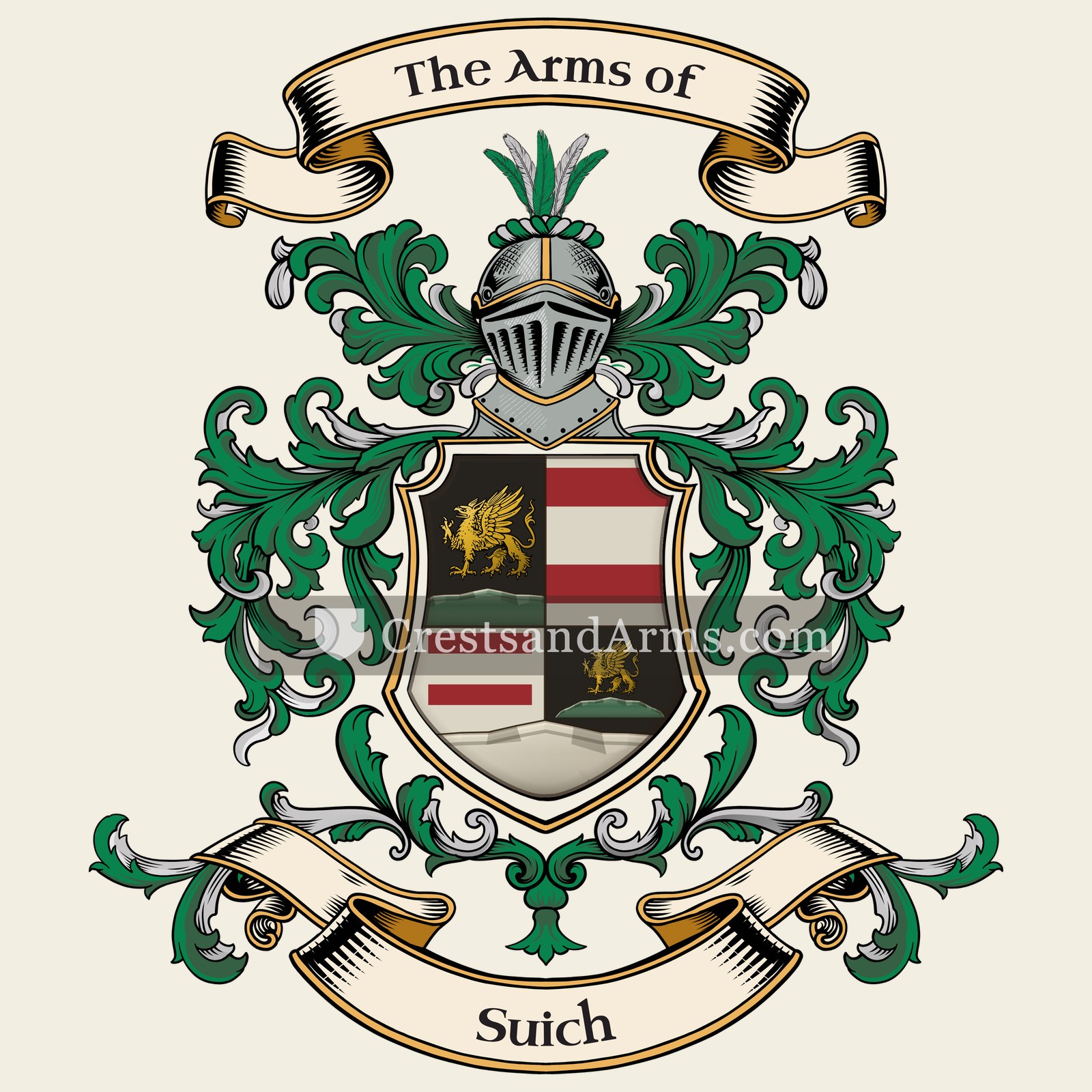
A record of documented arms, meaning and origin, researched for the Suich family of Germany.
Reg. 1865 · German, T–V
Coat of Arms & Family Crest Details
Symbols on this shield
mountThe ground held, and steadfastness upon it
fessThe military belt, and readiness to serve
griffinValour and vigilance, guarding great treasure
Colours
Black (Sable)Means: Constancy
Silver (Argent)Means: Peace and sincerity
Green (Vert)Means: Hope
Red (Gules)Means: Military strength
Gold (Or)Means: Generosity
Historical info
Source
J. B. Rietstap, Armorial Général, Gouda: G. B. van Goor Zonen, 1884–87
Blazon (the actual original written record)
“Ec.: aux 1 et 4 de sa. à un griffon d'or, cour. du même, tenant de sa patte dextre un couvercle d'or, au-dessus d'une coupe du même qu'il supporte de sa patte sen.; le griffon soutenu d'une terrasse rocheuse d'arg.; aux 2 et 3 d'arg. à deux fasces vivrées de gu. Cq. cour. C.: le griffon, iss., entre deux prob. coupées, à dextre d'arg. sur gu., à sen. d'or sur sa. L. conformes aux émaux des prob.”
Germanyc. 1765
Digital archive packCoat of arms PNG, gold border print PDF, vector SVG and the certificate of authenticity. Sent to your email in minutes.
Map of Germany showing where the Suich arms are recorded
The Suich arms were recorded in Germany, c. 1765.
Arms such as these were typically recorded in Bavaria.
Bavaria was a country of old landed families and walled market towns. Estates passed down the same line for centuries, and both the landowners and the leading townsmen kept arms, which is why so many Bavarian names sit in the registers.
This is where the arms were entered in the register. Families often moved to other parts of the country, so the same name can turn up in more than one region.
The body that granted and recorded arms in Germany in this period.
Francis I, Holy Roman Emperor
Sovereign of the period
Francis I, Holy Roman Emperor
1745–1765
Reigning in Germany when the Suich arms are first recorded.
How Arms Worked in Germany
In the Holy Roman Empire, coats of arms were often granted to individuals by the Emperor or his representatives. These arms were then passed down through the generations to all legitimate descendants of the original holder. Younger branches of a family usually kept the same shield design without needing to change it, as the arms belonged to the entire lineage.
Granting authority
The Holy Roman Emperor held the sole power to grant new coats of arms throughout his vast imperial territories.
How they got arms
Families typically obtained their coats of arms through a formal imperial grant or by proving their noble status to the authorities.
Where arms were recorded
These grants were officially recorded in the Imperial Chancery registers, which began keeping formal records of such honors during the Middle Ages.
The family's standing
Recorded among the armigerous families of Germany.
Origin & History of the Suich Family in Germany
The family name Suich finds its early roots in the historical region of Bavaria, where records confirm members of the family were established by 1765. During this period, Bavaria was a collection of territories governed by the House of Wittelsbach, and life for families like the Suichs was deeply tied to the local agricultural and village systems. The name likely evolved as a localized variation of German surnames that described a person’s trade, their physical traits, or the specific village they called home. As the family lived in a region known for its dense forests and river valleys, they were part of a society that valued community ties and regional identity. By the mid-18th century, the Suich family would have been subject to the administrative record-keeping of the local parish, which tracked births, marriages, and deaths to maintain order within the Bavarian electorate. This era was a time of transition, as the family navigated the social changes of the Holy Roman Empire while building their legacy in the heart of Southern Germany.
Suich Meaning & Related Branches
Root word
Süß
German adjective meaning sweet or pleasant.
This name
SuichA descriptive nickname for a person with a sweet, gentle, or agreeable temperament.
also spelled
Sick
Seek
Documented Sources
J. B. Rietstap, Armorial Général, Gouda: G. B. van Goor Zonen, 1884–87
Bayerisches Hauptstaatsarchiv, Kurbayern Hofkammer, Archiv der Hofkammer, 1765
Bayerisches Staatsministerium für Wissenschaft und Kunst, Handbuch der bayerischen Geschichte, 1974
Schmid, Alois, Die Wittelsbacher: Vom Mittelalter bis zur Gegenwart, 2005
Digital archive packCoat of arms PNG, gold border print PDF, vector SVG and the certificate of authenticity. Sent to your email in minutes.


 mountThe ground held, and steadfastness upon it
 fessThe military belt, and readiness to serve
 griffinValour and vigilance, guarding great treasure
 mountThe ground held, and steadfastness upon it
 fessThe military belt, and readiness to serve
 griffinValour and vigilance, guarding great treasure