Map of France showing where the Sully arms are recorded
The Sully arms were recorded in Berry, c. 1663.
Berry was central French farming country, quiet and long-settled. Its estates were modest and stayed in the same hands for centuries, and steady landholding of that kind is exactly what puts a name into the heraldic records.
This is where the arms were entered in the register. Families often moved to other parts of the country, so the same name can turn up in more than one region.
The body that granted and recorded arms in France in this period.
Louis XIV of France
Sovereign of the period
Louis XIV of France
1643–1715
Reigning in France when the Sully arms are first recorded.
How Arms Worked in France
In France, a coat of arms was a mark of honor that passed down through the male line to all legitimate descendants. Families often used the same shield without changes to show their shared heritage. If a branch wanted to stand out, they could add a small mark to their shield to show their specific place in the family tree.
Granting authority
The Juge d'armes de France acted as the official authority that regulated and verified coats of arms across the country.
How they got arms
Families typically inherited their arms from ancestors, though they could also receive them through royal grants or by proving their noble status.
Where arms were recorded
Coats of arms were officially recorded in the Armorial Général de France, which began its main collection in the year 1696.
The family's standing
Recorded among the armigerous families of Berry.
Origin & History of the Sully Family in France
The family name Sully is deeply rooted in the historical landscape of central France, particularly within the province of Berry. By the mid-seventeenth century, records confirm that members of the family were well-established in this region by 1663. The name itself is linked to the geography of the area, as it likely originated from individuals who lived near or managed lands associated with the town of Sully-sur-Loire. During this era, families in Berry were often tied to the local agricultural economy and the shifting political loyalties of the French nobility. As the family grew in the seventeenth century, they became part of the local social fabric that defined rural French life before the revolution. Their presence in Berry reflects a long history of settlement in the heart of the country, where they lived through the transition from the feudal traditions of the past to the more centralized administration of the French monarchy.
Meaning of the Sully family crest colors & symbols
Colours
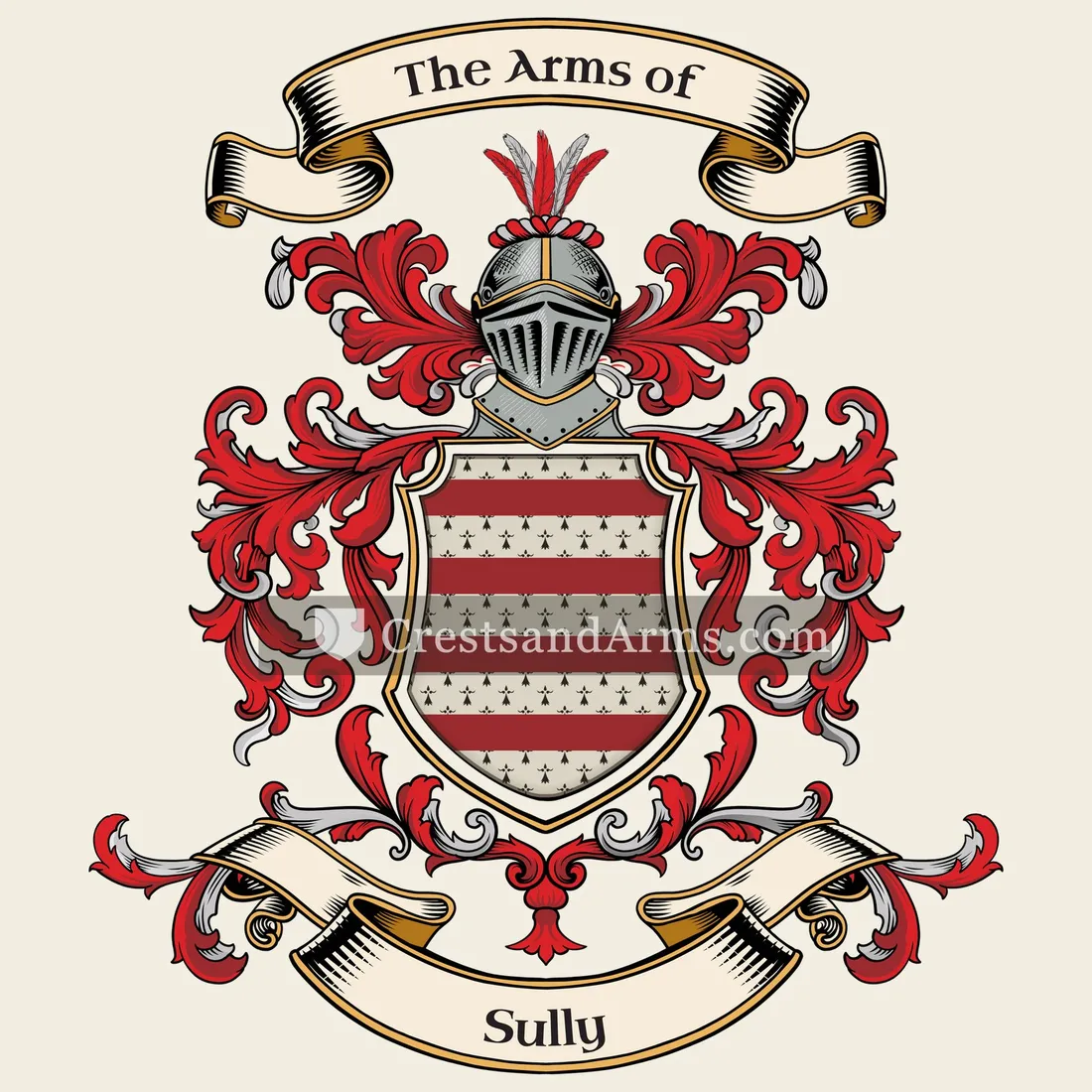
ErmineMeans: Dignity
Red (Gules)Means: Military strength
Historical info
Source
Sir Bernard Burke, The General Armory of England, Scotland, Ireland and Wales, London: Harrison & Sons, 1884
Blazon (the actual original written record)
“Erm. four bars gu”
DevonYederley · Devon, c. 1361
Digital archive packCoat of arms PNG, gold border print PDF, vector SVG and the certificate of authenticity. Sent to your email in minutes.
Map of England showing where the Sully arms are recorded
The Sully arms were recorded in Devon, c. 1361.
Devon was a county of small manors and seafaring families. Its gentry were spread thickly across the countryside, and money made at sea often bought an estate, which in turn brought a coat of arms.
This is where the arms were entered in the register. Families often moved to other parts of the country, so the same name can turn up in more than one region.
The body that granted and recorded arms in England in this period.
Edward III of England
Sovereign of the period
Edward III of England
1327–1377
Reigning in France when the Sully arms are first recorded.
How Arms Worked in England
English heraldry allowed arms to be shared by all legitimate descendants of the original owner. These symbols were treated as personal property that moved through the generations to all children. While the eldest son kept the original design, other family members could use the same shield without needing to change it or register their own unique versions.
Granting authority
The College of Arms in London has regulated the use of coats of arms throughout England and Wales since 1484.
How they got arms
Families typically obtained their coats of arms through a formal grant from the Crown or by proving their ancient right to them.
Where arms were recorded
All official coats of arms are recorded in the registers kept at the College of Arms, which date back to the fifteenth century.
The family's standing
Recorded among the armigerous families of Devon.
Origin & History of the Sully Family in England
The surname Sully traces its roots back to the arrival of Norman settlers in England following the conquest of 1066. The name is locational, meaning it was originally taken from a place name in Normandy, France. By the mid-14th century, the family had firmly established itself in the West Country of England. Historical records confirm that members of the Sully family were living in Devon by 1361, where they integrated into the local social and economic landscape. During this period, families with this name were often involved in the management of land and local administration. Their presence in Devon suggests they were part of the landed gentry or prosperous tenant farmers who played a key role in the development of rural English society during the Middle Ages.
Sully Meaning & Related Branches
Root word
Solliacum
A Gallo-Roman estate or settlement belonging to a person named Sollius.
This name
SullyA habitational name derived from the French commune of Sully-sur-Loire.
also spelled
Sullie
Sullye
Sullier
Sulee
Sulle
Related arms
Seulysame arms
Sulleyvariant spelling
Documented Sources
J. B. Rietstap, Armorial Général, Gouda: G. B. van Goor Zonen, 1884–87
Archives départementales du Cher, Série E, État civil et registres paroissiaux
Bouchard, Alain, Histoire du Berry et de ses familles, 1982
Deschamps de Pas, Louis, Recherches sur les familles nobles et bourgeoises du Berry, 1895
Digital archive packCoat of arms PNG, gold border print PDF, vector SVG and the certificate of authenticity. Sent to your email in minutes.


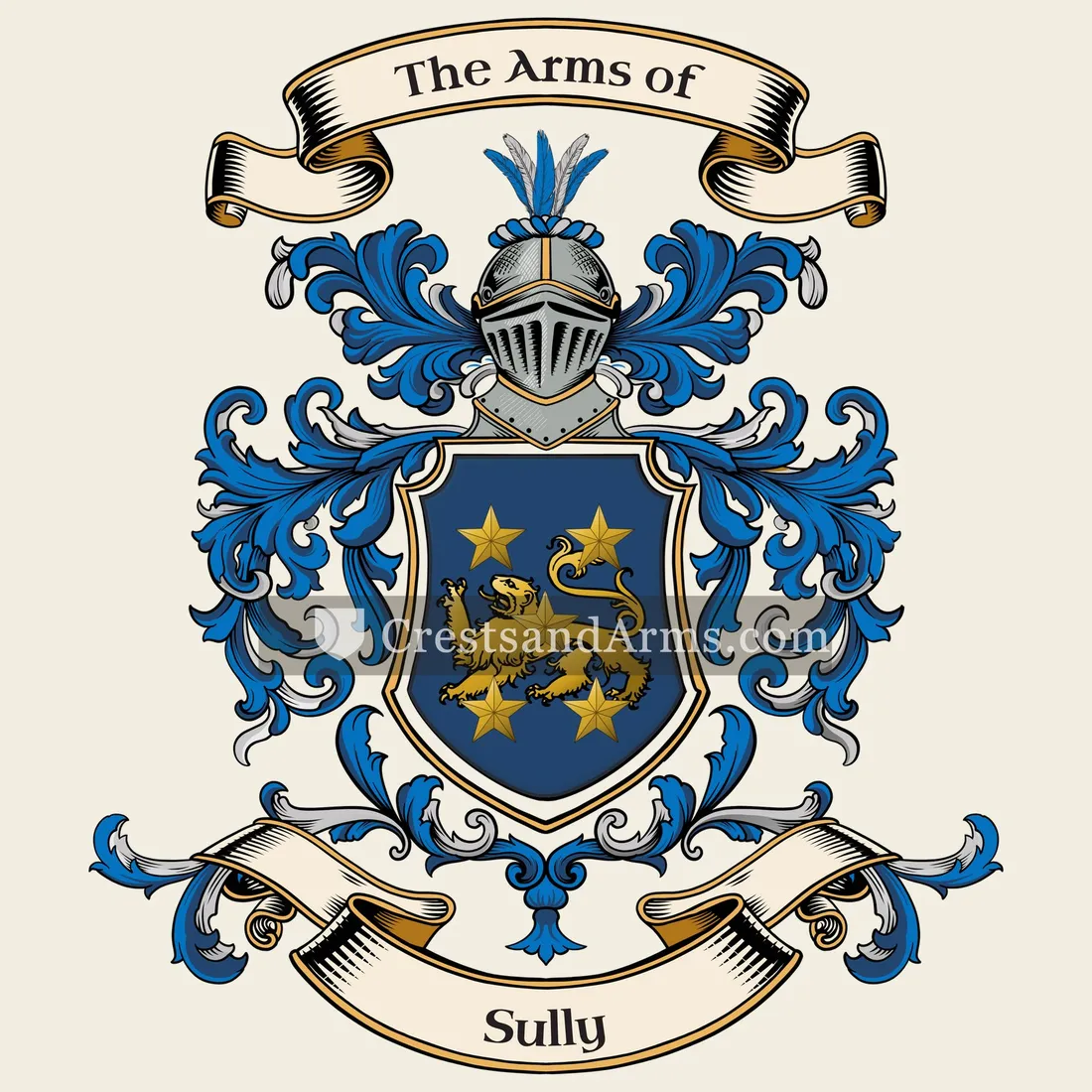
 lionCourage, strength and royalty
 mulletThe third son, and a divine quality from above
 lionCourage, strength and royalty
 mulletThe third son, and a divine quality from above