Map of Spain showing where the Sunner arms are recorded
The Sunner arms were recorded in Iles Baléares, c. 1725.
This is where the arms were entered in the register. Families often moved to other parts of the country, so the same name can turn up in more than one region.
The body that granted and recorded arms in Spain in this period.
Philip V of Spain
Sovereign of the period
Philip V of Spain
1724–1746
Reigning in Spain when the Sunner arms are first recorded.
How Arms Worked in Spain
In Spain, a coat of arms was considered a form of property that belonged to the entire family line. These arms were passed down from a father to all his children equally. Younger branches of the family usually kept the original design without needing to add any special marks to distinguish their specific line.
Granting authority
The Cronista Rey de Armas was the official body that regulated and granted coats of arms throughout Spain.
How they got arms
Families often obtained their arms through royal grants or by proving their noble status to the official heraldic authority.
Where arms were recorded
Coats of arms were officially recorded in the registers of the Cronista Rey de Armas starting in 1496.
The family's standing
Recorded among the armigerous families of Spain.
Origin & History of the Sunner Family in Spain
The family name Sunner has roots that stretch back to the Mediterranean, with documented evidence placing members of the family in the Balearic Islands by 1725. During this period, the islands served as a vital crossroads for trade and naval movement between Spain, France, and the Italian states. Families living in this region often adapted their surnames to fit the linguistic shifts occurring between Catalan, Spanish, and other regional dialects. The name likely evolved as a phonetic variation of local descriptors or occupational titles common to the maritime culture of the western Mediterranean. By the early 18th century, the Sunner family was integrated into the local social fabric of the islands, likely participating in the agricultural or mercantile activities that defined life in the Balearic archipelago during the transition into the modern era.
Related Branches & Arms
Root word
Sunna
Derived from the Germanic word for the sun.
This name
SunnerA habitational name referring to someone who lived near a sunny location.
also spelled
Sunner
Sunar
Sunyer
Documented Sources
J. B. Rietstap, Armorial Général, Gouda: G. B. van Goor Zonen, 1884–87
Arxiu del Regne de Mallorca, Protocolos Notariales de Mallorca, 1725
Pascual, A., La societat mallorquina del segle XVIII, 1998
Digital archive packCoat of arms PNG, gold border print PDF, vector SVG and the certificate of authenticity. Sent to your email in minutes.


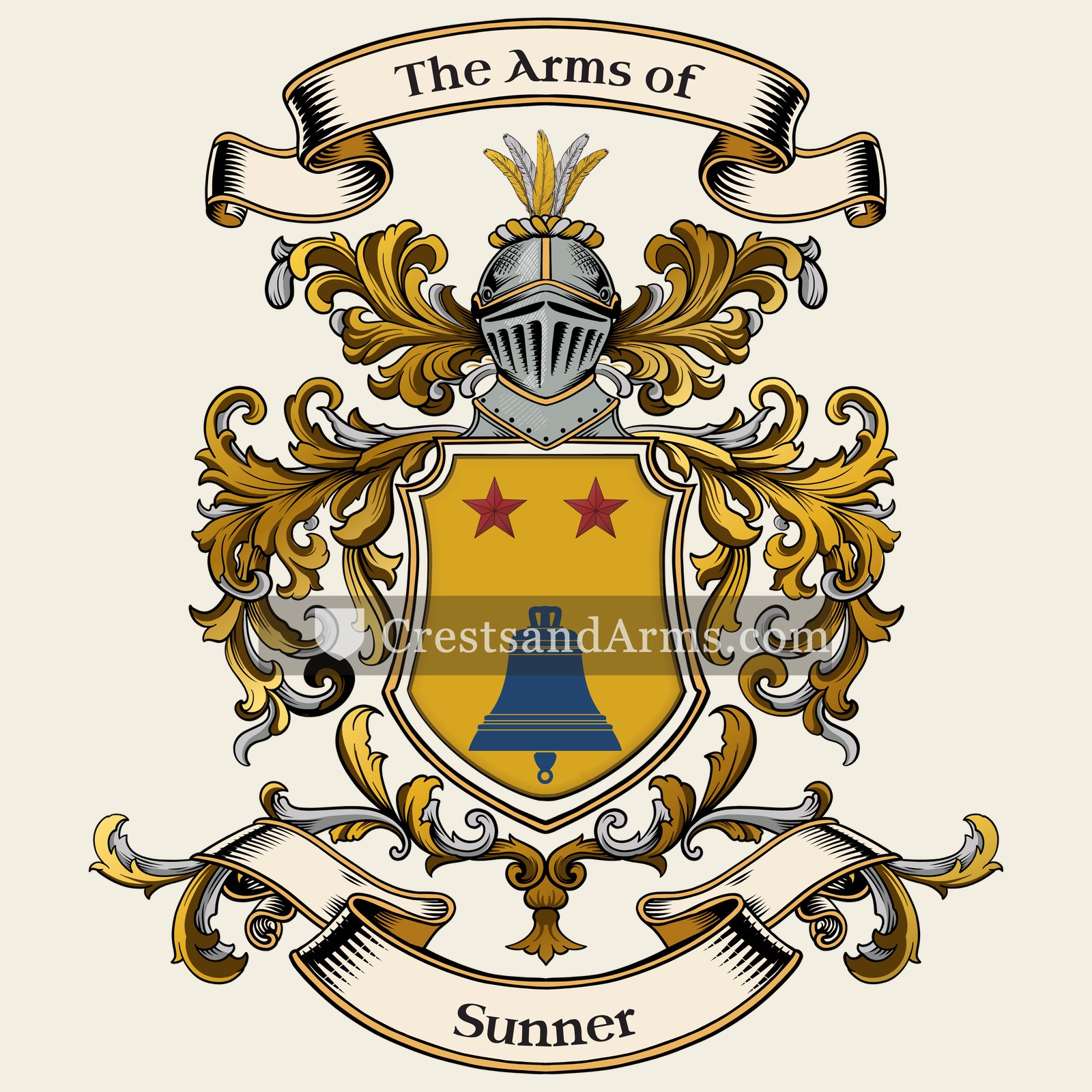
 bellA call to prayer, and a warning given
 mulletThe third son, and a divine quality from above
 bellA call to prayer, and a warning given
 mulletThe third son, and a divine quality from above