A record of documented arms, meaning and origin, researched for the Sutter family lines. Documented in 3 countries.
Reg. 1628 · Austrian, T–V
Coat of Arms & Family Crest Details
Symbols on this shield
bendDefence, and the scarf of a commander
fleur de lisPurity, light, and the sixth son
otterOne who lives life to the full
Colours
Blue (Azure)Means: Loyalty and truth
Black (Sable)Means: Constancy
Gold (Or)Means: Generosity
Silver (Argent)Means: Peace and sincerity
Red (Gules)Means: Military strength
Historical info
Source
J. B. Rietstap, Armorial Général, Gouda: G. B. van Goor Zonen, 1884–87
Blazon (the actual original written record)
“Ec.: aux 1 et 4 d'azur à une loutre naiss. au nat., mouv. d'une eau d'arg. et tenant entre ses dents un poisson au nat.; aux 2 et 3 tranché de sa. sur or; à la bande d'arg., br. sur le tranché et ch. de trois fleurs-de-lis de gu., posées dans le sens de la bande.”
Austriac. 1772
Digital archive packCoat of arms PNG, gold border print PDF, vector SVG and the certificate of authenticity. Sent to your email in minutes.
Map of Austria showing where the Sutter arms are recorded
The Sutter arms were recorded in Austria, c. 1772.
Arms such as these were typically recorded in Tyrol.
Tyrol was mountain country in western Austria, where the valleys were held by families who had been there a very long time. Old tenure counted for more than money, and old families carried arms.
This is where the arms were entered in the register. Families often moved to other parts of the country, so the same name can turn up in more than one region.
Region
Tyrol
First recorded
1772
Granting Authority for the Sutter Arms
Imperial and Royal chancery
Sodacan · CC BY-SA 3.0
The body that granted and recorded arms in Austria in this period.
Joseph II, Holy Roman Emperor
Sovereign of the period
Joseph II, Holy Roman Emperor
1765–1790
Reigning in Austria when the Sutter arms are first recorded.
How Arms Worked in Austria
Austrian coats of arms were often linked directly to noble titles granted by the Emperor. These symbols belonged to the entire family line rather than just one individual. When a family grew, new branches kept the original design without needing to change it. This system allowed all members of a noble house to share the same identity across many generations.
Granting authority
The Imperial and Royal chancery managed all heraldic matters and controlled the official granting of arms throughout the Austrian lands.
How they got arms
Families typically received their arms through a formal imperial decree that often accompanied the elevation of a person to noble status.
Where arms were recorded
Official records of these grants were kept in the Imperial Register of Nobility which began its formal documentation process in 1453.
The family's standing
Recorded among the armigerous families of Austria.
Origin & History of the Sutter Family in Austria
The surname Sutter is deeply rooted in the mountainous landscape of the Tyrol region, where families bearing this name were well-established by the late 18th century. Etymologically, the name is derived from the Middle High German word *sūter*, which refers to a shoemaker or a cobbler. This suggests that the earliest ancestors of the family were likely skilled tradespeople who provided essential footwear for the local farming and mining communities in the Alpine valleys. By 1772, records confirm that members of the Sutter family were active participants in the social and economic life of the region. They lived during a time when Tyrol was a central part of the Habsburg Monarchy, and their daily lives were shaped by the unique blend of rural traditions and strict administrative oversight characteristic of the era. As members of the working class, these early Sutters helped build the foundation of the local economy through their craftsmanship and dedication to their trade.
Coat of Arms & Family Crest Details
Symbols on this shield
bendDefence, and the scarf of a commander
horseReadiness to serve king and country
eagleNobility, strength and a keen mind
Colours
Blue (Azure)Means: Loyalty and truth
Gold (Or)Means: Generosity
Silver (Argent)Means: Peace and sincerity
Historical info
Source
J. B. Rietstap, Armorial Général, Gouda: G. B. van Goor Zonen, 1884–87
Blazon (the actual original written record)
“Ec.: aux 1 et 4 d'azur à un cheval naiss. d'arg., mouv. du bas; aux 2 et 3 d'or à la bande d'arg., ch. de trois alérions d'azur, posés dans le sens de la bande. Cq. cour. C.: un demi-vol aux armes du 2. L.: d'or et d'azur.”
SwitzerlandBâle, c. 1745
Digital archive packCoat of arms PNG, gold border print PDF, vector SVG and the certificate of authenticity. Sent to your email in minutes.
Map of Switzerland showing where the Sutter arms are recorded
The Sutter arms were recorded in Bâle, c. 1745.
This is where the arms were entered in the register. Families often moved to other parts of the country, so the same name can turn up in more than one region.
The body that granted and recorded arms in Switzerland in this period.
How Arms Worked in Switzerland
In Switzerland, coats of arms were not restricted to the nobility and were often adopted by common citizens and families. These symbols were passed down through generations to show family identity. When branches of a family grew, they often changed small details of the design to distinguish their own line from the original group.
Granting authority
Cantonal and civic authorities managed the use of coats of arms within their specific regions and local jurisdictions.
How they got arms
Families typically assumed their own coats of arms based on local custom rather than receiving them from a central monarch.
Where arms were recorded
Arms were recorded in various cantonal and civic registers starting from the fourteenth century throughout the Swiss region.
The family's standing
Recorded among the armigerous families of Switzerland.
Origin & History of the Sutter Family in Switzerland
The surname Sutter originates from the German word *Suter*, which historically identified a person who worked as a shoemaker or cobbler. In the context of Switzerland, the name became well-established across various German-speaking cantons as families settled into specific trades and local communities. By the time records place members of the family in Basel in 1745, the name was already deeply integrated into the social and economic fabric of the region. During this era, families like the Sutters often lived in urban centers where they contributed to the city's guild system, which regulated skilled labor and trade. These early ancestors were part of a growing middle class that helped shape the administrative and commercial life of Swiss cities. Their presence in Basel suggests they were likely involved in the active merchant or craft traditions that defined the city’s development during the eighteenth century.
Coat of Arms & Family Crest Details
Symbols on this shield
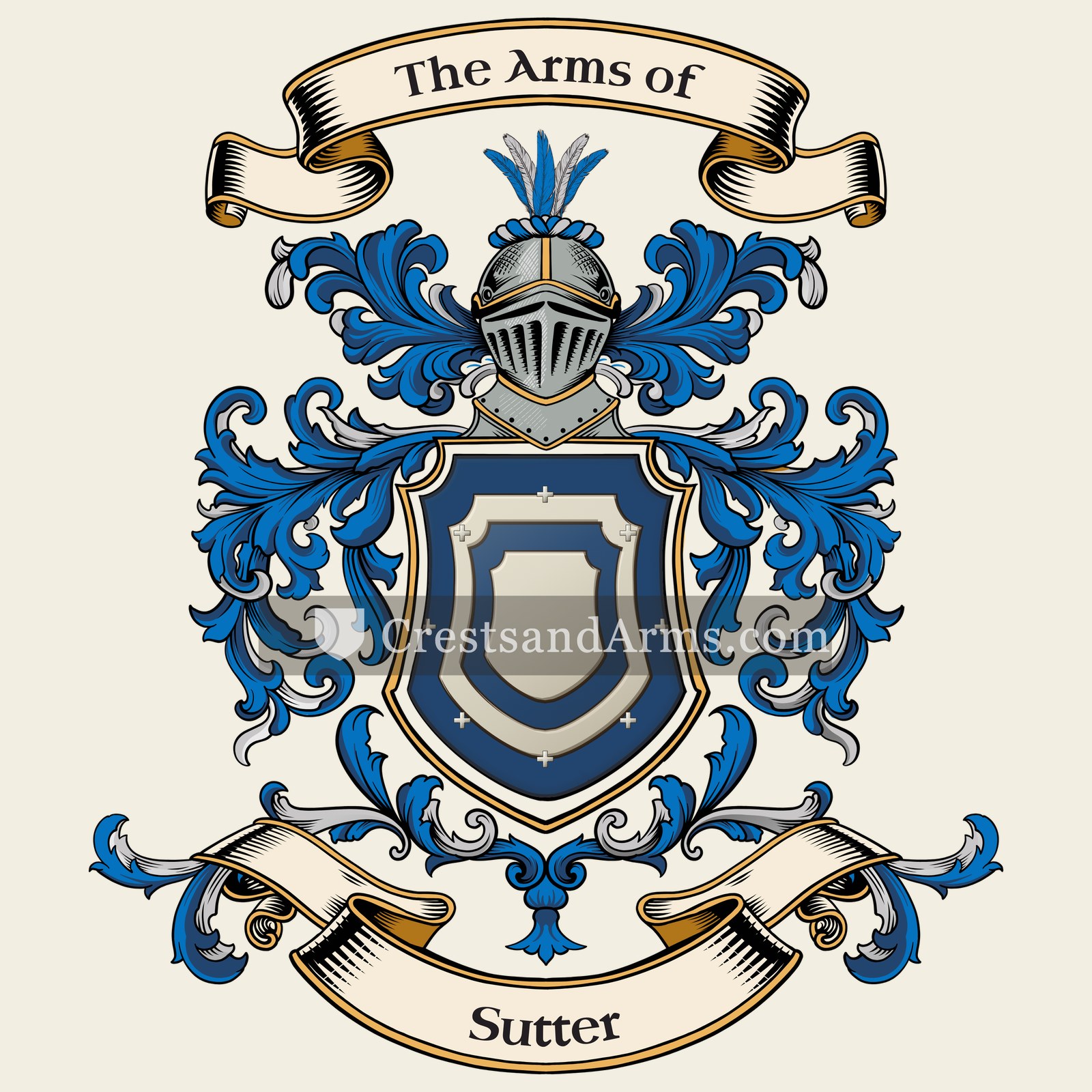
orlePreservation, and protection in battle
cross symbolChristian faith and service
Colours
Blue (Azure)Means: Loyalty and truth
Silver (Argent)Means: Peace and sincerity
Historical info
Source
Sir Bernard Burke, The General Armory of England, Scotland, Ireland and Wales, London: Harrison & Sons, 1884
Blazon (the actual original written record)
“Az. an escutcheon ar. an orle of eight crosses crosslet fitchée of the last”
Englandc. 1620
Digital archive packCoat of arms PNG, gold border print PDF, vector SVG and the certificate of authenticity. Sent to your email in minutes.
Map of England showing where the Sutter arms are recorded
The Sutter arms were recorded in England, c. 1620.
Arms such as these were typically recorded in York.
Yorkshire is the largest of the English counties, and it held more gentry families than any other. Land there was split among a great many households rather than a few, so a great many of them carried arms.
This is where the arms were entered in the register. Families often moved to other parts of the country, so the same name can turn up in more than one region.
The body that granted and recorded arms in England in this period.
James VI and I
Sovereign of the period
James VI and I
1603–1625
Reigning in Austria when the Sutter arms are first recorded.
How Arms Worked in England
English heraldry allowed arms to be shared by all legitimate descendants of the original owner. These symbols were treated as personal property that moved through the generations to all children. While the eldest son kept the original design, other family members could use the same shield without needing to change it or register their own unique versions.
Granting authority
The College of Arms in London has regulated the use of coats of arms throughout England and Wales since 1484.
How they got arms
Families typically obtained their coats of arms through a formal grant from the Crown or by proving their ancient right to them.
Where arms were recorded
All official coats of arms are recorded in the registers kept at the College of Arms, which date back to the fifteenth century.
The family's standing
Recorded among the armigerous families of England.
Origin & History of the Sutter Family in England
The surname Sutter has deep roots in the occupational history of medieval England, where it functioned as a descriptive name for a shoemaker or a cobbler. Derived from the Middle English word "souter," the name reflects the vital role that leather workers played in the daily lives of local communities. By the year 1620, records confirm that members of the Sutter family were well-established in the city of York. During this period, York served as a major northern hub for trade and craftsmanship, providing a stable environment for families to build their livelihoods through skilled labor. As these individuals moved through the bustling streets of the city, their name served as a permanent link to the essential craft of shoemaking that supported the growth of English towns. This connection to the trade of leatherwork highlights a history defined by practical skill and steady integration into the social fabric of early seventeenth-century England.
Related Branches & Arms
Root word
Sutor
Latin term for a shoemaker or cobbler.
This name
SutterAn occupational surname for a person who made or repaired shoes.
also spelled
Suter
Suttar
Sutor
Related arms
Krienssimilar arms
Sutervariant spelling
Capellerrecorded with Sutter, same area
Conradrecorded with Sutter, same area
Documented Sources
J. B. Rietstap, Armorial Général, Gouda: G. B. van Goor Zonen, 1884–87
Kranzmayer, Eberhard. Ortsnamenbuch von Kärnten. 1956
Schweiger, Fritz. Tiroler Familiennamen. 1992
Tiroler Landesarchiv, Tiroler Steuerkataster
Tiroler Landesarchiv, Matriken der Pfarreien (Kirchenbücher)
Digital archive packCoat of arms PNG, gold border print PDF, vector SVG and the certificate of authenticity. Sent to your email in minutes.


 bendDefence, and the scarf of a commander
 fleur de lisPurity, light, and the sixth son
 otterOne who lives life to the full
 bendDefence, and the scarf of a commander
 fleur de lisPurity, light, and the sixth son
 otterOne who lives life to the full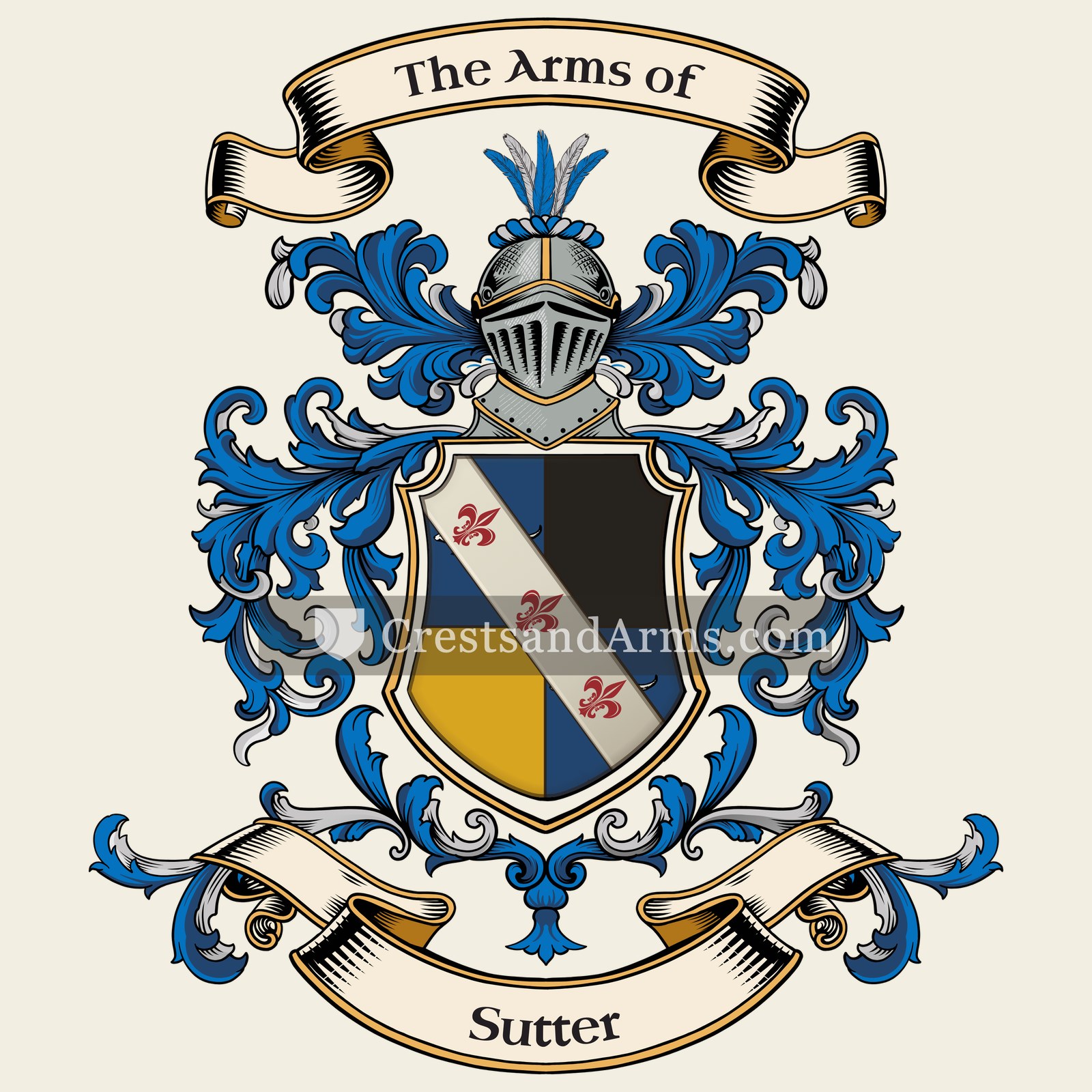


 horseReadiness to serve king and country
 eagleNobility, strength and a keen mind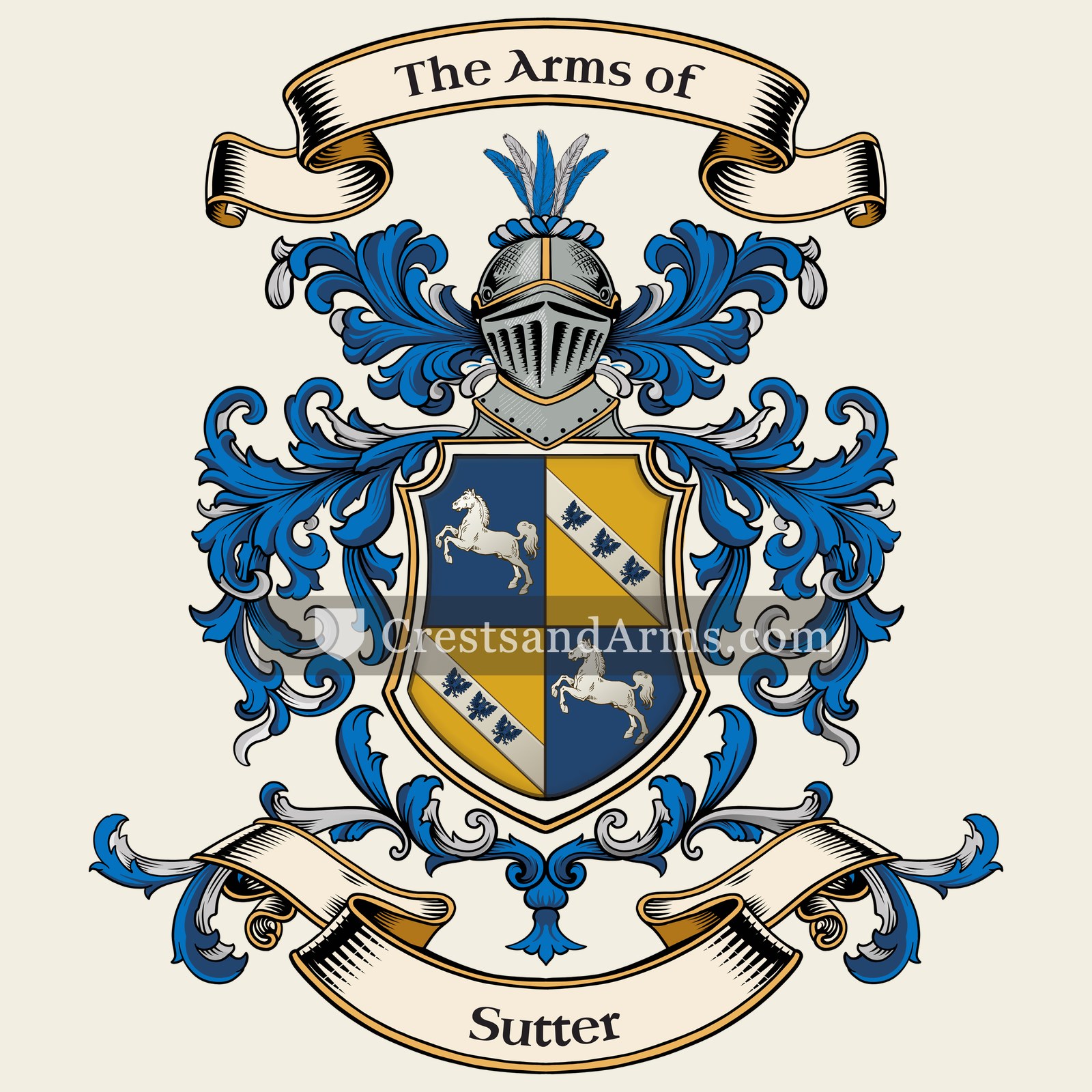

 orlePreservation, and protection in battle
 cross symbolChristian faith and service