A record of documented arms, meaning and origin, researched for the Swanger family lines. Documented in 2 countries.
Reg. 2474 · German, T–V
Coat of Arms & Family Crest Details
Symbols on this shield
bendDefence, and the scarf of a commander
lionCourage, strength and royalty
Colours
Red (Gules)Means: Military strength
Blue (Azure)Means: Loyalty and truth
Gold (Or)Means: Generosity
Historical info
Source
J. B. Rietstap, Armorial Général, Gouda: G. B. van Goor Zonen, 1884–87
Blazon (the actual original written record)
“Coupé: au 1 de gu. au lion léopardé d'or; au 2 bandé d'azur et d'or, de quatre pièces. Cq. cour. C.: un lion ramp. d'or, tenant de ses pattes une banderole flottante à dextre, coupée d'azur sur or. L. d'or et de gu.”
FranconiaFranconia, c. 1765
Digital archive packCoat of arms PNG, gold border print PDF, vector SVG and the certificate of authenticity. Sent to your email in minutes.
Map of Germany showing where the Swanger arms are recorded
The Swanger arms were recorded in Franconia, c. 1765.
Franconia was a patchwork of small territories in central Germany, full of minor landowners and prosperous market towns. So many separate households held land there that the region produced a great many coats of arms.
This is where the arms were entered in the register. Families often moved to other parts of the country, so the same name can turn up in more than one region.
The body that granted and recorded arms in Germany in this period.
Francis I, Holy Roman Emperor
Sovereign of the period
Francis I, Holy Roman Emperor
1745–1765
Reigning in Germany when the Swanger arms are first recorded.
How Arms Worked in Germany
In the Holy Roman Empire, coats of arms were often granted to individuals by the Emperor or his representatives. These arms were then passed down through the generations to all legitimate descendants of the original holder. Younger branches of a family usually kept the same shield design without needing to change it, as the arms belonged to the entire lineage.
Granting authority
The Holy Roman Emperor held the sole power to grant new coats of arms throughout his vast imperial territories.
How they got arms
Families typically obtained their coats of arms through a formal imperial grant or by proving their noble status to the authorities.
Where arms were recorded
These grants were officially recorded in the Imperial Chancery registers, which began keeping formal records of such honors during the Middle Ages.
The family's standing
Recorded among the armigerous families of Franconia.
Origin & History of the Swanger Family in Germany
The family name Swanger finds its historical roots in the region of Franconia, a territory in southern Germany known for its distinct cultural and linguistic traditions. During the mid-18th century, families bearing this name were established members of the local community, living in a landscape defined by small agricultural villages and growing market towns. The name itself likely evolved from older Germanic terms related to specific occupations or geographic features common to the Franconian countryside. By 1765, these individuals were part of a society that placed a high value on land ownership and local craftsmanship. Life for the Swanger family at this time was centered around the rhythms of the seasons and the administrative requirements of the local parish, which kept detailed records of births, marriages, and deaths. These early ancestors were part of a larger wave of German families who navigated the social and economic changes of the Holy Roman Empire before many eventually sought new opportunities abroad.
Coat of Arms & Family Crest Details
Symbols on this shield
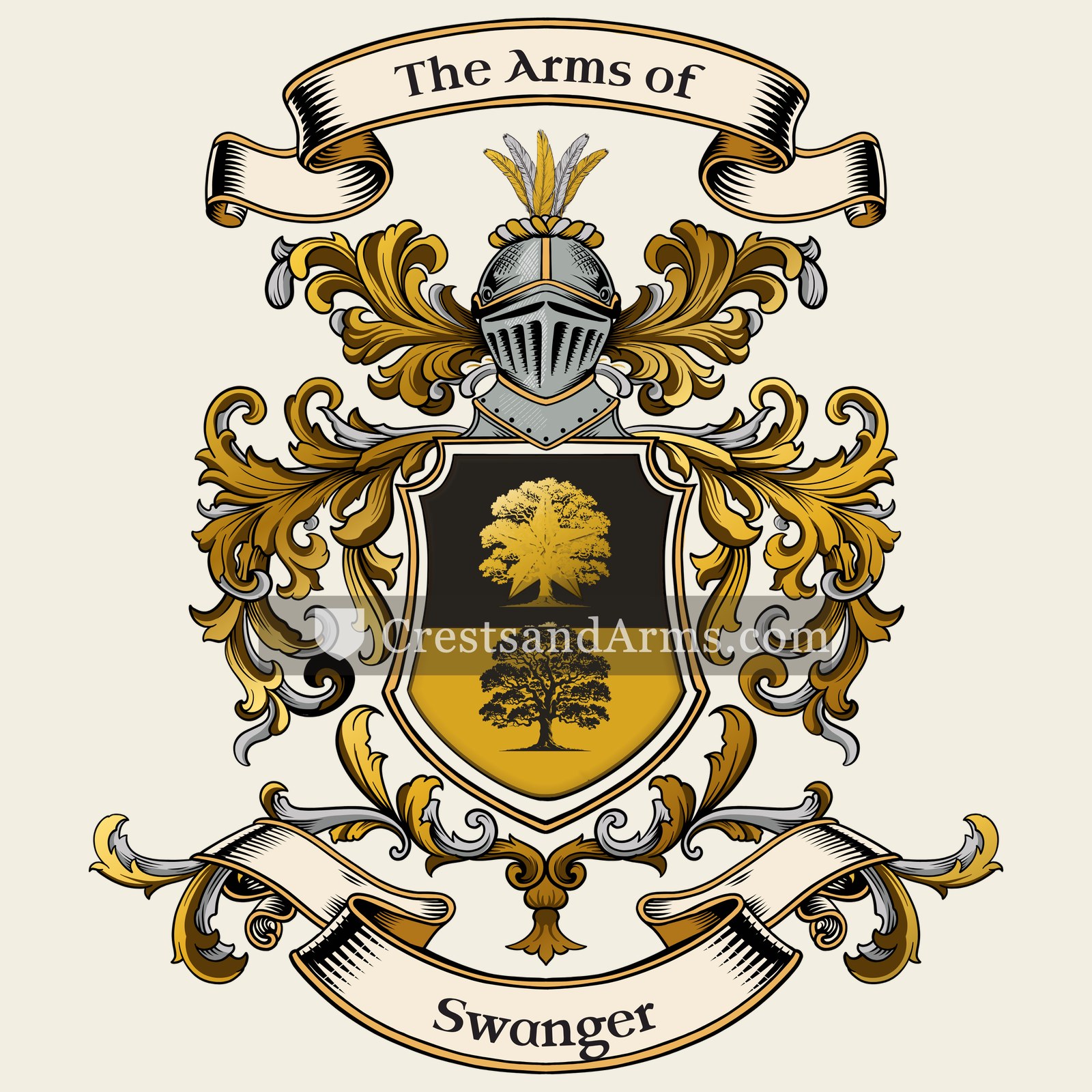
treeLife, endurance and deep roots
mulletThe third son, and a divine quality from above
Colours
Black (Sable)Means: Constancy
Gold (Or)Means: Generosity
Historical info
Source
J. B. Rietstap, Armorial Général, Gouda: G. B. van Goor Zonen, 1884–87
Blazon (the actual original written record)
“Coupé de sa. sur or; à un tronc d'arbre de l'un en l'autre, posé en bande, adextré d'uue étoile d'or sur le sa. C.: cinq pl. d'aut., alt. d'or et de sa.”
SwitzerlandBaden Argovie, c. 1745
Digital archive packCoat of arms PNG, gold border print PDF, vector SVG and the certificate of authenticity. Sent to your email in minutes.
Map of Switzerland showing where the Swanger arms are recorded
The Swanger arms were recorded in Baden Argovie, c. 1745.
This is where the arms were entered in the register. Families often moved to other parts of the country, so the same name can turn up in more than one region.
The body that granted and recorded arms in Switzerland in this period.
How Arms Worked in Switzerland
In Switzerland, coats of arms were not restricted to the nobility and were often adopted by common citizens and families. These symbols were passed down through generations to show family identity. When branches of a family grew, they often changed small details of the design to distinguish their own line from the original group.
Granting authority
Cantonal and civic authorities managed the use of coats of arms within their specific regions and local jurisdictions.
How they got arms
Families typically assumed their own coats of arms based on local custom rather than receiving them from a central monarch.
Where arms were recorded
Arms were recorded in various cantonal and civic registers starting from the fourteenth century throughout the Swiss region.
The family's standing
Recorded among the armigerous families of Switzerland.
Origin & History of the Swanger Family in Switzerland
The family name Swanger finds its roots in the German-speaking regions of Europe, with strong historical connections to the borderlands between Switzerland and the German state of Baden. The name is believed to be a variation of the German word "Schwanger," which historically functioned as a descriptive surname used to identify individuals or families living in specific geographic areas. By the mid-18th century, records confirm that members of the family were well-established in the Baden region by 1745. During this era, many families moved fluidly across the Rhine River, which served as a natural boundary between the Swiss cantons and the neighboring German territories. This movement was often driven by the search for fertile farmland and the desire to escape the political instability that frequently affected the Alpine regions. As these families settled into new communities, they maintained their cultural traditions and linguistic heritage, helping to preserve the identity of the name as it spread further across the continent and eventually toward North America.
Related Branches & Arms
Root word
Schwanger
Derived from the Middle High German word for a swinger or fighter.
This name
SwangerAn occupational or descriptive name for a person who wielded a weapon or tool.
also spelled
Wangar
Vanger
Documented Sources
J. B. Rietstap, Armorial Général, Gouda: G. B. van Goor Zonen, 1884–87
Bauer, Karl. Die Geschichte der Franken: Ein Überblick. 1985
Röll, Walter. Fränkische Familiennamen und ihre Herkunft. 1992
Staatsarchiv Bamberg, Kirchenbücher der Pfarreien im Hochstift Bamberg


 bendDefence, and the scarf of a commander
 lionCourage, strength and royalty
 bendDefence, and the scarf of a commander
 lionCourage, strength and royalty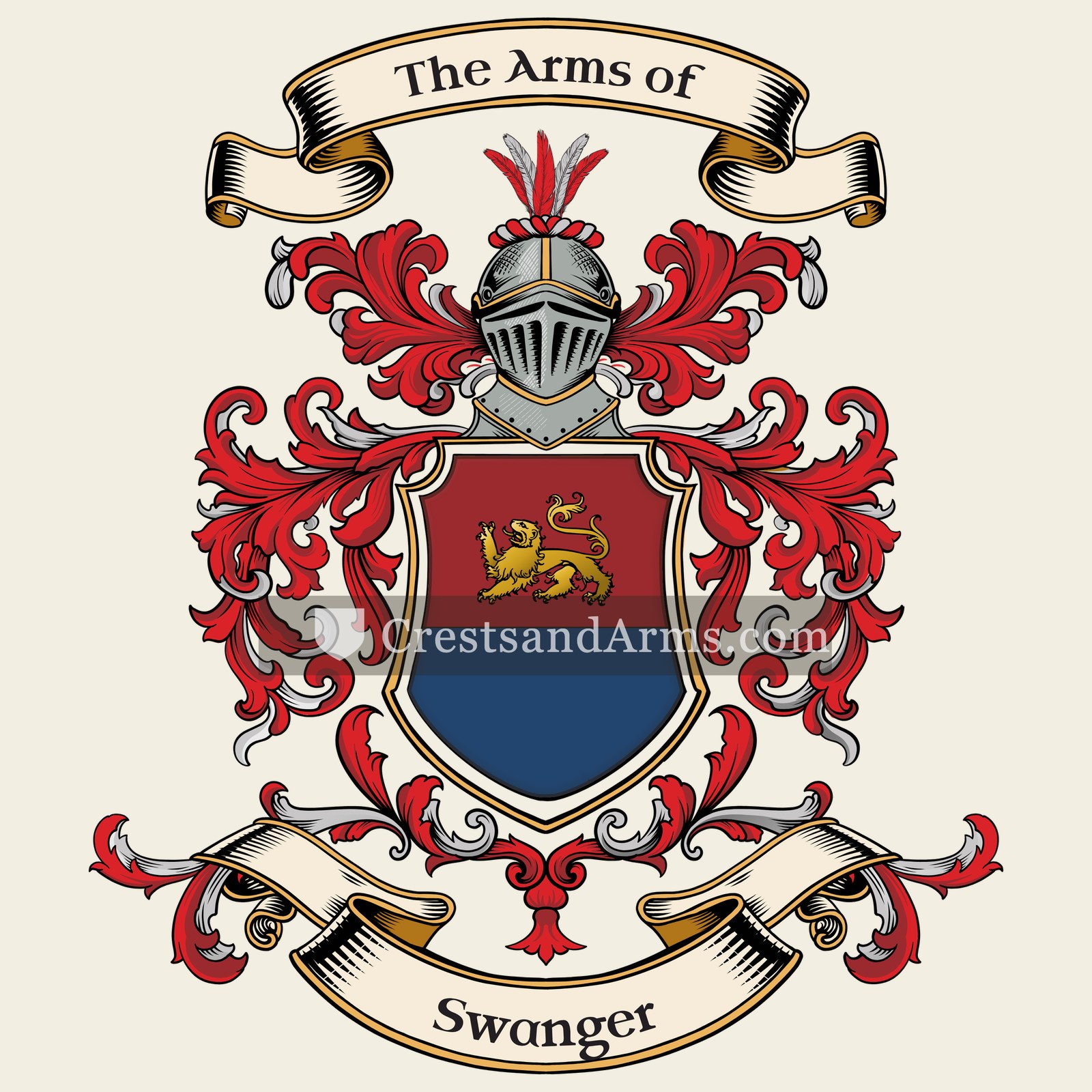


 treeLife, endurance and deep roots
 mulletThe third son, and a divine quality from above