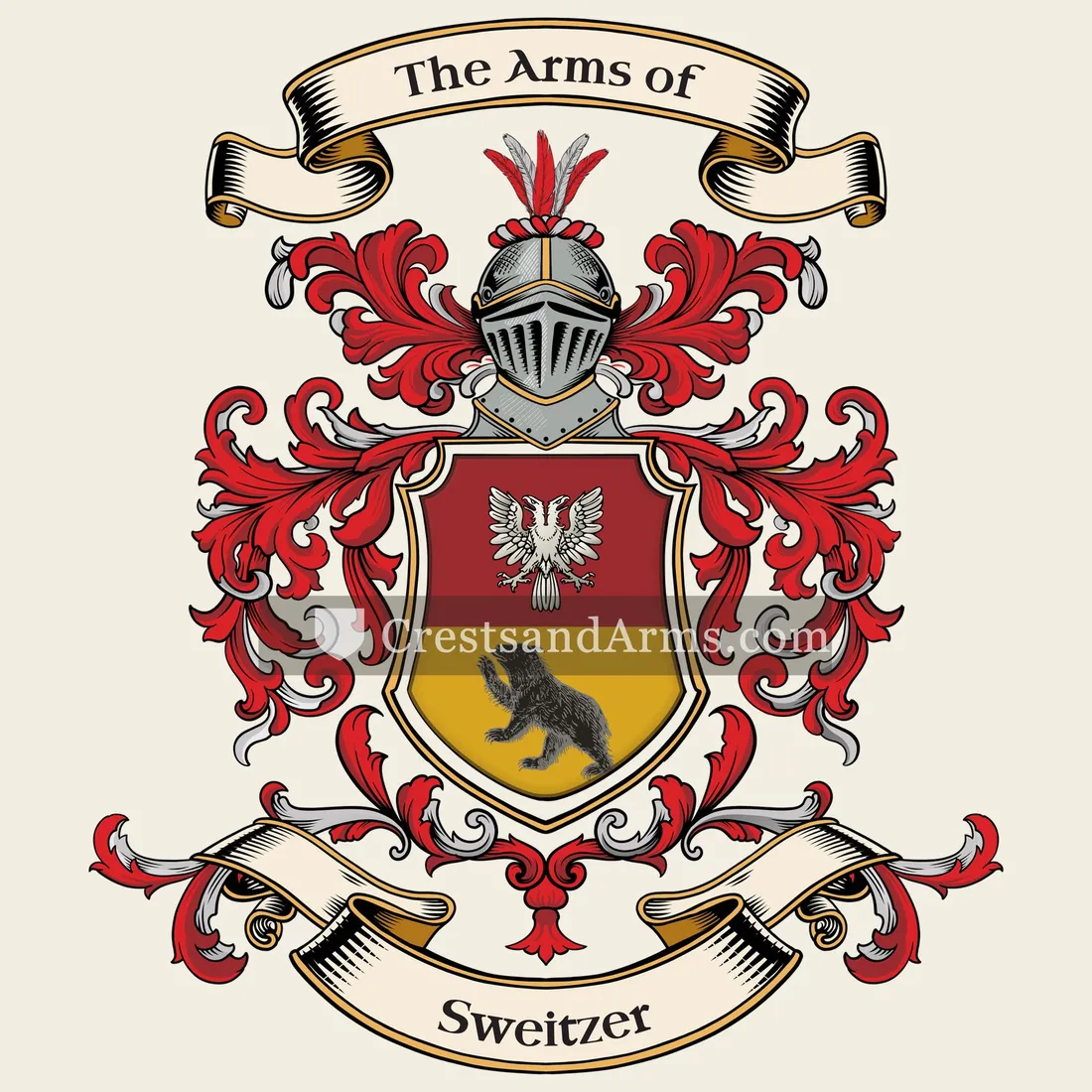
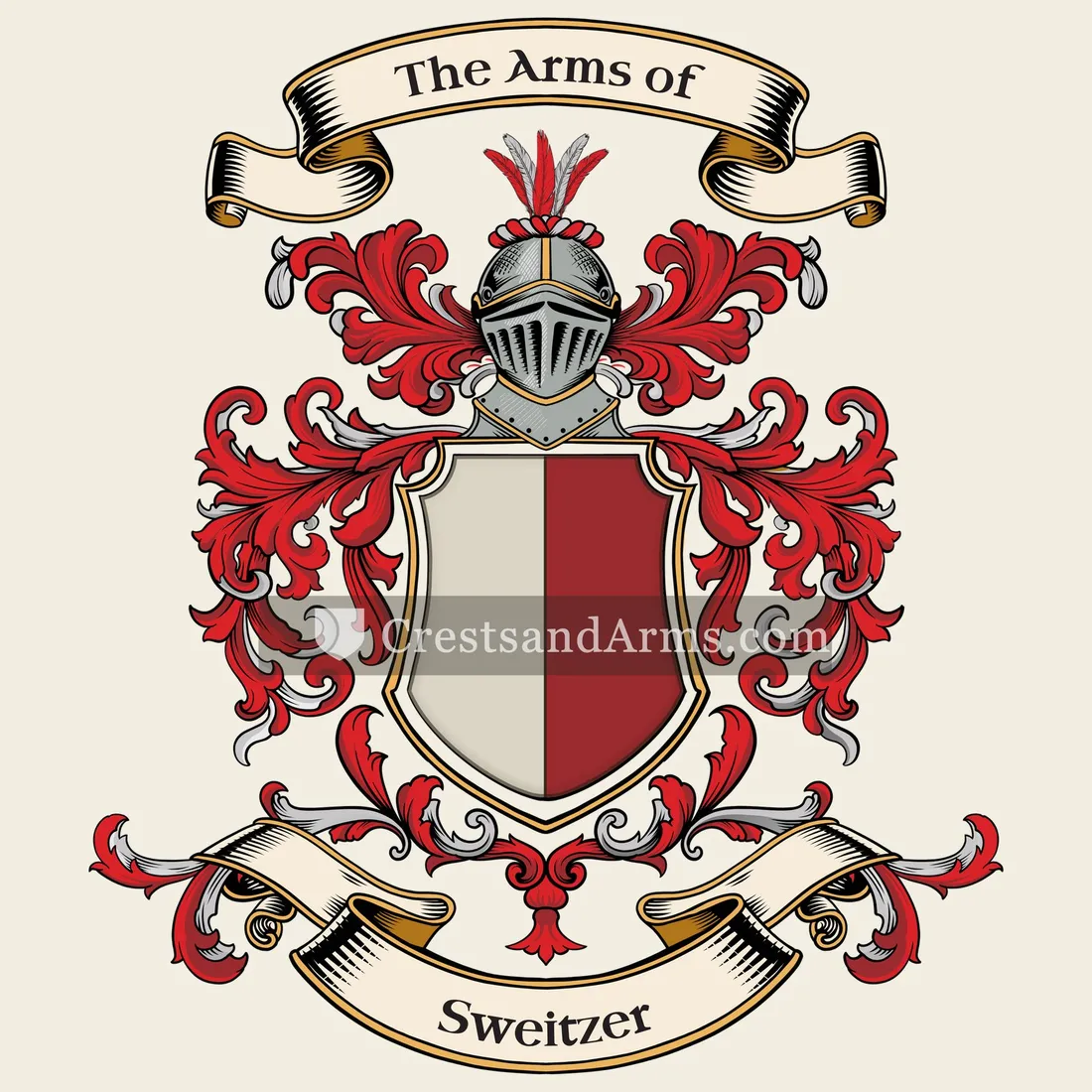
A record of documented arms, meaning and origin, researched for the Sweitzer family lines. Documented in 2 countries.
Reg. 8493 · German, T–V
Meaning of the Sweitzer family crest colors & symbols
Symbols on this shield
eagleNobility, strength and a keen mind
bearStrength, cunning and protection of kin
Colours
Red (Gules)Means: Military strength
Gold (Or)Means: Generosity
Silver (Argent)Means: Peace and sincerity
Black (Sable)Means: Constancy
Historical info
Source
J. B. Rietstap, Armorial Général, Gouda: G. B. van Goor Zonen, 1884–87
Blazon (the actual original written record)
“Coupé: au 1 de gu. à l'aigle d'arg., cour. d'or; au 2 d'or à un ours pass. de sa. Deux cq. cour. C.: 1º l'aigle: l. d'arg. et de gu.; 2º l'ours, iss.; l. d'or et de sa. [V. Allesina dit Schweitzer.]”
SaxonySaxony, c. 1844
Digital archive packCoat of arms PNG, gold border print PDF, vector SVG and the certificate of authenticity. Sent to your email in minutes.
Map of Germany showing where the Sweitzer arms are recorded
The Sweitzer arms were recorded in Saxony, c. 1844.
Saxony had mines, trade and old landed families all at once. Silver made some fortunes and land held others, and both sorts of family kept arms, which is why Saxon names appear so often in the registers.
This is where the arms were entered in the register. Families often moved to other parts of the country, so the same name can turn up in more than one region.
The body that granted and recorded arms in Germany in this period.
Frederick William IV of Prussia
Sovereign of the period
Frederick William IV of Prussia
1840–1861
Reigning in Germany when the Sweitzer arms are first recorded.
How Arms Worked in Germany
Prussian heraldry was strictly tied to social rank and noble status rather than being a free choice for every citizen. These symbols were treated as permanent family property that moved through the generations to all legitimate heirs. If a family branch wanted to change their design to stand out, they had to apply for official permission to alter their specific version of the shield.
Granting authority
The Prussian Heroldsamt acted as the central state office that managed and strictly controlled all noble titles and coats of arms.
How they got arms
Families usually obtained their arms through formal royal grants or by proving their long-standing noble status to the state authorities.
Where arms were recorded
All official coats of arms were kept in the rolls of the Prussian Heroldsamt, which functioned from 1706 until 1918.
The family's standing
Recorded among the armigerous families of Saxony.
Origin & History of the Sweitzer Family in Germany
The surname Sweitzer is a classic example of a locative name, which means it was originally used to identify someone based on where they lived or where they came from. In the German language, the name is derived from the word "Schweizer," which translates to someone from Switzerland. During the Middle Ages, many people moved across the German-speaking lands for work, trade, or religious reasons. When a person migrated from the Swiss cantons into other regions like Saxony, neighbors often began to refer to them by their place of origin rather than their given name. By the time ancestors of the family were documented in Saxony in 1844, the name had long since transitioned from a simple description of a traveler’s home into a permanent family identifier. This reflects a broader pattern in German history where surnames became fixed as families settled into specific communities and established roots in their new local economies.
Meaning of the Sweitzer family crest colors & symbols
Colours
Silver (Argent)Means: Peace and sincerity
Red (Gules)Means: Military strength
Historical info
Source
J. B. Rietstap, Armorial Général, Gouda: G. B. van Goor Zonen, 1884–87
Blazon (the actual original written record)
“Parti d'arg. et de gu.; à un Suisse, br. sur le parti, hab. d'azur, coiffé d'une toque du même, l'épée à la hanche. Cq. cour. C.: un bras, paré d'azur semé de boutons d'or, la main de carn. brandissant une épée d'arg.; entre un vol coupé, à dextre d'arg. sur gu., à sen. d'azur sur or. L.: à dextre sur or d'azur, à sen. d'arg et de gu.”
Austriac. 1772
Digital archive packCoat of arms PNG, gold border print PDF, vector SVG and the certificate of authenticity. Sent to your email in minutes.
Map of Austria showing where the Sweitzer arms are recorded
The Sweitzer arms were recorded in Austria, c. 1772.
Arms such as these were typically recorded in Tyrol.
Tyrol was mountain country in western Austria, where the valleys were held by families who had been there a very long time. Old tenure counted for more than money, and old families carried arms.
This is where the arms were entered in the register. Families often moved to other parts of the country, so the same name can turn up in more than one region.
Region
Tyrol
First recorded
1772
Granting Authority for the Sweitzer Arms
Imperial and Royal chancery
Sodacan · CC BY-SA 3.0
The body that granted and recorded arms in Austria in this period.
Joseph II, Holy Roman Emperor
Sovereign of the period
Joseph II, Holy Roman Emperor
1765–1790
Reigning in Germany when the Sweitzer arms are first recorded.
How Arms Worked in Austria
Austrian coats of arms were often linked directly to noble titles granted by the Emperor. These symbols belonged to the entire family line rather than just one individual. When a family grew, new branches kept the original design without needing to change it. This system allowed all members of a noble house to share the same identity across many generations.
Granting authority
The Imperial and Royal chancery managed all heraldic matters and controlled the official granting of arms throughout the Austrian lands.
How they got arms
Families typically received their arms through a formal imperial decree that often accompanied the elevation of a person to noble status.
Where arms were recorded
Official records of these grants were kept in the Imperial Register of Nobility which began its formal documentation process in 1453.
The family's standing
Recorded among the armigerous families of Austria.
Origin & History of the Sweitzer Family in Austria
The family name Sweitzer, often spelled Schweitzer in its original German form, functions as a descriptive surname that historically identified individuals who had migrated from Switzerland to other German-speaking regions. By the time members of the family were recorded in the Tyrol region of Austria in 1772, the name had become a well-established way to distinguish newcomers from local populations. In the mountainous terrain of Tyrol, families often settled in specific valleys where they worked as farmers, craftsmen, or traders. Because 18th-century Tyrol was a central hub for trade routes crossing the Alps, the presence of the Sweitzer family suggests they were part of the steady movement of people seeking new economic opportunities in the Austrian Empire. These early ancestors likely integrated into the local village life by participating in parish activities and contributing to the agricultural economy that defined the region during the late 1700s.
Sweitzer Meaning & Related Branches
Root word
Schweizer
A person who originates from the country of Switzerland.
This name
SweitzerAn occupational or habitational name for someone who came from the Swiss region.
also spelled
Sweitzer
Schweitzerr
Sweitzerr
Shweitzer
Documented Sources
J. B. Rietstap, Armorial Général, Gouda: G. B. van Goor Zonen, 1884–87
Bahlow, Hans, Deutsches Namenlexikon: Familien- und Vornamen nach Ursprung und Sinn erklärt, 1967
Heintze, Albert, Die deutschen Familiennamen: geschichtlich, geographisch, sprachlich, 1903
Sächsisches Staatsarchiv, Bestand 10036: Finanzministerium, Kirchenvisitationsprotokolle, 1844
Digital archive packCoat of arms PNG, gold border print PDF, vector SVG and the certificate of authenticity. Sent to your email in minutes.


 eagleNobility, strength and a keen mind
 bearStrength, cunning and protection of kin
 eagleNobility, strength and a keen mind
 bearStrength, cunning and protection of kin