Map of France showing where the Swick arms are recorded
The Swick arms were recorded in Alsace, c. 1663.
Alsace lay between France and the German lands and belonged to both at different times. Its families held small estates and served whichever side ruled, and men who served in arms carried arms of their own.
This is where the arms were entered in the register. Families often moved to other parts of the country, so the same name can turn up in more than one region.
The body that granted and recorded arms in France in this period.
Louis XIV of France
Sovereign of the period
Louis XIV of France
1643–1715
Reigning in France when the Swick arms are first recorded.
How Arms Worked in France
In France, a coat of arms was a mark of honor that passed down through the male line to all legitimate descendants. Families often used the same shield without changes to show their shared heritage. If a branch wanted to stand out, they could add a small mark to their shield to show their specific place in the family tree.
Granting authority
The Juge d'armes de France acted as the official authority that regulated and verified coats of arms across the country.
How they got arms
Families typically inherited their arms from ancestors, though they could also receive them through royal grants or by proving their noble status.
Where arms were recorded
Coats of arms were officially recorded in the Armorial Général de France, which began its main collection in the year 1696.
The family's standing
Recorded among the armigerous families of Alsace.
Origin & History of the Swick Family in France
The history of the Swick family in France is deeply rooted in the unique cultural landscape of Alsace during the seventeenth century. By 1663, records confirm that members of the family were established in this region, which served as a historic crossroads between French and Germanic influences. At that time, Alsace was a territory defined by the aftermath of the Thirty Years' War, a period that saw significant shifts in population and local governance. Families like the Swicks lived in a society where language and customs often blended, reflecting the complex identity of the borderland. Living in this area meant navigating a changing political environment as the region transitioned toward greater integration with the French crown. The presence of the family in these early parish and civil registers highlights their role as part of the resilient communities that rebuilt the Alsatian countryside during the mid-1600s.
Meaning of the Swick family crest colors & symbols
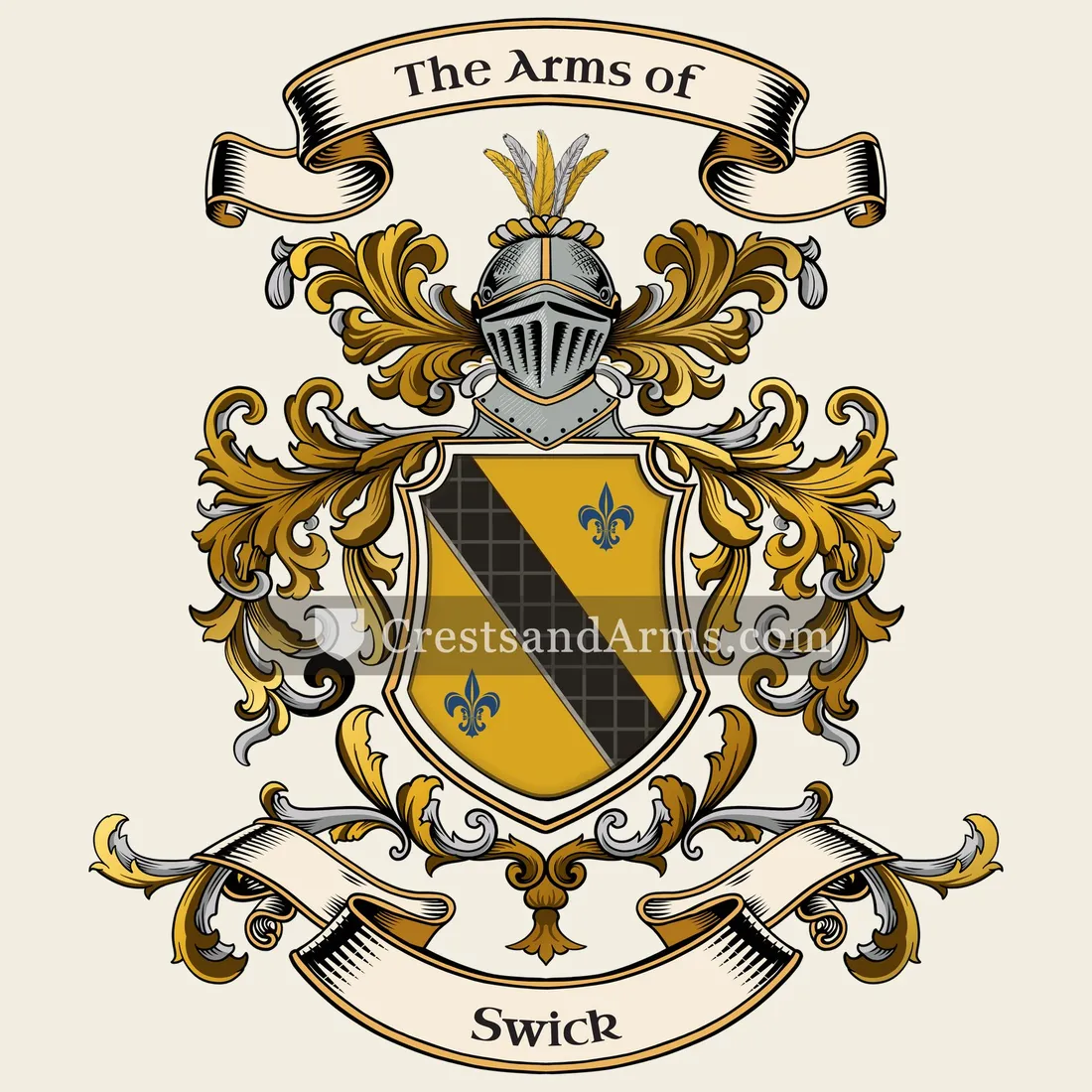
Symbols on this shield
bendDefence, and the scarf of a commander
fleur de lisPurity, light, and the sixth son
Colours
Gold (Or)Means: Generosity
Black (Sable)Means: Constancy
Blue (Azure)Means: Loyalty and truth
Historical info
Source
J. B. Rietstap, Armorial Général, Gouda: G. B. van Goor Zonen, 1884–87
Blazon (the actual original written record)
“D'or à la bande de sa., acc. de deux fleurs-de-lis d'azur et ch. d'un fer de flèche, emm. d'or, posé dans le sens de la bande. Cq. cour. C.: un buste d'homme, à longues moustaches, hab. de sa., ch. du fer de flèche en pal. L. d'or et de sa.”
WurttembergWurttemberg, c. 1855
Digital archive packCoat of arms PNG, gold border print PDF, vector SVG and the certificate of authenticity. Sent to your email in minutes.
Map of Germany showing where the Swick arms are recorded
The Swick arms were recorded in Wurttemberg, c. 1855.
Wurttemberg was southern German country of small estates and well-off market towns. Both landowners and leading townsmen kept arms there, so the region carries far more names than its size suggests.
This is where the arms were entered in the register. Families often moved to other parts of the country, so the same name can turn up in more than one region.
The body that granted and recorded arms in Germany in this period.
Frederick William IV of Prussia
Sovereign of the period
Frederick William IV of Prussia
1840–1861
Reigning in France when the Swick arms are first recorded.
How Arms Worked in Germany
Prussian heraldry was strictly tied to social rank and noble status rather than being a free choice for every citizen. These symbols were treated as permanent family property that moved through the generations to all legitimate heirs. If a family branch wanted to change their design to stand out, they had to apply for official permission to alter their specific version of the shield.
Granting authority
The Prussian Heroldsamt acted as the central state office that managed and strictly controlled all noble titles and coats of arms.
How they got arms
Families usually obtained their arms through formal royal grants or by proving their long-standing noble status to the state authorities.
Where arms were recorded
All official coats of arms were kept in the rolls of the Prussian Heroldsamt, which functioned from 1706 until 1918.
The family's standing
Recorded among the armigerous families of Wurttemberg.
Origin & History of the Swick Family in Germany
The surname Swick is deeply rooted in the historical landscape of southwestern Germany, particularly within the region of Württemberg. Linguistic experts often trace the origins of such names to the Middle High German word *swick*, which historically referred to a specialized trade area, a marketplace, or a specific type of settlement. During the mid-19th century, families bearing this name were well-established in the rural districts of Württemberg, a time when the region was transitioning from a traditional agrarian society into a more industrial economy. Life for these early ancestors was defined by the strict social structures of the German Confederation, where families were often tied to specific villages through local parish records and land ownership. By 1855, the Swick family was already part of a long-standing demographic tradition in this area, living through a period marked by significant social change and the early waves of migration that would eventually see many families move beyond the borders of the German states.
Swick Meaning & Related Branches
Root word
vicus
Latin term for a village, neighborhood, or row of houses.
This name
SwickDerived from a topographic location indicating someone who lived near a village or hamlet.
also spelled
Syk
Seek
Documented Sources
J. B. Rietstap, Armorial Général, Gouda: G. B. van Goor Zonen, 1884–87
Archives départementales du Bas-Rhin, Registres paroissiaux et d'état civil
Grasser, Jean-Paul, Histoire de l'Alsace, 1988
Livet, Georges, L'Alsace et les provinces du Rhin au XVIIIe siècle, 1956
Digital archive packCoat of arms PNG, gold border print PDF, vector SVG and the certificate of authenticity. Sent to your email in minutes.


 arms pheon arrowheadReadiness for battle, and the broad arrow of the sovereign
 arms pheon arrowheadReadiness for battle, and the broad arrow of the sovereign
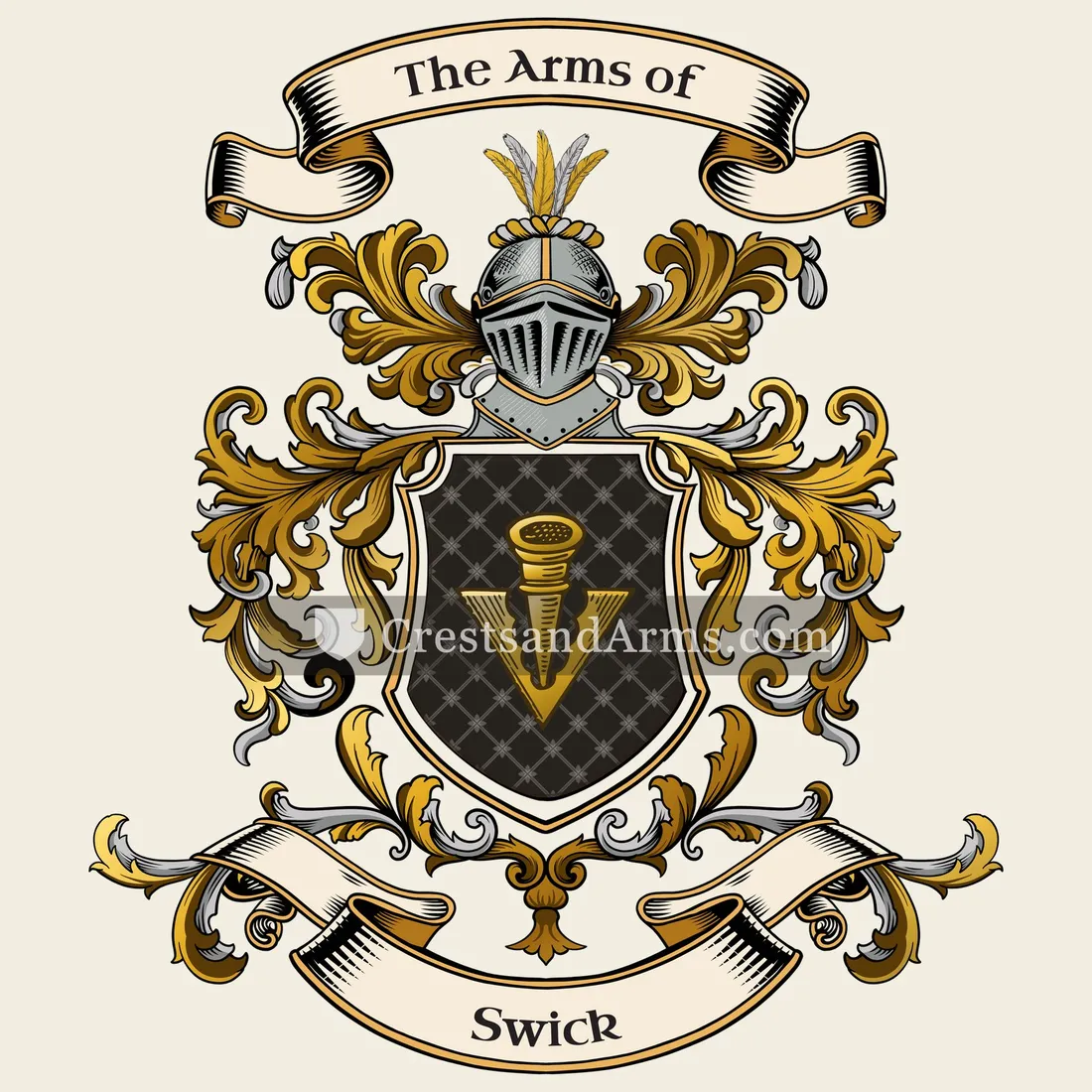


 bendDefence, and the scarf of a commander
 fleur de lisPurity, light, and the sixth son