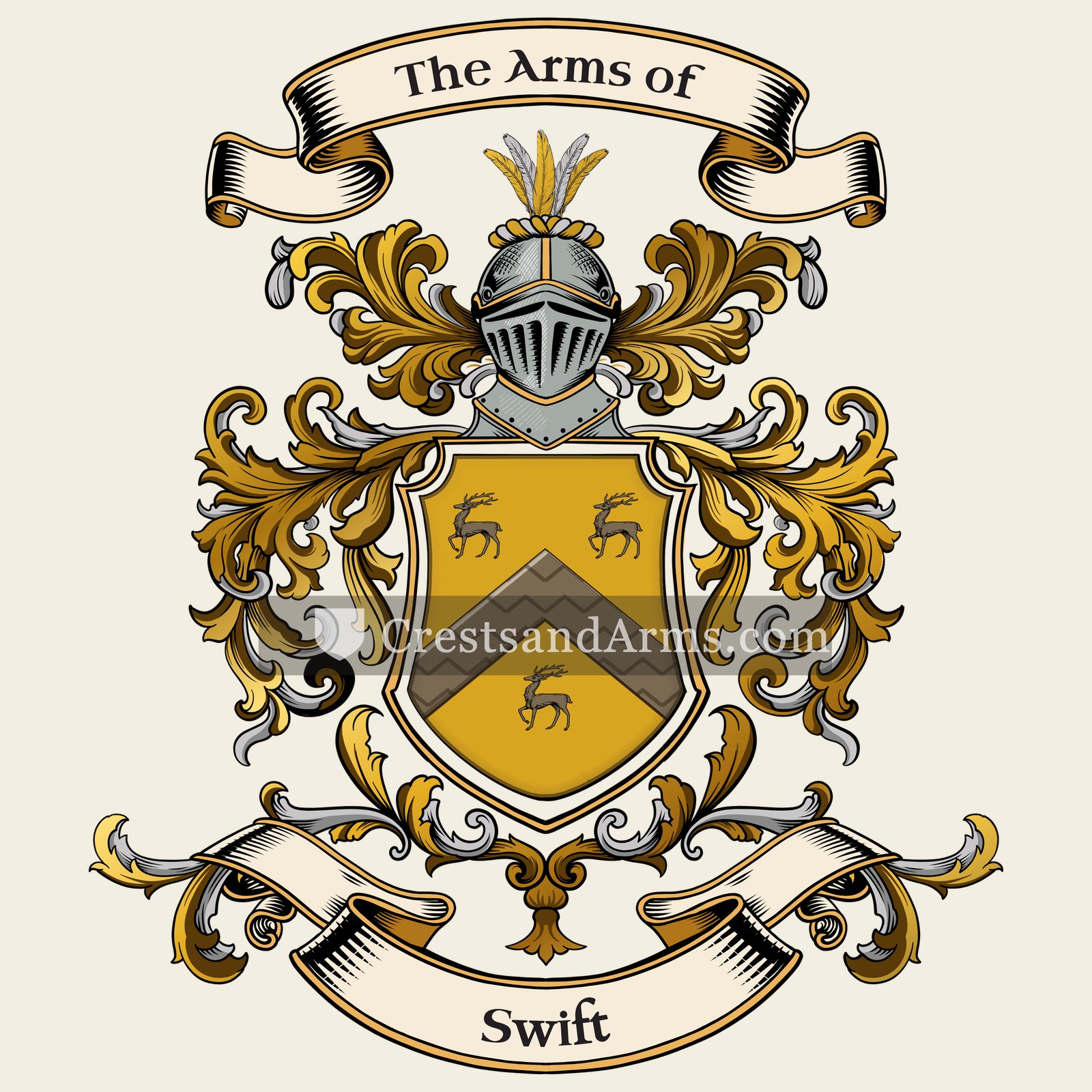
A record of documented arms, meaning and origin, researched for the Swift family lines. Documented in 2 countries.
Reg. 2307 · Britain, T–V
Coat of Arms & Family Crest Details
Symbols on this shield
chevronProtection, and faithful service completed
vairProtection, and the winter fur
stagPeace and harmony, and one who will not fight unprovoked
Colours
Gold (Or)Means: Generosity
Historical info
Source
J. B. Rietstap, Armorial Général, Gouda: G. B. van Goor Zonen, 1884–87
Blazon (the actual original written record)
“D'or au chev. de vair, acc. de trois cerfs élancés au nat. C.: un cerf iss. au nat., tenant entre ses dents une chèvrefeuille tigée et feuillée. D.: CUM MAGNIS VIXISSE [Armes du célèbre doyen Swift.]”
Britainc. 1700
Digital archive packCoat of arms PNG, gold border print PDF, vector SVG and the certificate of authenticity. Sent to your email in minutes.
Map of Britain showing where the Swift arms are recorded
The Swift arms were recorded in Britain, c. 1700.
Arms such as these were typically recorded in Kent.
Kent sits between London and the short crossing to Europe, and the trade passing through made it wealthy. Merchant families bought land with that money, and it was landowners who took coats of arms.
This is where the arms were entered in the register. Families often moved to other parts of the country, so the same name can turn up in more than one region.
The body that granted and recorded arms in Britain in this period.
William III of England
Sovereign of the period
William III of England
1694–1702
Reigning in Britain when the Swift arms are first recorded.
How Arms Worked in Britain
English heraldry allowed arms to be shared by all legitimate descendants of the original owner. These symbols were treated as personal property that moved through the generations to all children. While the eldest son kept the original design, other family members could use the same shield without needing to change it or register their own unique versions.
Granting authority
The College of Arms in London has regulated the use of coats of arms throughout England and Wales since 1484.
How they got arms
Families typically obtained their coats of arms through a formal grant from the Crown or by proving their ancient right to them.
Where arms were recorded
All official coats of arms are recorded in the registers kept at the College of Arms, which date back to the fifteenth century.
The family's standing
Recorded among the armigerous families of Britain.
Origin & History of the Swift Family in Britain
The surname Swift originated in England as a descriptive nickname, likely given to someone who was known for their physical speed or quick-witted nature. During the Middle Ages, people often adopted names based on their personal traits or occupations to help distinguish them from their neighbors. By the time the family established a notable presence in Kent around 1700, the name had already been in use across Britain for several centuries. These early families in Kent were typically part of the local agrarian or tradesman classes, contributing to the development of the region through farming and local commerce. As the name spread from its medieval roots, it became a permanent fixture in English society, reflecting the common practice of turning personal characteristics into lasting family identities.
Coat of Arms & Family Crest Details
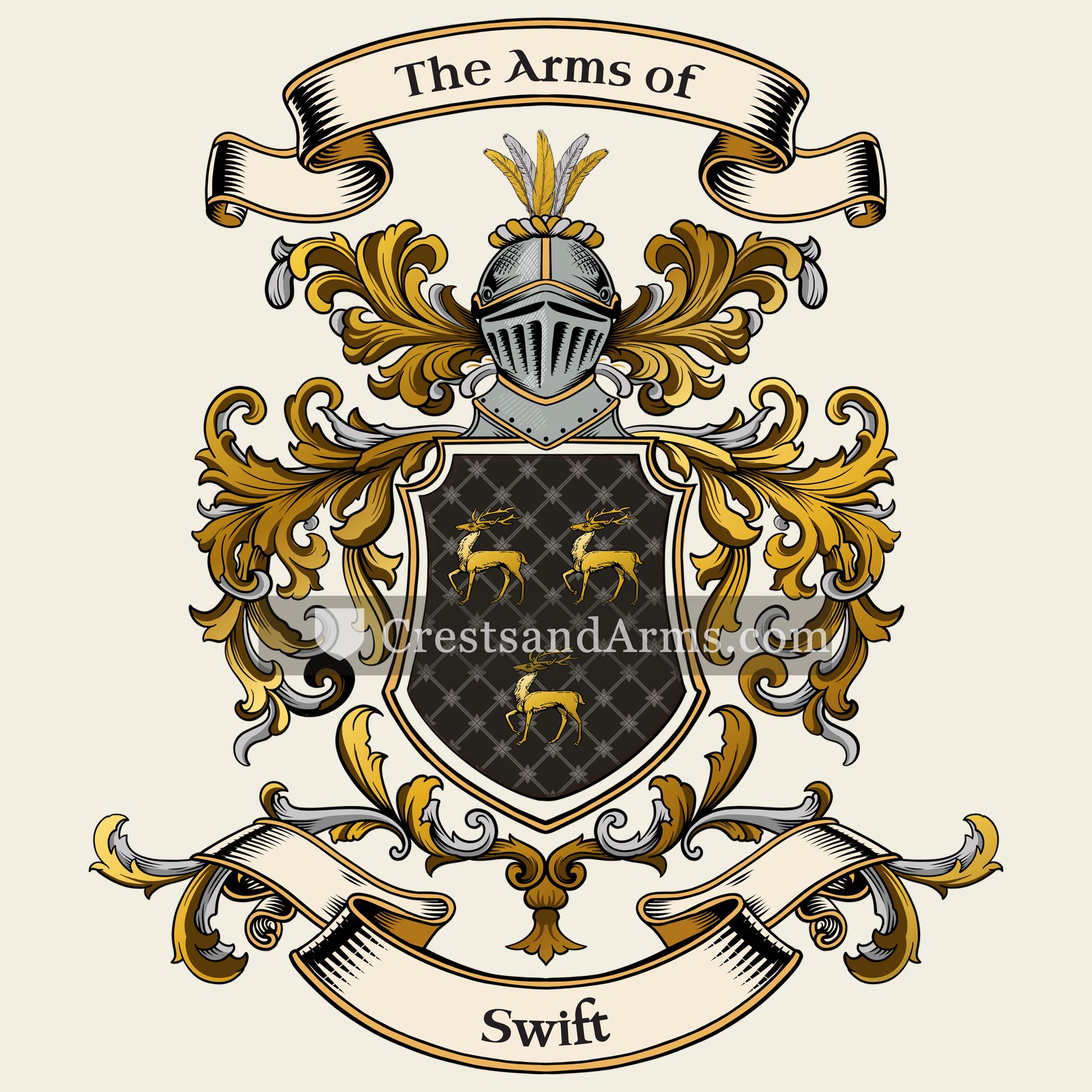
Symbols on this shield
stagPeace and harmony, and one who will not fight unprovoked
Colours
Black (Sable)Means: Constancy
Gold (Or)Means: Generosity
Historical info
Source
Sir Bernard Burke, The General Armory of England, Scotland, Ireland and Wales, London: Harrison & Sons, 1884
Blazon (the actual original written record)
“Sa. three bucks trippant or”
DorsetBlandford · Dorset, c. 1620
Digital archive packCoat of arms PNG, gold border print PDF, vector SVG and the certificate of authenticity. Sent to your email in minutes.
Map of England showing where the Swift arms are recorded
The Swift arms were recorded in Dorset, c. 1620.
Dorset was quiet farming and grazing country along the south coast. Its gentry were middling rather than grand, but they held their manors for a very long time, and long holding is what puts a name in the records.
This is where the arms were entered in the register. Families often moved to other parts of the country, so the same name can turn up in more than one region.
The body that granted and recorded arms in England in this period.
James VI and I
Sovereign of the period
James VI and I
1603–1625
Reigning in Britain when the Swift arms are first recorded.
How Arms Worked in England
English heraldry allowed arms to be shared by all legitimate descendants of the original owner. These symbols were treated as personal property that moved through the generations to all children. While the eldest son kept the original design, other family members could use the same shield without needing to change it or register their own unique versions.
Granting authority
The College of Arms in London has regulated the use of coats of arms throughout England and Wales since 1484.
How they got arms
Families typically obtained their coats of arms through a formal grant from the Crown or by proving their ancient right to them.
Where arms were recorded
All official coats of arms are recorded in the registers kept at the College of Arms, which date back to the fifteenth century.
The family's standing
Recorded among the armigerous families of Dorset.
Origin & History of the Swift Family in England
The surname Swift originated in England as a descriptive nickname for a person who possessed great speed or agility. During the Middle Ages, names were often assigned based on a person’s physical traits or their reputation in the local community. By the time the family was firmly established in the county of Dorset in 1620, the name had been in use for several centuries across various English regions. Families bearing this name were typically part of the common citizenry, often working as farmers or tradespeople who contributed to the local economy of the West Country. As they settled in Dorset, these early ancestors helped shape the rural landscape of the region while maintaining the traditions and naming patterns common to seventeenth-century England. The persistence of the name in parish records from this era highlights how families moved and grew within the social structures of the time.
Swift Meaning & Related Branches
Root word
swifan
An Old English verb meaning to move quickly or sweep.
This name
SwiftA descriptive nickname for a person who was notably fast, agile, or prompt.
also spelled
Swifte
Swiftt
Swiftte
Swyft
Swyfte
Related arms
Gardinerrecorded with Swift, same area
Swaynerecorded with Swift, same area
Documented Sources
J. B. Rietstap, Armorial Général, Gouda: G. B. van Goor Zonen, 1884–87
Reaney, P.H., A Dictionary of English Surnames, 1958
Lower, Mark Antony, Patronymica Britannica: A Dictionary of the Family Names of the United Kingdom, 1860
Kent Archives, Quarter Sessions Records, Q/S/P
Digital archive packCoat of arms PNG, gold border print PDF, vector SVG and the certificate of authenticity. Sent to your email in minutes.


 chevronProtection, and faithful service completed
 stagPeace and harmony, and one who will not fight unprovoked
 chevronProtection, and faithful service completed
 stagPeace and harmony, and one who will not fight unprovoked