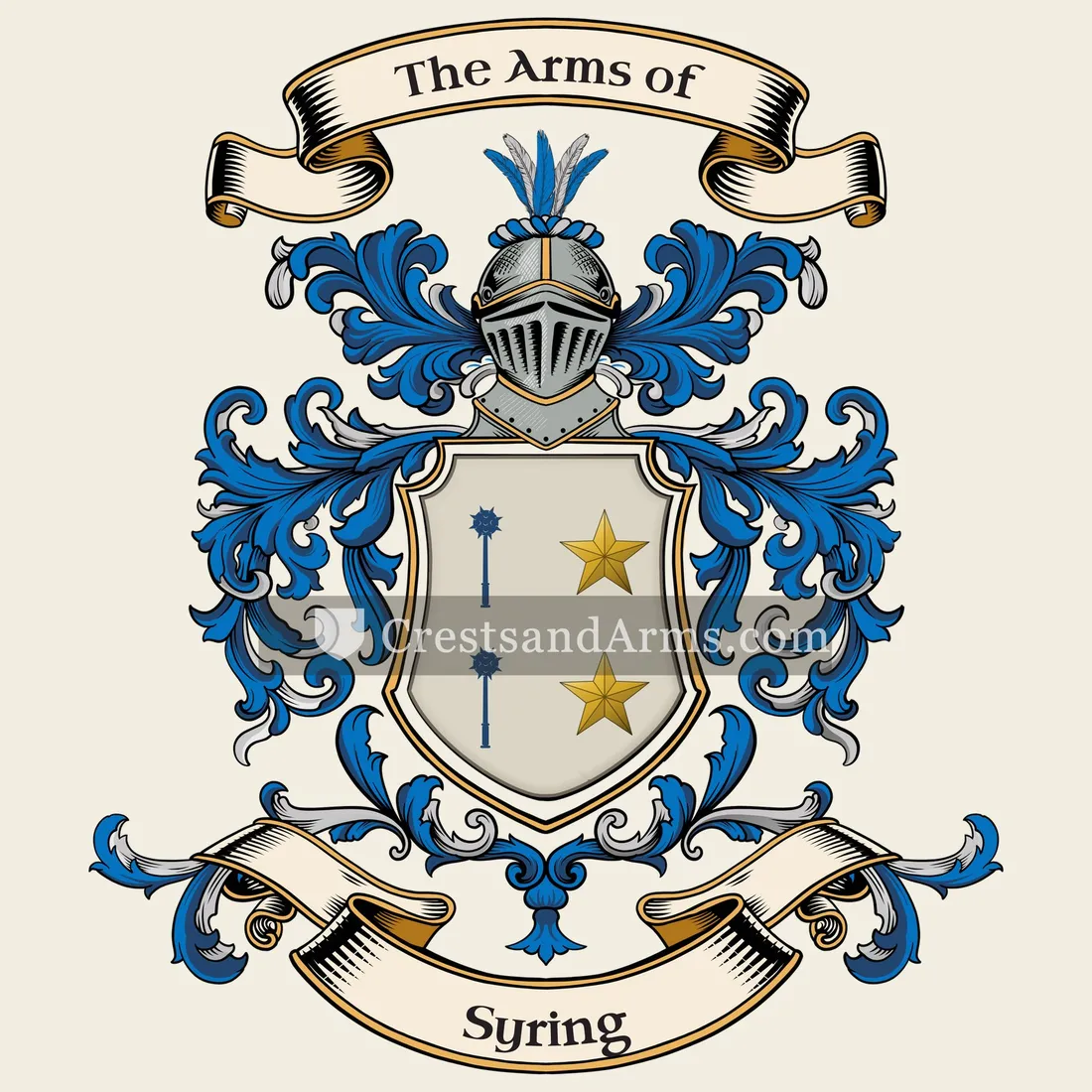
A record of documented arms, meaning and origin, researched for the Syring family of Germany.
Reg. 1419 · German, T–V
Meaning of the Syring family crest colors & symbols
Symbols on this shield
maceAuthority, and the officer who bears it
mulletThe third son, and a divine quality from above
Colours
Silver (Argent)Means: Peace and sincerity
Blue (Azure)Means: Loyalty and truth
Gold (Or)Means: Generosity
Historical info
Source
J. B. Rietstap, Armorial Général, Gouda: G. B. van Goor Zonen, 1884–87
Blazon (the actual original written record)
“D'arg. à deux masses à picotons d'azur, emm. de sa., les gardes d'or, passées en saut., acc. de deux étoiles d'or, dans les cantons de la p. C.: trois pl. d'aut.: d'or, d'azur et d'arg. L. d'or, d'azur et d'arg.”
PomeraniaPomerania, c. 1765
Digital archive packCoat of arms PNG, gold border print PDF, vector SVG and the certificate of authenticity. Sent to your email in minutes.
Map of Germany showing where the Syring arms are recorded
The Syring arms were recorded in Pomerania, c. 1765.
Pomerania was flat farming country on the Baltic coast, held in large estates by a small number of families. They kept their land for generations, and generations of landholding is what fills the registers.
This is where the arms were entered in the register. Families often moved to other parts of the country, so the same name can turn up in more than one region.
The body that granted and recorded arms in Germany in this period.
Francis I, Holy Roman Emperor
Sovereign of the period
Francis I, Holy Roman Emperor
1745–1765
Reigning in Germany when the Syring arms are first recorded.
How Arms Worked in Germany
In the Holy Roman Empire, coats of arms were often granted to individuals by the Emperor or his representatives. These arms were then passed down through the generations to all legitimate descendants of the original holder. Younger branches of a family usually kept the same shield design without needing to change it, as the arms belonged to the entire lineage.
Granting authority
The Holy Roman Emperor held the sole power to grant new coats of arms throughout his vast imperial territories.
How they got arms
Families typically obtained their coats of arms through a formal imperial grant or by proving their noble status to the authorities.
Where arms were recorded
These grants were officially recorded in the Imperial Chancery registers, which began keeping formal records of such honors during the Middle Ages.
The family's standing
Recorded among the armigerous families of Pomerania.
Origin & History of the Syring Family in Germany
The family name Syring finds its historical roots in the region of Pomerania, a coastal area along the Baltic Sea that was historically divided between Germany and Poland. By 1765, records confirm that members of the Syring family were established residents in this territory. The name likely originated as a topographic or habitational surname, which was a common practice in Northern Europe during the Middle Ages. In many cases, these names were derived from the specific landscape features or the names of small villages where a family first settled. Given the linguistic patterns of the region, the name may have been influenced by local dialects that blended Slavic and Germanic roots. Families in Pomerania during the eighteenth century were often tied to the land through agriculture or trade in the bustling port cities along the coast. These early ancestors lived through a period of significant political change as the region shifted between various European powers, which often required families to maintain strong local ties to their communities to ensure stability and growth.
Syring Meaning & Related Branches
Root word
Syrinx
A Greek term for a reed pipe or pan flute.
This name
SyringAn occupational name for a musician who played the pan pipes.
also spelled
Sueringg
Sueringe
Suring
Documented Sources
J. B. Rietstap, Armorial Général, Gouda: G. B. van Goor Zonen, 1884–87
Krollmann, Christian. Altpreußische Biographie. 1941
State Archive in Greifswald (Landesarchiv Greifswald), Kirchenbücher der Provinz Pommern. 1765
Zoder, Rudolf. Familiennamen in Ostfalen. 1968
Digital archive packCoat of arms PNG, gold border print PDF, vector SVG and the certificate of authenticity. Sent to your email in minutes.


 maceAuthority, and the officer who bears it
 mulletThe third son, and a divine quality from above
 maceAuthority, and the officer who bears it
 mulletThe third son, and a divine quality from above