Map of Belgium showing where the Szmidt arms are recorded
The Szmidt arms were recorded in Flandre, c. 1663.
Flandre grew rich on cloth, and its towns were among the busiest in Europe. Merchant families bought land with their profits and took arms to go with it, so trade put as many names in the registers here as land did.
This is where the arms were entered in the register. Families often moved to other parts of the country, so the same name can turn up in more than one region.
The body that granted and recorded arms in Belgium in this period.
Philip IV of Spain
Sovereign of the period
Philip IV of Spain
1621–1665
Reigning in Belgium when the Szmidt arms are first recorded.
How Arms Worked in Belgium
In Belgium, a coat of arms is considered personal property that is passed down through the male line to legitimate descendants. Families often use the same shield design across generations to show their shared heritage. If a branch of the family wants to change the design, they must apply for an official update to their specific version of the arms.
Granting authority
The Conseil héraldique is the official body that regulates and approves all coats of arms in Belgium.
How they got arms
Families obtain their coats of arms through formal royal grants or by confirming their historical right to use existing designs.
Where arms were recorded
All approved coats of arms are officially recorded in the public registers of the Conseil héraldique since 1844.
The family's standing
Recorded among the armigerous families of Flandre.
Origin & History of the Szmidt Family in Belgium
The family name Szmidt traces its roots to the Germanic word for a blacksmith, reflecting a lineage tied to the essential trade of metalworking that was vital to medieval society. By the year 1663, records confirm that members of this family were already established in the Flanders region of Belgium. During this period, the Low Countries were a bustling center of trade and craftsmanship, providing a stable environment for families skilled in ironwork to settle and integrate into local communities. As these early ancestors moved through the Flemish landscape, the spelling of their name often shifted to match the local dialects and the phonetic preferences of regional record keepers. This transition highlights how the family name evolved from a simple professional title into a permanent hereditary surname that became deeply woven into the social fabric of early modern Belgium.
Coat of Arms & Family Crest Details
Symbols on this shield
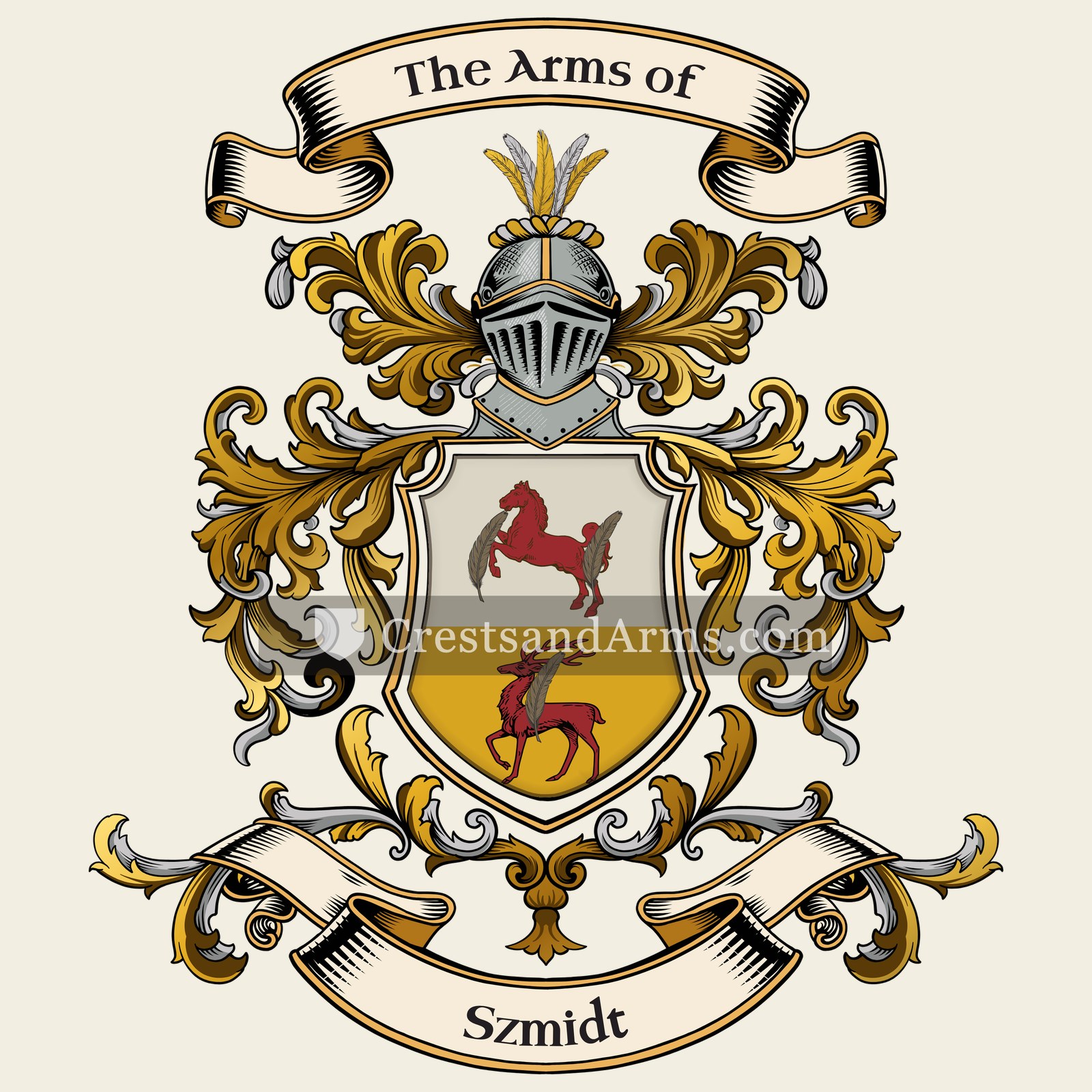
feathersWilling obedience and serenity
horseReadiness to serve king and country
stagPeace and harmony, and one who will not fight unprovoked
Colours
Silver (Argent)Means: Peace and sincerity
Gold (Or)Means: Generosity
Red (Gules)Means: Military strength
Historical info
Source
J. B. Rietstap, Armorial Général, Gouda: G. B. van Goor Zonen, 1884–87
Blazon (the actual original written record)
“Coupé: au 1 d'arg. à un cheval galopant de gu.; au 2 parti: a. d'or à une demi-ramure de cerf de gu.; b. de gu. à un panache de trois plumes de paon au nat. Cq. cour. C.: le cheval, iss. L.: à dextre d'arg. et de gu., à sen. d'or et de gu.”
Germanyc. 1765
Digital archive packCoat of arms PNG, gold border print PDF, vector SVG and the certificate of authenticity. Sent to your email in minutes.
Map of Germany showing where the Szmidt arms are recorded
The Szmidt arms were recorded in Germany, c. 1765.
Arms such as these were typically recorded in Bavaria.
Bavaria was a country of old landed families and walled market towns. Estates passed down the same line for centuries, and both the landowners and the leading townsmen kept arms, which is why so many Bavarian names sit in the registers.
This is where the arms were entered in the register. Families often moved to other parts of the country, so the same name can turn up in more than one region.
The body that granted and recorded arms in Germany in this period.
Francis I, Holy Roman Emperor
Sovereign of the period
Francis I, Holy Roman Emperor
1745–1765
Reigning in Belgium when the Szmidt arms are first recorded.
How Arms Worked in Germany
In the Holy Roman Empire, coats of arms were often granted to individuals by the Emperor or his representatives. These arms were then passed down through the generations to all legitimate descendants of the original holder. Younger branches of a family usually kept the same shield design without needing to change it, as the arms belonged to the entire lineage.
Granting authority
The Holy Roman Emperor held the sole power to grant new coats of arms throughout his vast imperial territories.
How they got arms
Families typically obtained their coats of arms through a formal imperial grant or by proving their noble status to the authorities.
Where arms were recorded
These grants were officially recorded in the Imperial Chancery registers, which began keeping formal records of such honors during the Middle Ages.
The family's standing
Recorded among the armigerous families of Germany.
Origin & History of the Szmidt Family in Germany
The surname Szmidt is a variant of the German name Schmidt, which originated as an occupational title for a blacksmith. During the Middle Ages, metalworking was a vital trade in German-speaking regions, and those who mastered the forge were essential members of their communities. By the time your ancestors were documented in Bavaria in 1765, the name had become a well-established identifier for families involved in skilled labor or trade. Because Bavaria was a region defined by its strong guild systems and agricultural traditions, families carrying this name often held stable positions within their local villages. The spelling variation you possess likely reflects the regional linguistic influences or the specific clerical habits of the Bavarian parish record keepers during the eighteenth century. This name serves as a direct link to a time when a person’s surname was a clear reflection of their daily work and their contribution to the local economy.
Related Branches & Arms
Root word
Smid
A person who works with metal or a blacksmith.
This name
SzmidtAn occupational surname for a blacksmith or metalworker originating from Germanic linguistic roots.
also spelled
Schmidt
Smit
Smith
Documented Sources
J. B. Rietstap, Armorial Général, Gouda: G. B. van Goor Zonen, 1884–87
Debrabandere, Frans. Woordenboek van de familienamen in België en Noord-Frankrijk. 2003
State Archives in Belgium (Rijksarchief), Parochieregisters (Dopen, Trouwen, Begraven)
Digital archive packCoat of arms PNG, gold border print PDF, vector SVG and the certificate of authenticity. Sent to your email in minutes.


 anchorHope, and steadfastness in trouble
 mulletThe third son, and a divine quality from above
 anchorHope, and steadfastness in trouble
 mulletThe third son, and a divine quality from above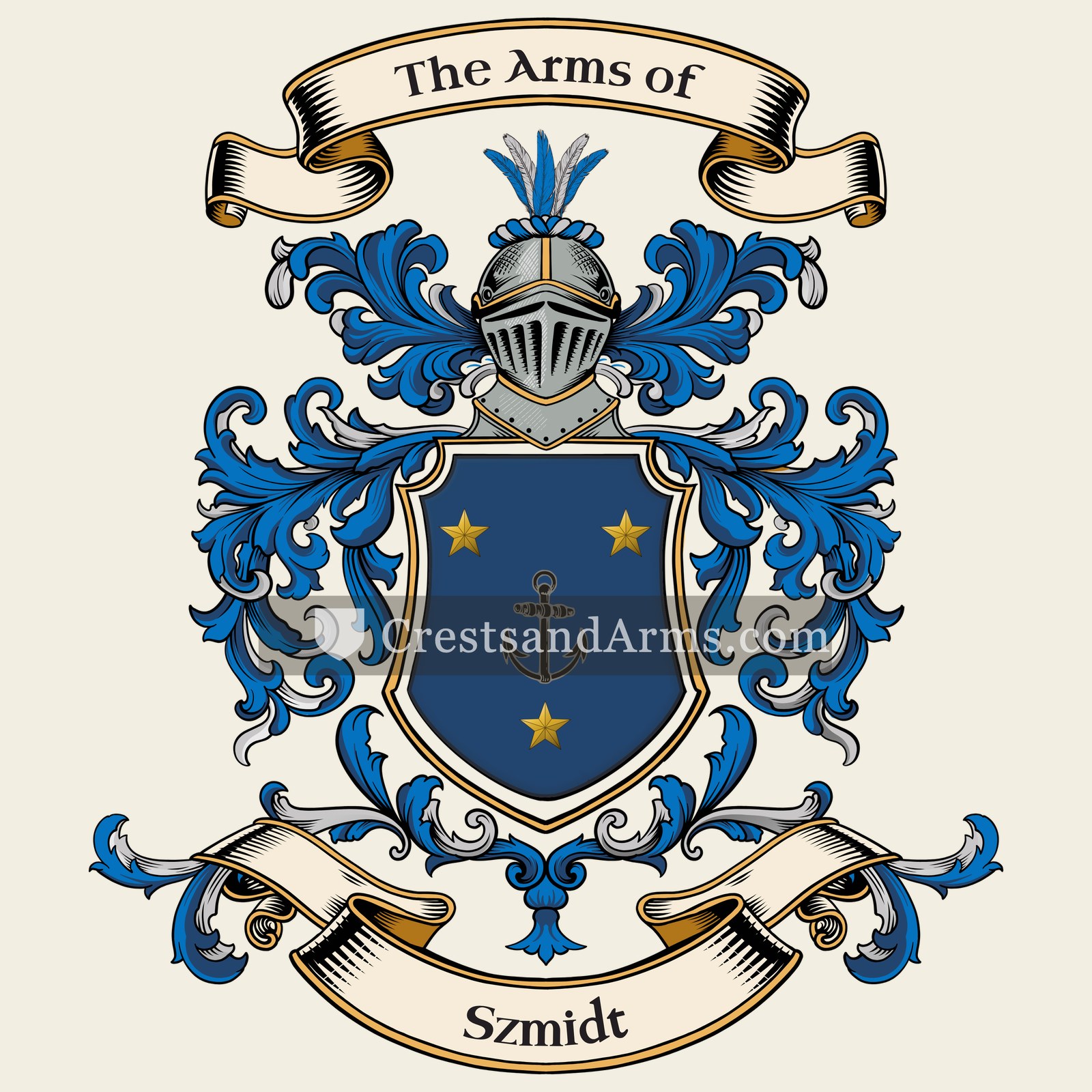


 feathersWilling obedience and serenity
 horseReadiness to serve king and country
 stagPeace and harmony, and one who will not fight unprovoked