Map of Britain showing where the Tailor arms are recorded
The Tailor arms were recorded in Kent, c. 1700.
Kent sits between London and the short crossing to Europe, and the trade passing through made it wealthy. Merchant families bought land with that money, and it was landowners who took coats of arms.
This is where the arms were entered in the register. Families often moved to other parts of the country, so the same name can turn up in more than one region.
The body that granted and recorded arms in Britain in this period.
William III of England
Sovereign of the period
William III of England
1694–1702
Reigning in Britain when the Tailor arms are first recorded.
How Arms Worked in Britain
English heraldry allowed arms to be shared by all legitimate descendants of the original owner. These symbols were treated as personal property that moved through the generations to all children. While the eldest son kept the original design, other family members could use the same shield without needing to change it or register their own unique versions.
Granting authority
The College of Arms in London has regulated the use of coats of arms throughout England and Wales since 1484.
How they got arms
Families typically obtained their coats of arms through a formal grant from the Crown or by proving their ancient right to them.
Where arms were recorded
All official coats of arms are recorded in the registers kept at the College of Arms, which date back to the fifteenth century.
The family's standing
Recorded among the armigerous families of Kent.
Origin & History of the Tailor Family in Britain
The surname Tailor is an occupational name that originated from the Old French word *tailleur*, which means a cutter of cloth. During the medieval period, people often adopted surnames based on the work they performed to help distinguish individuals within growing communities. By the time your ancestors were documented in Kent in the early 1700s, the name had already been established in England for several centuries. Families with this name were typically involved in the essential trade of tailoring, which required precision and skill to create garments for the local population. Because clothing was a vital necessity, tailors were respected figures who often held stable positions in village life. As these families moved through the English countryside, they helped preserve the craft of garment making across generations, eventually settling into the specific records of Kent that track your family history today.
Tailor Meaning & Related Branches
Root word
taillour
Old French term for a cutter of cloth.
This name
TailorAn occupational surname for a person who made or repaired clothing.
also spelled
Tayler
Tailor
Taylour
Documented Sources
J. B. Rietstap, Armorial Général, Gouda: G. B. van Goor Zonen, 1884–87
Reaney, P.H., A Dictionary of English Surnames, 1958
Lower, Mark Antony, Patronymica Britannica: A Dictionary of the Family Names of the United Kingdom, 1860
Kent Archives, Quarter Sessions Records, Q/S
Digital archive packCoat of arms PNG, gold border print PDF, vector SVG and the certificate of authenticity. Sent to your email in minutes.


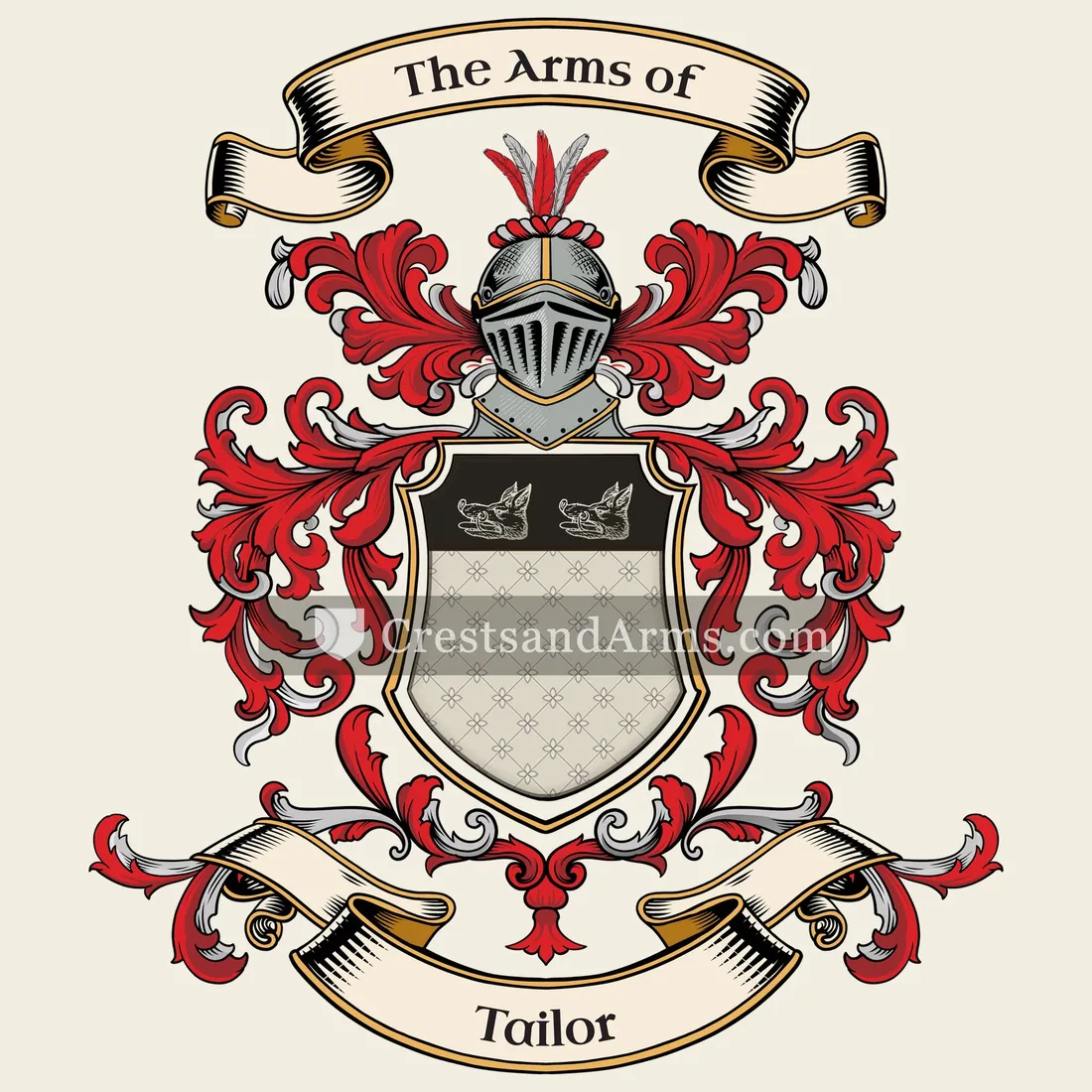
 chiefAuthority, wisdom and dominion
 boars headA fierce fighter who battles to the end
 chiefAuthority, wisdom and dominion
 boars headA fierce fighter who battles to the end