Map of Netherlands showing where the Tall arms are recorded
The Tall arms were recorded in Delft, c. 1815.
This is where the arms were entered in the register. Families often moved to other parts of the country, so the same name can turn up in more than one region.
Region
Delft
Town
Delft
First recorded
1815
Granting Authority for the Tall Arms
Hoge Raad van Adel
Photograph made by me · CC BY-SA 3.0
The body that granted and recorded arms in Netherlands in this period.
William I of the Netherlands
Sovereign of the period
William I of the Netherlands
1815–1840
Reigning in Netherlands when the Tall arms are first recorded.
How Arms Worked in Netherlands
In the Netherlands, coats of arms were often used by noble families and those who held specific public offices. These arms were passed down through the generations to legitimate descendants. Younger branches of a family usually kept the original design without needing to add special marks. This system ensured that the family identity remained clear and consistent over many years.
Granting authority
The Hoge Raad van Adel is the official body that regulates and manages noble titles and coats of arms in the Netherlands.
How they got arms
Families typically obtained their coats of arms through official royal grants or by proving their long-standing historical use of the symbols.
Where arms were recorded
Coats of arms are officially recorded in the registers held by the Hoge Raad van Adel, which began its work in 1814.
The family's standing
Recorded among the armigerous families of Netherlands.
Origin & History of the Tall Family in Netherlands
The surname Tall carries a rich history rooted in the cultural landscape of the Netherlands. By the early 19th century, members of the family were firmly established in the historic city of Delft. During this period, Delft was a center of craftsmanship and trade, providing a stable environment for families to grow and contribute to the local economy. The name itself likely originated as a descriptive nickname, as was common during the time when surnames were first becoming permanent. In many Germanic and Dutch dialects, such names often highlighted a physical trait or a specific characteristic of an ancestor. As the family lived in Delft in 1815, they were part of a society transitioning through significant political changes following the Napoleonic era. This era encouraged the formal registration of family names, helping to solidify the identity of the Tall lineage within the Dutch records.
Tall Meaning & Related Branches
Root word
tal
A Germanic term referring to a valley or low-lying land.
This name
TallA topographic descriptor for someone who lived in or near a valley.
also spelled
Tal
Taal
Talle
Tall
Documented Sources
J. B. Rietstap, Armorial Général, Gouda: G. B. van Goor Zonen, 1884–87


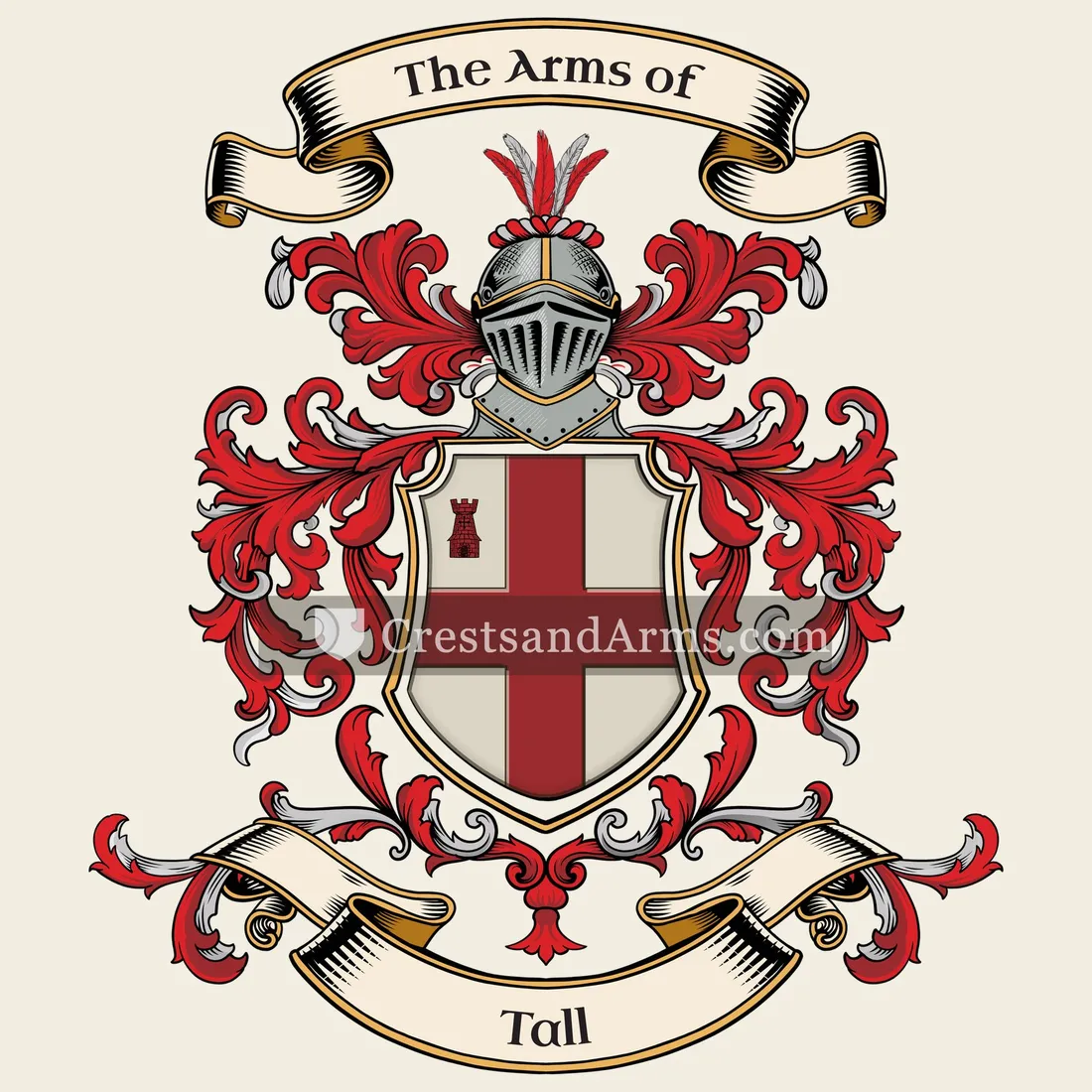
 cross symbolChristian faith and service
 towerGrandeur and solidity, and a stronghold defended
 cross symbolChristian faith and service
 towerGrandeur and solidity, and a stronghold defended