Map of France showing where the Tarazona arms are recorded
The Tarazona arms were recorded in Ile-de-France, c. 1663.
Ile-de-France is the country around Paris, and proximity to the court mattered. Families who served the crown were rewarded with land near it, and land near the capital carried arms almost as a matter of course.
This is where the arms were entered in the register. Families often moved to other parts of the country, so the same name can turn up in more than one region.
The body that granted and recorded arms in France in this period.
Louis XIV of France
Sovereign of the period
Louis XIV of France
1643–1715
Reigning in France when the Tarazona arms are first recorded.
How Arms Worked in France
In France, a coat of arms was a mark of honor that passed down through the male line to all legitimate descendants. Families often used the same shield without changes to show their shared heritage. If a branch wanted to stand out, they could add a small mark to their shield to show their specific place in the family tree.
Granting authority
The Juge d'armes de France acted as the official authority that regulated and verified coats of arms across the country.
How they got arms
Families typically inherited their arms from ancestors, though they could also receive them through royal grants or by proving their noble status.
Where arms were recorded
Coats of arms were officially recorded in the Armorial Général de France, which began its main collection in the year 1696.
The family's standing
Recorded among the armigerous families of Ile-de-France.
Origin & History of the Tarazona Family in France
The surname Tarazona originates from the ancient city of the same name located in the Aragon region of Spain. While the name is deeply rooted in Iberian geography, historical records confirm that members of the family had established a presence in the Ile-de-France region by 1663. During the seventeenth century, the movement of families across European borders was often driven by trade, military service, or the shifting political alliances of the era. The presence of the Tarazona name in France during this period suggests that the family was part of a broader network of migration that linked the Spanish kingdoms with the French royal territories. By settling in the heart of France, these early ancestors integrated into a new cultural landscape while maintaining a name that served as a direct link to their ancestral origins in the foothills of the Moncayo mountains.
Related Branches & Arms
Root word
Taraso
A pre-Roman or Iberian term likely referring to a rocky hill.
This name
TarazonaA habitational surname originating from the town of Tarazona in Spain.
also spelled
Tarragone
Tarragoni
Tarragona
Documented Sources
J. B. Rietstap, Armorial Général, Gouda: G. B. van Goor Zonen, 1884–87
Archives nationales de France, Minutier central des notaires de Paris
Archivo Histórico Nacional, Sección Nobleza
Moll, Francesc de Borja, Els llinatges catalans: Catalunya, País Valencià i les Illes, 1959
Pescador del Hoyo, María del Carmen, La población de Tarazona en el siglo XVI, 1976
Digital archive packCoat of arms PNG, gold border print PDF, vector SVG and the certificate of authenticity. Sent to your email in minutes.


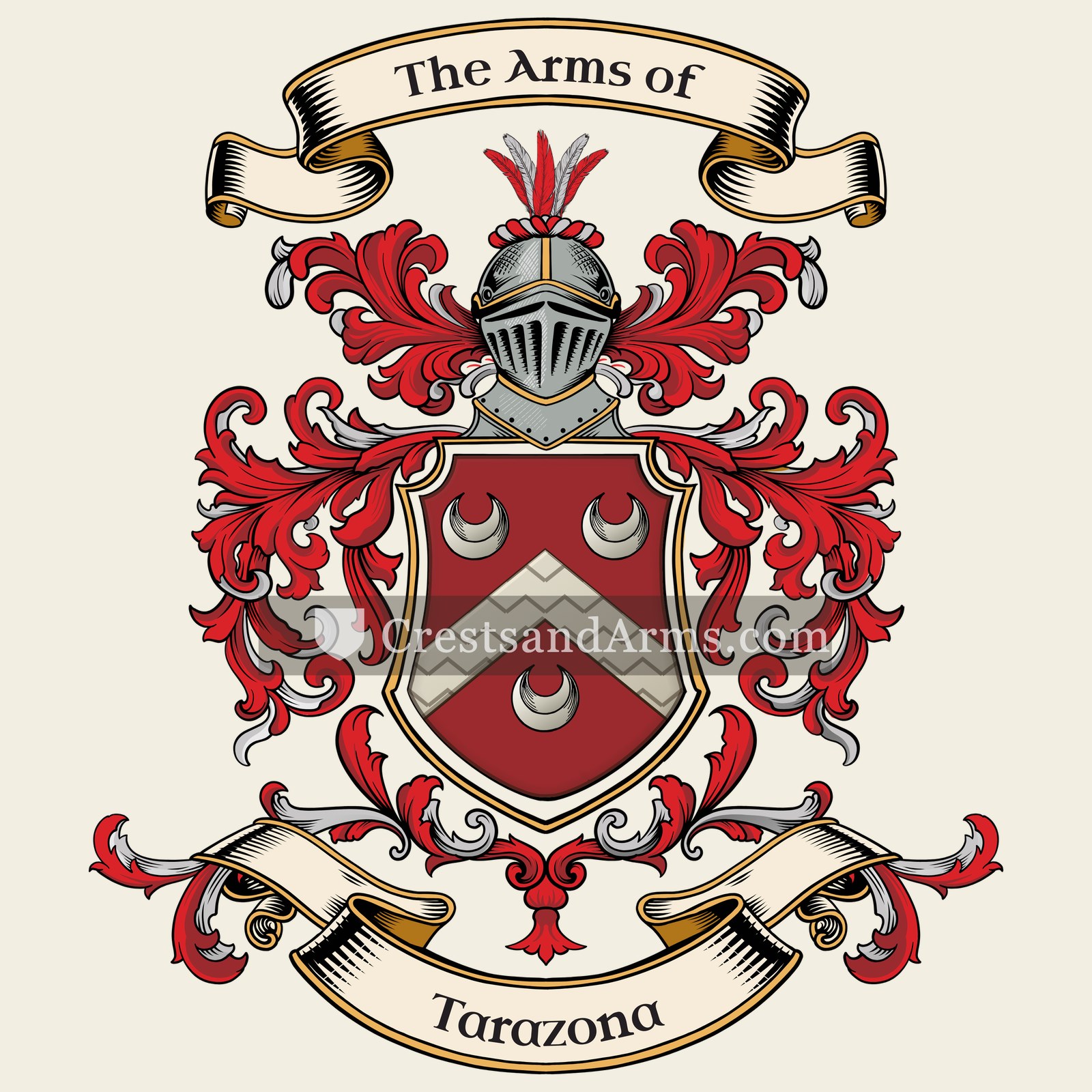
 chevronProtection, and faithful service completed
 crescentHonour by the sovereign, and the second son
 chevronProtection, and faithful service completed
 crescentHonour by the sovereign, and the second son