Map of Switzerland showing where the Tardy arms are recorded
The Tardy arms were recorded in Fribourg, c. 1745.
This is where the arms were entered in the register. Families often moved to other parts of the country, so the same name can turn up in more than one region.
The body that granted and recorded arms in Switzerland in this period.
How Arms Worked in Switzerland
In Switzerland, coats of arms were not restricted to the nobility and were often adopted by common citizens and families. These symbols were passed down through generations to show family identity. When branches of a family grew, they often changed small details of the design to distinguish their own line from the original group.
Granting authority
Cantonal and civic authorities managed the use of coats of arms within their specific regions and local jurisdictions.
How they got arms
Families typically assumed their own coats of arms based on local custom rather than receiving them from a central monarch.
Where arms were recorded
Arms were recorded in various cantonal and civic registers starting from the fourteenth century throughout the Swiss region.
The family's standing
Recorded among the armigerous families of Switzerland.
Origin & History of the Tardy Family in Switzerland
The Tardy family name has deep roots in the Swiss canton of Fribourg, where records confirm their presence as early as 1745. During this period, the region was characterized by a mix of agricultural traditions and a growing influence from the Catholic Church, which played a central role in documenting the lives of local families. The name itself likely originated from a descriptive nickname, as the word "tardy" shares linguistic ties to terms meaning slow or late, which may have been used to identify a specific ancestor in a small village setting. As the family established themselves in Fribourg, they became part of the local social fabric, likely working in trades or farming that supported the economy of the Swiss plateau. By the mid-18th century, the Tardy family was well-integrated into the civic life of the region, participating in the parish systems that served as the primary method for tracking births, marriages, and deaths in pre-industrial Switzerland.
Meaning of the Tardy family crest colors & symbols
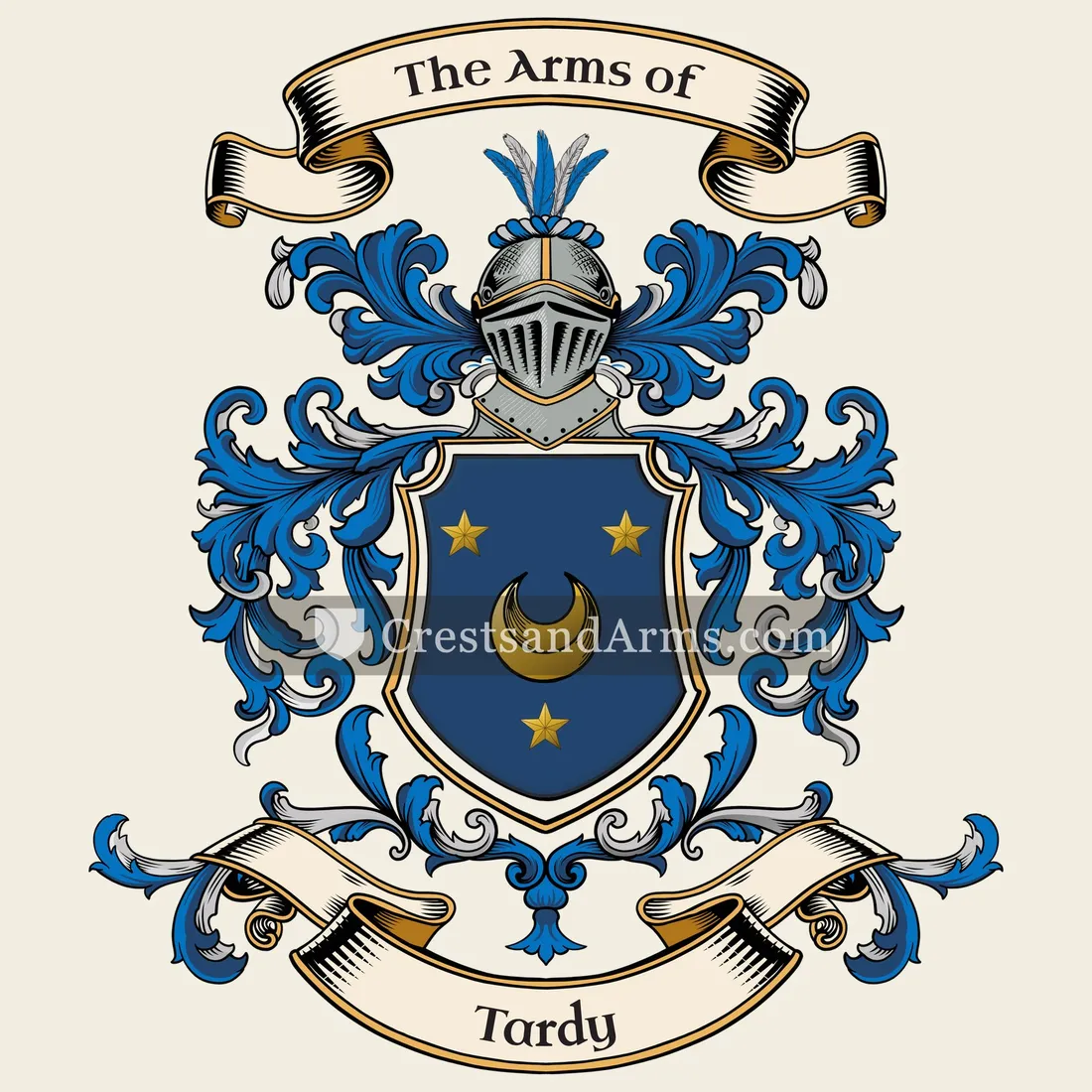
Symbols on this shield
crescentHonour by the sovereign, and the second son
mulletThe third son, and a divine quality from above
Colours
Blue (Azure)Means: Loyalty and truth
Gold (Or)Means: Generosity
Historical info
Source
J. B. Rietstap, Armorial Général, Gouda: G. B. van Goor Zonen, 1884–87
Blazon (the actual original written record)
“D'azur à un croiss. d'or, acc. de trois étoiles du même.”
ForezForez, c. 1663
Digital archive packCoat of arms PNG, gold border print PDF, vector SVG and the certificate of authenticity. Sent to your email in minutes.
Map of France showing where the Tardy arms are recorded
The Tardy arms were recorded in Forez, c. 1663.
Forez was a small upland county in central France, thick with minor gentry holding modest estates. Its families were more numerous than wealthy, and even a small holding was enough for a shield of one's own.
This is where the arms were entered in the register. Families often moved to other parts of the country, so the same name can turn up in more than one region.
The body that granted and recorded arms in France in this period.
Louis XIV of France
Sovereign of the period
Louis XIV of France
1643–1715
Reigning in Switzerland when the Tardy arms are first recorded.
How Arms Worked in France
In France, a coat of arms was a mark of honor that passed down through the male line to all legitimate descendants. Families often used the same shield without changes to show their shared heritage. If a branch wanted to stand out, they could add a small mark to their shield to show their specific place in the family tree.
Granting authority
The Juge d'armes de France acted as the official authority that regulated and verified coats of arms across the country.
How they got arms
Families typically inherited their arms from ancestors, though they could also receive them through royal grants or by proving their noble status.
Where arms were recorded
Coats of arms were officially recorded in the Armorial Général de France, which began its main collection in the year 1696.
The family's standing
Recorded among the armigerous families of Forez.
Origin & History of the Tardy Family in France
The Tardy family name has deep roots in the historical province of Forez, located in east-central France. By the year 1663, records confirm that members of the family were well-established in this region, which was known for its rugged landscape and strong agricultural traditions. The name itself is thought to have originated as a descriptive nickname, likely referring to someone who was slow-moving or perhaps someone who arrived late to a specific event or task. In the social structure of seventeenth-century France, such surnames often began as informal labels used by neighbors to distinguish between different people in a village. As the family grew, they became integrated into the local community life of Forez, participating in the rural economy and the evolving social systems of the Ancien Régime. Their presence in this specific area suggests a long history of stability and connection to the land that defined the region during the early modern period.
Tardy Meaning & Related Branches
Root word
tardus
Latin adjective meaning slow, sluggish, or late.
This name
TardyA nickname for a person who was habitually slow, late, or deliberate in their actions.
also spelled
Tardie
Tardis
Tardey
Related arms
Haslersimilar arms
von Scriversimilar arms
Tardieuvariant spelling
Documented Sources
J. B. Rietstap, Armorial Général, Gouda: G. B. van Goor Zonen, 1884–87
Archives de l'État de Fribourg, Registres paroissiaux de la ville de Fribourg
Archives de l'État de Fribourg, Fonds de la bourgeoisie de Fribourg
Godet, Marcel, Dictionnaire historique et biographique de la Suisse, 1933
Dubler, Anne-Marie, Histoire du canton de Fribourg, 1981
Digital archive packCoat of arms PNG, gold border print PDF, vector SVG and the certificate of authenticity. Sent to your email in minutes.


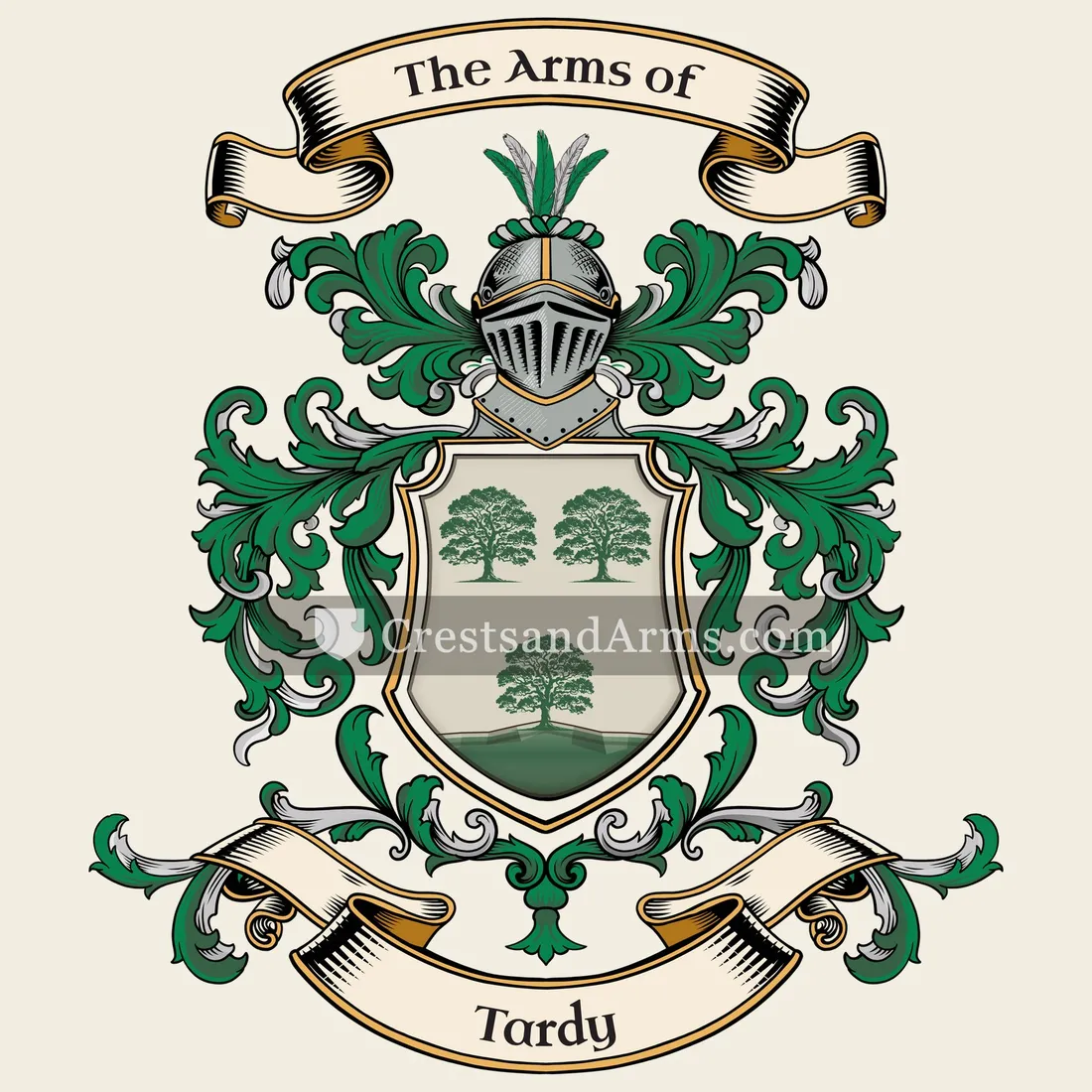
 mountThe ground held, and steadfastness upon it
 treeLife, endurance and deep roots
 mountThe ground held, and steadfastness upon it
 treeLife, endurance and deep roots

 crescentHonour by the sovereign, and the second son
 mulletThe third son, and a divine quality from above