A record of documented arms, meaning and origin, researched for the Tarleton family lines. Documented in 2 countries.
Reg. 6776 · Britain, T–V
Coat of Arms & Family Crest Details
Symbols on this shield
chevronProtection, and faithful service completed
ermineDignity and rank
cinquefoilHope and joy
Colours
Red (Gules)Means: Military strength
Gold (Or)Means: Generosity
Black (Sable)Means: Constancy
Historical info
Source
J. B. Rietstap, Armorial Général, Gouda: G. B. van Goor Zonen, 1884–87
Blazon (the actual original written record)
“De gu. au chev. d'or, semé de mouch. d'herm. de sa. et acc. de trois quintefeuilles d'or. Cq. timbré d'une couronne murale de gu., ch. d'une tête de léopard d'or. C.: deux pl. d'aut. d'arg.”
Britainc. 1818
Digital archive packCoat of arms PNG, gold border print PDF, vector SVG and the certificate of authenticity. Sent to your email in minutes.
Map of Britain showing where the Tarleton arms are recorded
The Tarleton arms were recorded in Britain, c. 1818.
Arms such as these were typically recorded in Kent.
Kent sits between London and the short crossing to Europe, and the trade passing through made it wealthy. Merchant families bought land with that money, and it was landowners who took coats of arms.
This is where the arms were entered in the register. Families often moved to other parts of the country, so the same name can turn up in more than one region.
The body that granted and recorded arms in Britain in this period.
George III of Great Britain
Sovereign of the period
George III of Great Britain
1801–1820
Reigning in Britain when the Tarleton arms are first recorded.
How Arms Worked in Britain
English heraldry allowed arms to be shared by all legitimate descendants of the original owner. These symbols were treated as personal property that moved through the generations to all children. While the eldest son kept the original design, other family members could use the same shield without needing to change it or register their own unique versions.
Granting authority
The College of Arms in London has regulated the use of coats of arms throughout England and Wales since 1484.
How they got arms
Families typically obtained their coats of arms through a formal grant from the Crown or by proving their ancient right to them.
Where arms were recorded
All official coats of arms are recorded in the registers kept at the College of Arms, which date back to the fifteenth century.
The family's standing
Recorded among the armigerous families of Britain.
Origin & History of the Tarleton Family in Britain
The surname Tarleton is a locative name, meaning it originated from a specific place in England rather than from a trade or a personal nickname. Etymologically, the name is derived from Old English roots, likely referring to a farm or settlement belonging to a person named Tarla. While the family established a notable presence in Kent by 1818, the name itself traces its deepest roots to the northern regions of England, particularly Lancashire, where the village of Tarleton served as the ancestral seat for the earliest bearers of the name. Over several centuries, members of the family migrated across the British Isles for various reasons, including shifts in agricultural labor, trade opportunities, and the expansion of urban centers. By the time the family appeared in Kentish records during the early nineteenth century, they were part of a long tradition of families moving to follow the economic growth of the era. This movement reflects the broader patterns of internal migration that helped shape the distribution of English surnames throughout history.
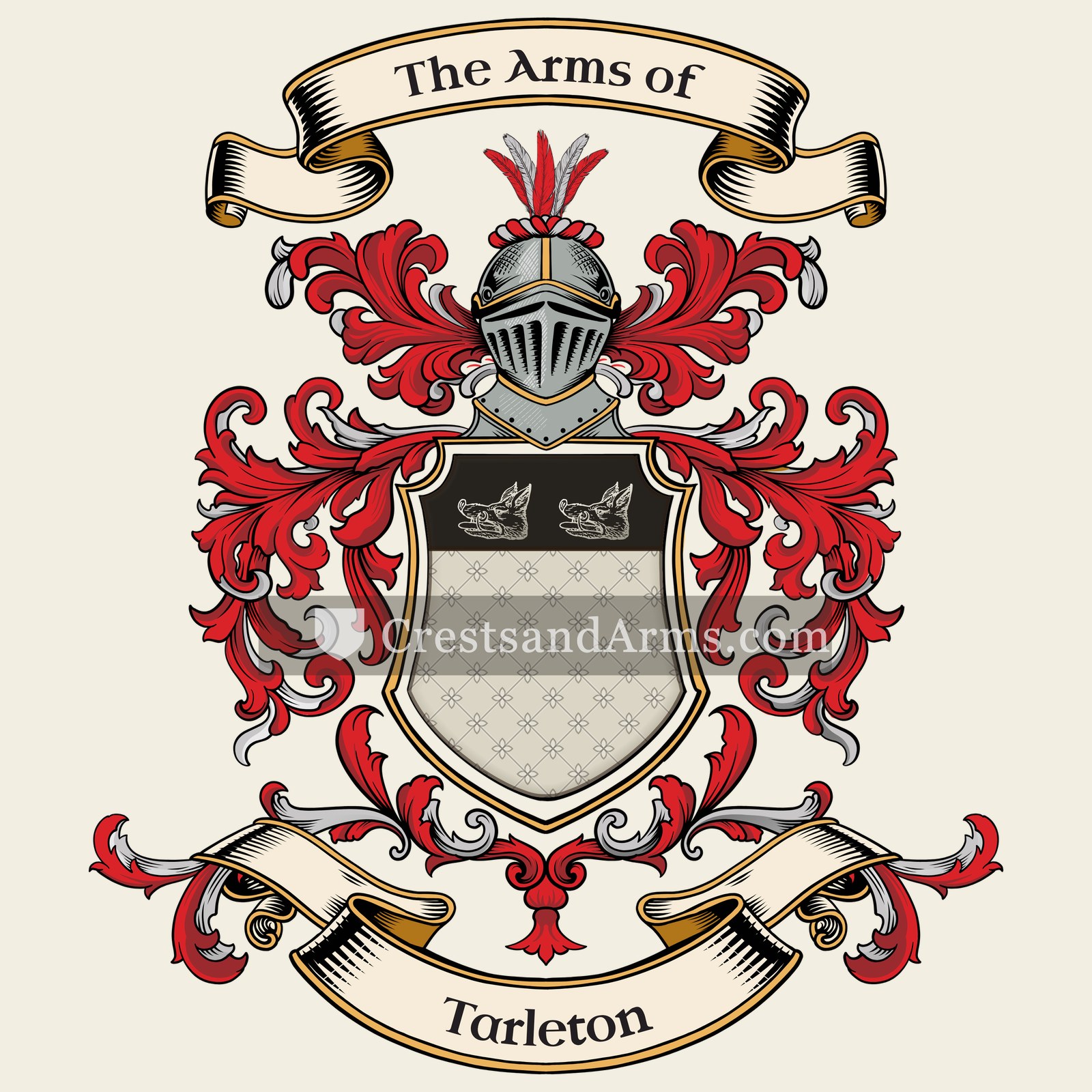
Coat of Arms & Family Crest Details
Symbols on this shield
chiefAuthority, wisdom and dominion
boars headA fierce fighter who battles to the end
Colours
Silver (Argent)Means: Peace and sincerity
Black (Sable)Means: Constancy
Historical info
Source
Sir Bernard Burke, The General Armory of England, Scotland, Ireland and Wales, London: Harrison & Sons, 1884
Blazon (the actual original written record)
“Ar. on a chief sa. two boars' heads couped of the first”
KentPark House · Kent, c. 1665
Digital archive packCoat of arms PNG, gold border print PDF, vector SVG and the certificate of authenticity. Sent to your email in minutes.
Map of England showing where the Tarleton arms are recorded
The Tarleton arms were recorded in Kent, c. 1665.
Kent sits between London and the short crossing to Europe, and the trade passing through made it wealthy. Merchant families bought land with that money, and it was landowners who took coats of arms.
This is where the arms were entered in the register. Families often moved to other parts of the country, so the same name can turn up in more than one region.
The body that granted and recorded arms in England in this period.
Charles II of England
Sovereign of the period
Charles II of England
1660–1685
Reigning in Britain when the Tarleton arms are first recorded.
How Arms Worked in England
English heraldry allowed arms to be shared by all legitimate descendants of the original owner. These symbols were treated as personal property that moved through the generations to all children. While the eldest son kept the original design, other family members could use the same shield without needing to change it or register their own unique versions.
Granting authority
The College of Arms in London has regulated the use of coats of arms throughout England and Wales since 1484.
How they got arms
Families typically obtained their coats of arms through a formal grant from the Crown or by proving their ancient right to them.
Where arms were recorded
All official coats of arms are recorded in the registers kept at the College of Arms, which date back to the fifteenth century.
The family's standing
Recorded among the armigerous families of Kent.
Origin & History of the Tarleton Family in England
The surname Tarleton is a locative name, meaning it originated from a specific place rather than a trade or a personal characteristic. Etymologists believe the name derives from the Old English words for a farm or settlement belonging to a man named Tarl. While the family name is most famously associated with the county of Lancashire in the north of England, where a village named Tarleton has existed since the medieval period, members of the family migrated across the country over the centuries. By the year 1665, historical records confirm that the Tarleton family had established a presence in the county of Kent. This migration was common during the seventeenth century as families moved to follow new economic opportunities or to settle in the growing trade hubs of southern England. The name serves as a linguistic bridge to the early agrarian society of Britain, marking the transition from families being identified by their local village to carrying that identity as a permanent surname across different regions.
Related Branches & Arms
Root word
Thorleif
Derived from Old Norse elements meaning Thor and descendant or heir.
This name
TarletonA locational surname originating from a settlement in Lancashire meaning Thor's farm or estate.
also spelled
Tarletone
Tarltone
Tarletoni
Tarletonne
Related arms
Taylorsame arms
Bestrecorded with Tarleton, same area
D'Amery, or Aumaryrecorded with Tarleton, same area
Lushingtonrecorded with Tarleton, same area
Documented Sources
J. B. Rietstap, Armorial Général, Gouda: G. B. van Goor Zonen, 1884–87
Bardsley, Charles Wareing, A Dictionary of English and Welsh Surnames, 1901
Ekwall, Eilert, The Concise Oxford Dictionary of English Place-names, 1936
Reaney, Percy Hide, A Dictionary of British Surnames, 1958
The National Archives, Census Returns of England and Wales, 1841
Kent Archives and Local History Service, Parish Registers of Kent, 1818
Digital archive packCoat of arms PNG, gold border print PDF, vector SVG and the certificate of authenticity. Sent to your email in minutes.


 chevronProtection, and faithful service completed
 ermineDignity and rank
 cinquefoilHope and joy
 chevronProtection, and faithful service completed
 ermineDignity and rank
 cinquefoilHope and joy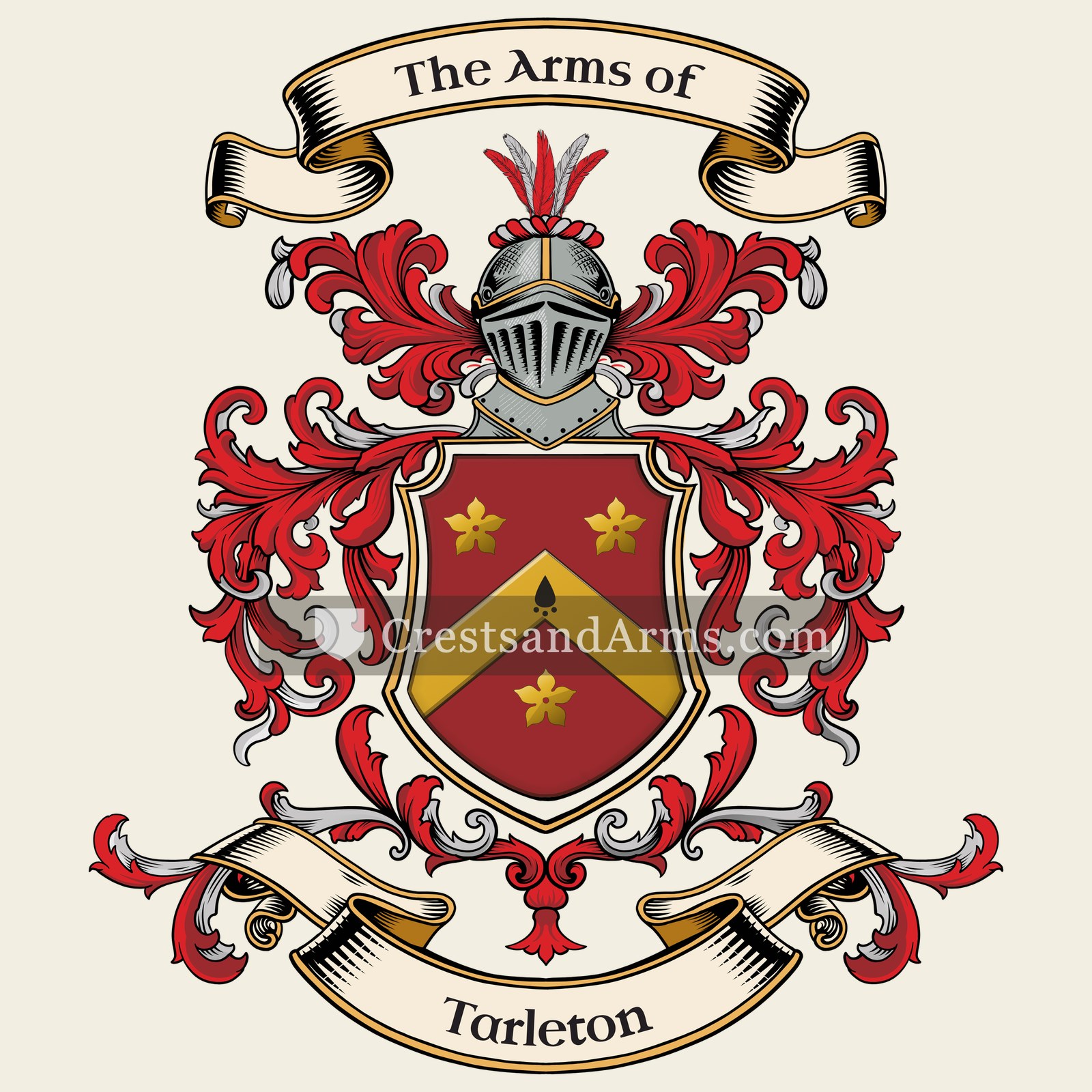


 chiefAuthority, wisdom and dominion
 boars headA fierce fighter who battles to the end