Map of Austria showing where the Taube arms are recorded
The Taube arms were recorded in Austria, c. 1772.
Arms such as these were typically recorded in Tyrol.
Tyrol was mountain country in western Austria, where the valleys were held by families who had been there a very long time. Old tenure counted for more than money, and old families carried arms.
This is where the arms were entered in the register. Families often moved to other parts of the country, so the same name can turn up in more than one region.
Region
Tyrol
First recorded
1772
Granting Authority for the Taube Arms
Imperial and Royal chancery
Sodacan · CC BY-SA 3.0
The body that granted and recorded arms in Austria in this period.
Joseph II, Holy Roman Emperor
Sovereign of the period
Joseph II, Holy Roman Emperor
1765–1790
Reigning in Austria when the Taube arms are first recorded.
How Arms Worked in Austria
Austrian coats of arms were often linked directly to noble titles granted by the Emperor. These symbols belonged to the entire family line rather than just one individual. When a family grew, new branches kept the original design without needing to change it. This system allowed all members of a noble house to share the same identity across many generations.
Granting authority
The Imperial and Royal chancery managed all heraldic matters and controlled the official granting of arms throughout the Austrian lands.
How they got arms
Families typically received their arms through a formal imperial decree that often accompanied the elevation of a person to noble status.
Where arms were recorded
Official records of these grants were kept in the Imperial Register of Nobility which began its formal documentation process in 1453.
The family's standing
Recorded among the armigerous families of Austria.
Origin & History of the Taube Family in Austria
The family name Taube, which translates to dove in German, has deep roots in the Alpine regions of Central Europe. By the year 1772, records confirm that members of the Taube family were firmly established in the province of Tyrol. During this period, Tyrol served as a vital crossroads for trade and migration within the Habsburg Monarchy. Families with this surname often lived in mountain valleys where they worked as skilled craftsmen or local administrators. Because the name is derived from a common bird, it likely originated as a nickname for a person with a gentle personality or perhaps someone who lived near a landmark associated with the bird. As the family grew, they integrated into the social fabric of the Austrian landscape, contributing to the local community life that defined the rural culture of the eighteenth century.
Meaning of the Taube family crest colors & symbols
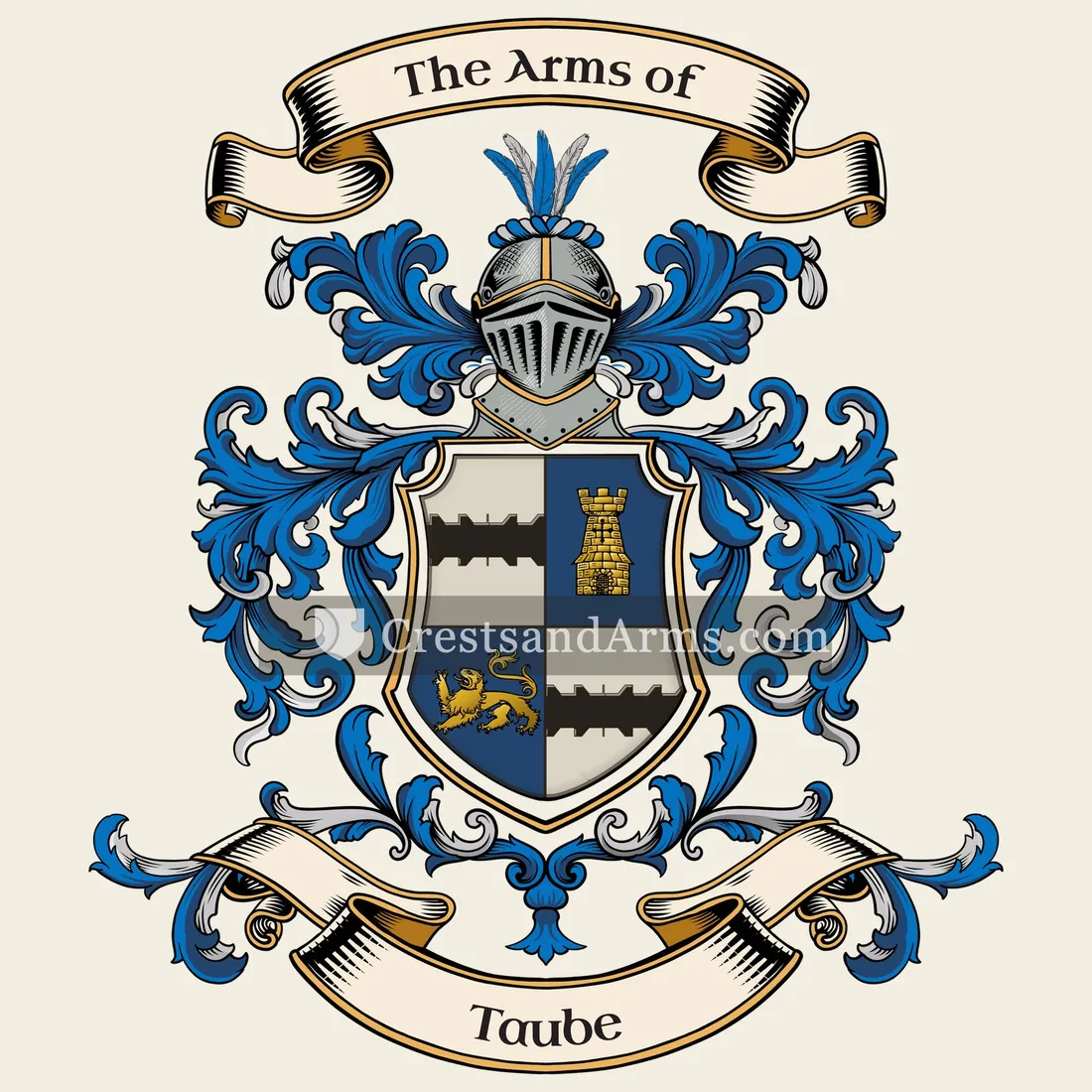
Symbols on this shield
fessThe military belt, and readiness to serve
towerGrandeur and solidity, and a stronghold defended
lionCourage, strength and royalty
Colours
Silver (Argent)Means: Peace and sincerity
Blue (Azure)Means: Loyalty and truth
Gold (Or)Means: Generosity
Historical info
Source
J. B. Rietstap, Armorial Général, Gouda: G. B. van Goor Zonen, 1884–87
Blazon (the actual original written record)
“Ec.: aux 1 et 4 d'arg. à la fasce crén. de sa.; au 2 d'azur à une tour d'or, sommée d'un lion iss. du même, tenant un rameau de laurier de sin.; au 3 d'azur au lion d'or, lamp. de gu., tenant de ses pattes uue hache d'arg. au manche arrondi d'or. Sur le tout d'or à un tronc d'arbre arr. au nat., feuillé de deux pièces de sin., à dextre et à sen. Deux cq. cour. C.: 1° une queue de paon au nat., accostée de deux troncs d'arbre au nat., feuillés chacun d'une seule pièce de sin. à l'ext.; 2° une masse à picotons d'arg. en pal, entre six banderoles d'azur à la croix d'or.”
Swedenc. 1698
Digital archive packCoat of arms PNG, gold border print PDF, vector SVG and the certificate of authenticity. Sent to your email in minutes.
Map of Sweden showing where the Taube arms are recorded
The Taube arms were recorded in Sweden, c. 1698.
Arms such as these were typically recorded in Stockholm.
Stockholm held the Swedish court and the House of Nobility, where every noble family's arms were entered and kept. Families ennobled for service registered there, which is why so many are recorded around the city.
This is where the arms were entered in the register. Families often moved to other parts of the country, so the same name can turn up in more than one region.
The body that granted and recorded arms in Sweden in this period.
Carl XII of Sweden
Sovereign of the period
Carl XII of Sweden
1697–1718
Reigning in Austria when the Taube arms are first recorded.
How Arms Worked in Sweden
In Sweden, a coat of arms belonged to a noble family as a whole rather than just one individual. These arms were passed down through the generations to all legitimate descendants. Younger branches of the family used the same shield without needing to change it. This system ensured that the entire lineage shared the same identity and status under the law.
Granting authority
The Riddarhuset, or House of Nobility, regulated all noble coats of arms in Sweden under royal authority.
How they got arms
Families received their coats of arms through royal grants of nobility which were then officially registered with the House.
Where arms were recorded
Coats of arms were officially recorded in the Swedish House of Nobility register starting in the year 1626.
The family's standing
Recorded among the armigerous families of Sweden.
Origin & History of the Taube Family in Sweden
The Taube family name has deep roots in the history of Sweden, where it became a prominent noble house during the seventeenth century. While the family originated from German lands, they integrated quickly into the Swedish administration and military. By the year 1698, members of the family were well-established in Stockholm, holding influential positions within the royal court and the government. They were known for their service to the Swedish Crown, often acting as diplomats or high-ranking officers during an era when Sweden was a major power in Northern Europe. This period of history saw the family gain significant land and social status, allowing them to play a central role in the political life of the capital. Their presence in Stockholm at the end of the century reflects their successful transition from foreign origins to becoming a foundational part of the Swedish aristocracy.
Meaning of the Taube family crest colors & symbols
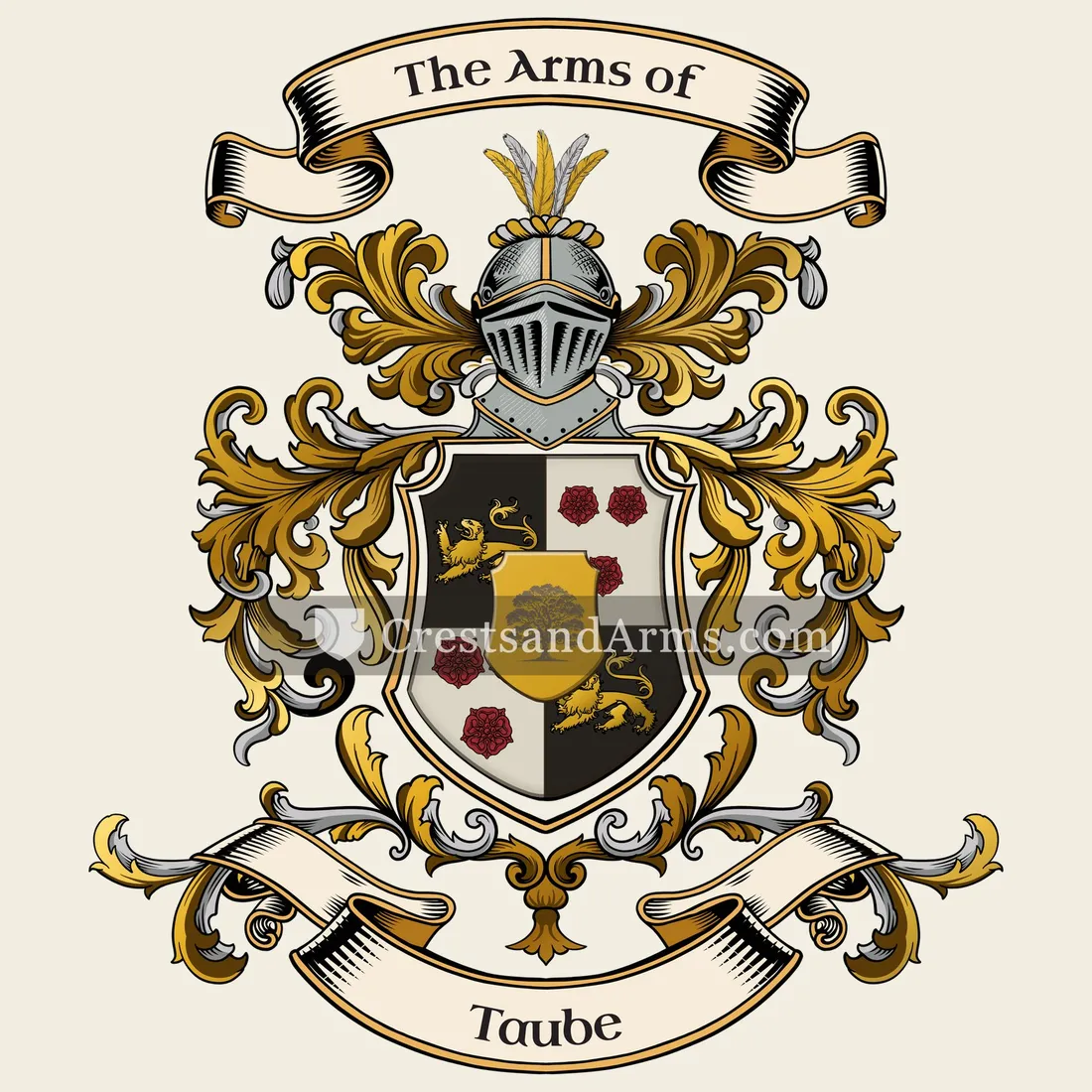
Symbols on this shield
treeLife, endurance and deep roots
lionCourage, strength and royalty
roseThe seventh son, and beauty with grace
Colours
Black (Sable)Means: Constancy
Silver (Argent)Means: Peace and sincerity
Gold (Or)Means: Generosity
Red (Gules)Means: Military strength
Historical info
Source
J. B. Rietstap, Armorial Général, Gouda: G. B. van Goor Zonen, 1884–87
Blazon (the actual original written record)
“Ec.: aux 1 et 4 de sa. au lion d'or, cour. du même; aux 2 et 3 d'arg. à trois roses de gu., bout. d'or. Sur le tout d'or à un tronc d'arbre coupé et arr. au nat., posé en pal, feuillé de chaque côté d'une seule pièce de sin. Deux cq. cour. C.: 1º une aigle de sa., cour. d'or; l. d'or et de sa.; 2º une queue de paon au nat., accostée et bordée de deux chicots au nat., poussant chacun à l'ext. une feuille de sin.; l. d'arg. et de gu.”
BavariaBavaria, c. 1765
Digital archive packCoat of arms PNG, gold border print PDF, vector SVG and the certificate of authenticity. Sent to your email in minutes.
Map of Germany showing where the Taube arms are recorded
The Taube arms were recorded in Bavaria, c. 1765.
Bavaria was a country of old landed families and walled market towns. Estates passed down the same line for centuries, and both the landowners and the leading townsmen kept arms, which is why so many Bavarian names sit in the registers.
This is where the arms were entered in the register. Families often moved to other parts of the country, so the same name can turn up in more than one region.
The body that granted and recorded arms in Germany in this period.
Francis I, Holy Roman Emperor
Sovereign of the period
Francis I, Holy Roman Emperor
1745–1765
Reigning in Austria when the Taube arms are first recorded.
How Arms Worked in Germany
In the Holy Roman Empire, coats of arms were often granted to individuals by the Emperor or his representatives. These arms were then passed down through the generations to all legitimate descendants of the original holder. Younger branches of a family usually kept the same shield design without needing to change it, as the arms belonged to the entire lineage.
Granting authority
The Holy Roman Emperor held the sole power to grant new coats of arms throughout his vast imperial territories.
How they got arms
Families typically obtained their coats of arms through a formal imperial grant or by proving their noble status to the authorities.
Where arms were recorded
These grants were officially recorded in the Imperial Chancery registers, which began keeping formal records of such honors during the Middle Ages.
The family's standing
Recorded among the armigerous families of Bavaria.
Origin & History of the Taube Family in Germany
The surname Taube is a German occupational and descriptive name that translates directly to the word dove. In the context of early German history, such names were often assigned to individuals based on their personality traits or their physical appearance. A person who was considered gentle, peaceful, or quiet might have been nicknamed Taube by their neighbors. By the time the family was firmly established in the Bavarian region in 1765, the name had become a permanent identifier passed down through generations. During this period, Bavaria was a hub of agricultural and trade activity, and families like the Taubes were often deeply connected to the local village life and the regional church records that tracked births and marriages. These early ancestors lived through a time of significant social change in the Holy Roman Empire, where the stability of a family name helped define one’s place within the local community and the broader German landscape.
Taube Meaning & Related Branches
Root word
Tuba
A Latin term referring to a trumpet or pipe instrument.
This name
TaubeDerived from the Middle High German word for a dove, often used as a nickname for a gentle person.
also spelled
Tauben
Tauber
Taub
Documented Sources
J. B. Rietstap, Armorial Général, Gouda: G. B. van Goor Zonen, 1884–87
Tiroler Landesarchiv, Tiroler Steuerkataster 1772
Kohl, Wilhelm, Die Familiennamen in Tirol, 1984
Heintze, Albert, Die deutschen Familiennamen: geschichtlich, geographisch, sprachlich, 1903
Digital archive packCoat of arms PNG, gold border print PDF, vector SVG and the certificate of authenticity. Sent to your email in minutes.


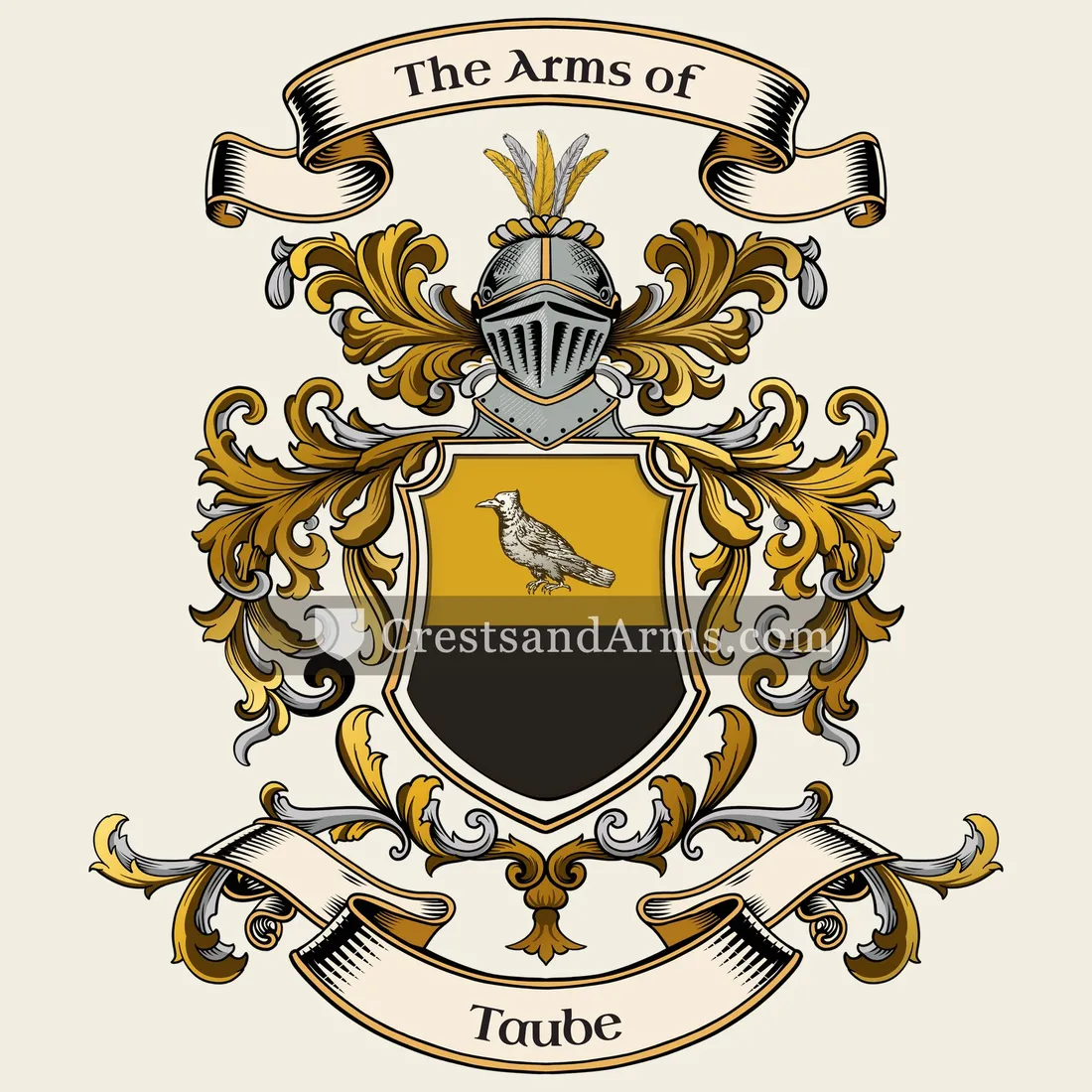
 dovePeace, love and the Holy Spirit
 dovePeace, love and the Holy Spirit


 fessThe military belt, and readiness to serve
 towerGrandeur and solidity, and a stronghold defended
 lionCourage, strength and royalty


 treeLife, endurance and deep roots
 roseThe seventh son, and beauty with grace