Map of England showing where the Taverner arms are recorded
The Taverner arms were recorded in Hertford, c. 1575.
Hertfordshire lay just north of London and filled with families who had made money in the City. Buying an estate within a day's ride was the usual next step, and an estate brought arms with it.
This is where the arms were entered in the register. Families often moved to other parts of the country, so the same name can turn up in more than one region.
The body that granted and recorded arms in England in this period.
Elizabeth I of England
Sovereign of the period
Elizabeth I of England
1558–1603
Reigning in England when the Taverner arms are first recorded.
How Arms Worked in England
English heraldry allowed arms to be shared by all legitimate descendants of the original owner. These symbols were treated as personal property that moved through the generations to all children. While the eldest son kept the original design, other family members could use the same shield without needing to change it or register their own unique versions.
Granting authority
The College of Arms in London has regulated the use of coats of arms throughout England and Wales since 1484.
How they got arms
Families typically obtained their coats of arms through a formal grant from the Crown or by proving their ancient right to them.
Where arms were recorded
All official coats of arms are recorded in the registers kept at the College of Arms, which date back to the fifteenth century.
The family's standing
Recorded among the armigerous families of Hertford.
Origin & History of the Taverner Family in England
The surname Taverner is an occupational name that originated in medieval England to describe a person who worked in or managed a tavern. During the Middle Ages, a taverner was responsible for selling wine and providing hospitality to travelers, making the role a vital part of local community life. By the time the family established a documented presence in Hertford in 1575, the name had transitioned from a simple job title into a hereditary surname passed down through generations. Families with this name were often integrated into the social and economic fabric of market towns, where their trade allowed them to interact with a wide variety of people. This historical connection to the hospitality industry reflects the importance of trade guilds and local commerce in shaping the identities of English families during the sixteenth century.
Related Branches & Arms
Root word
taberna
Latin term for a hut, shed, or shop.
This name
TavernerAn occupational surname for an innkeeper or a tavern keeper.
also spelled
Tavernor
Related arms
Hallrecorded with Taverner, same area
Pitfieldrecorded with Taverner, same area
Wallrecorded with Taverner, same area
Documented Sources
Sir Bernard Burke, The General Armory of England, Scotland, Ireland and Wales, London: Harrison & Sons, 1884
Reaney, P.H., A Dictionary of English Surnames, 1991
Bardsley, Charles Wareing, A Dictionary of English and Welsh Surnames, 1901
Hertfordshire Archives and Local Studies, Hertford St Andrew Parish Registers, 1575
Digital archive packCoat of arms PNG, gold border print PDF, vector SVG and the certificate of authenticity. Sent to your email in minutes.


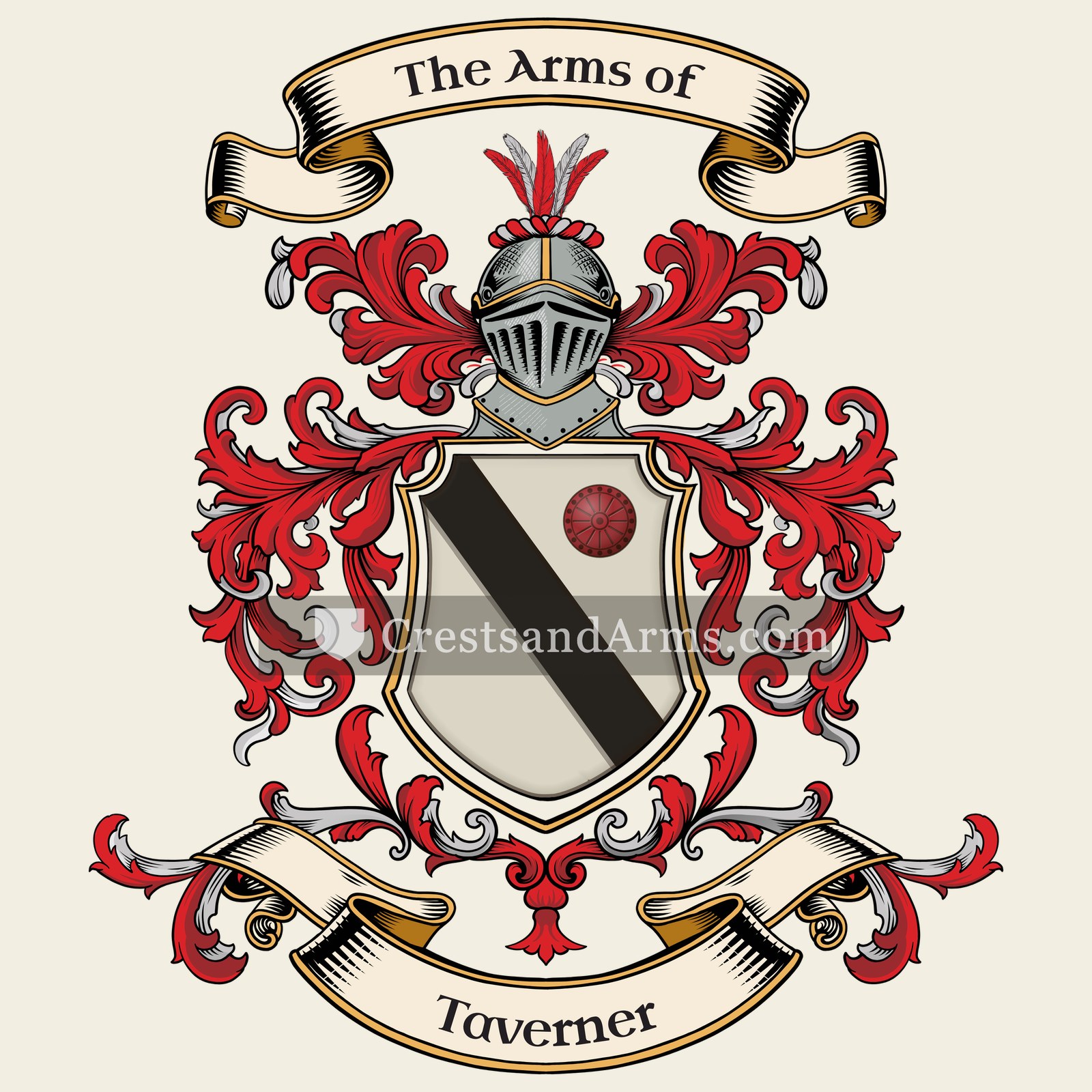
 bendDefence, and the scarf of a commander
 roundelA coin, and one who has been to the crusades
 bendDefence, and the scarf of a commander
 roundelA coin, and one who has been to the crusades