Map of France showing where the Tecson arms are recorded
The Tecson arms were recorded in Cambr, c. 1663.
This is where the arms were entered in the register. Families often moved to other parts of the country, so the same name can turn up in more than one region.
The body that granted and recorded arms in France in this period.
Louis XIV of France
Sovereign of the period
Louis XIV of France
1643–1715
Reigning in France when the Tecson arms are first recorded.
How Arms Worked in France
In France, a coat of arms was a mark of honor that passed down through the male line to all legitimate descendants. Families often used the same shield without changes to show their shared heritage. If a branch wanted to stand out, they could add a small mark to their shield to show their specific place in the family tree.
Granting authority
The Juge d'armes de France acted as the official authority that regulated and verified coats of arms across the country.
How they got arms
Families typically inherited their arms from ancestors, though they could also receive them through royal grants or by proving their noble status.
Where arms were recorded
Coats of arms were officially recorded in the Armorial Général de France, which began its main collection in the year 1696.
The family's standing
Recorded among the armigerous families of France.
Origin & History of the Tecson Family in France
The history of the Tecson family is deeply rooted in the colonial landscape of the Philippines, with documented evidence placing members of the clan in the town of Camiling as early as 1663. During this period, the name became associated with the local principalia, which was the ruling class of native elites who held administrative positions under the Spanish colonial government. As the family established their presence in the region, they became influential figures in local agriculture and community governance. Over the following generations, the Tecsons played a significant role in the development of the Tarlac province, often acting as intermediaries between the local population and the colonial authorities. This early stability allowed the family to maintain a consistent social standing that lasted well into the nineteenth century.
Tecson Meaning & Related Branches
Root word
Tesson
Derived from the Old French word for a badger.
This name
TecsonA locative or nickname surname originally denoting a person resembling a badger or living near a badger sett.
also spelled
Tessonnet
Tessone
Tessun
Teson
Documented Sources
J. B. Rietstap, Armorial Général, Gouda: G. B. van Goor Zonen, 1884–87
Cullinane, Michael, Ilustrado Politics: Filipino Elite Responses to American Rule, 1898-1908, 2003
National Archives of the Philippines, Protocolos de Tarlac, 18th–19th century
Scott, William Henry, Barangay: Sixteenth-Century Philippine Culture and Society, 1994
Digital archive packCoat of arms PNG, gold border print PDF, vector SVG and the certificate of authenticity. Sent to your email in minutes.


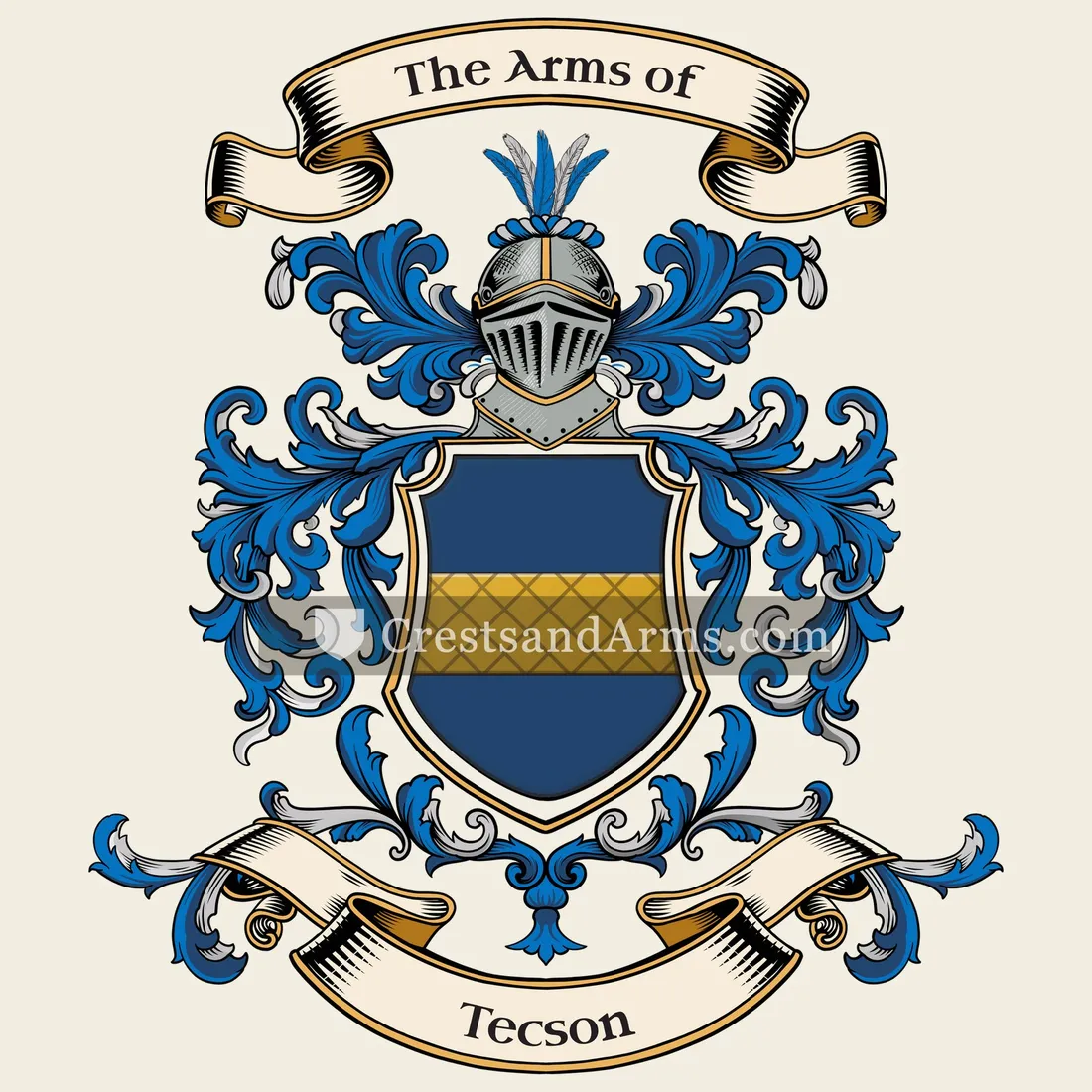
 fessThe military belt, and readiness to serve
 fessThe military belt, and readiness to serve