Map of Austria showing where the Teer arms are recorded
The Teer arms were recorded in Austria, c. 1772.
Arms such as these were typically recorded in Tyrol.
Tyrol was mountain country in western Austria, where the valleys were held by families who had been there a very long time. Old tenure counted for more than money, and old families carried arms.
This is where the arms were entered in the register. Families often moved to other parts of the country, so the same name can turn up in more than one region.
Region
Tyrol
First recorded
1772
Granting Authority for the Teer Arms
Imperial and Royal chancery
Sodacan · CC BY-SA 3.0
The body that granted and recorded arms in Austria in this period.
Joseph II, Holy Roman Emperor
Sovereign of the period
Joseph II, Holy Roman Emperor
1765–1790
Reigning in Austria when the Teer arms are first recorded.
How Arms Worked in Austria
Austrian coats of arms were often linked directly to noble titles granted by the Emperor. These symbols belonged to the entire family line rather than just one individual. When a family grew, new branches kept the original design without needing to change it. This system allowed all members of a noble house to share the same identity across many generations.
Granting authority
The Imperial and Royal chancery managed all heraldic matters and controlled the official granting of arms throughout the Austrian lands.
How they got arms
Families typically received their arms through a formal imperial decree that often accompanied the elevation of a person to noble status.
Where arms were recorded
Official records of these grants were kept in the Imperial Register of Nobility which began its formal documentation process in 1453.
The family's standing
Recorded among the armigerous families of Austria.
Origin & History of the Teer Family in Austria
The family name Teer is deeply rooted in the rugged landscape of the Tyrol region, where records confirm the family was well-established by 1772. The name likely originated as a descriptive term linked to the local environment or the specific trade of its earliest bearers. In the German language, the word "Teer" translates to tar, which suggests that the family may have been involved in the traditional industry of wood distillation. This was a common and essential practice in the forested Alpine valleys, where families produced tar from pine resin for use in waterproofing and construction. Living in the mountainous terrain of Tyrol, these early ancestors were part of a resilient community that relied on the natural resources of the high-altitude forests to sustain their livelihoods and build their homes.
Teer Meaning & Related Branches
Root word
Tier
Germanic word for animal or beast.
This name
TeerAn occupational name for a hunter or a nickname for someone with animal-like traits.
also spelled
Tehre
Tehrs
Teer
Documented Sources
J. B. Rietstap, Armorial Général, Gouda: G. B. van Goor Zonen, 1884–87


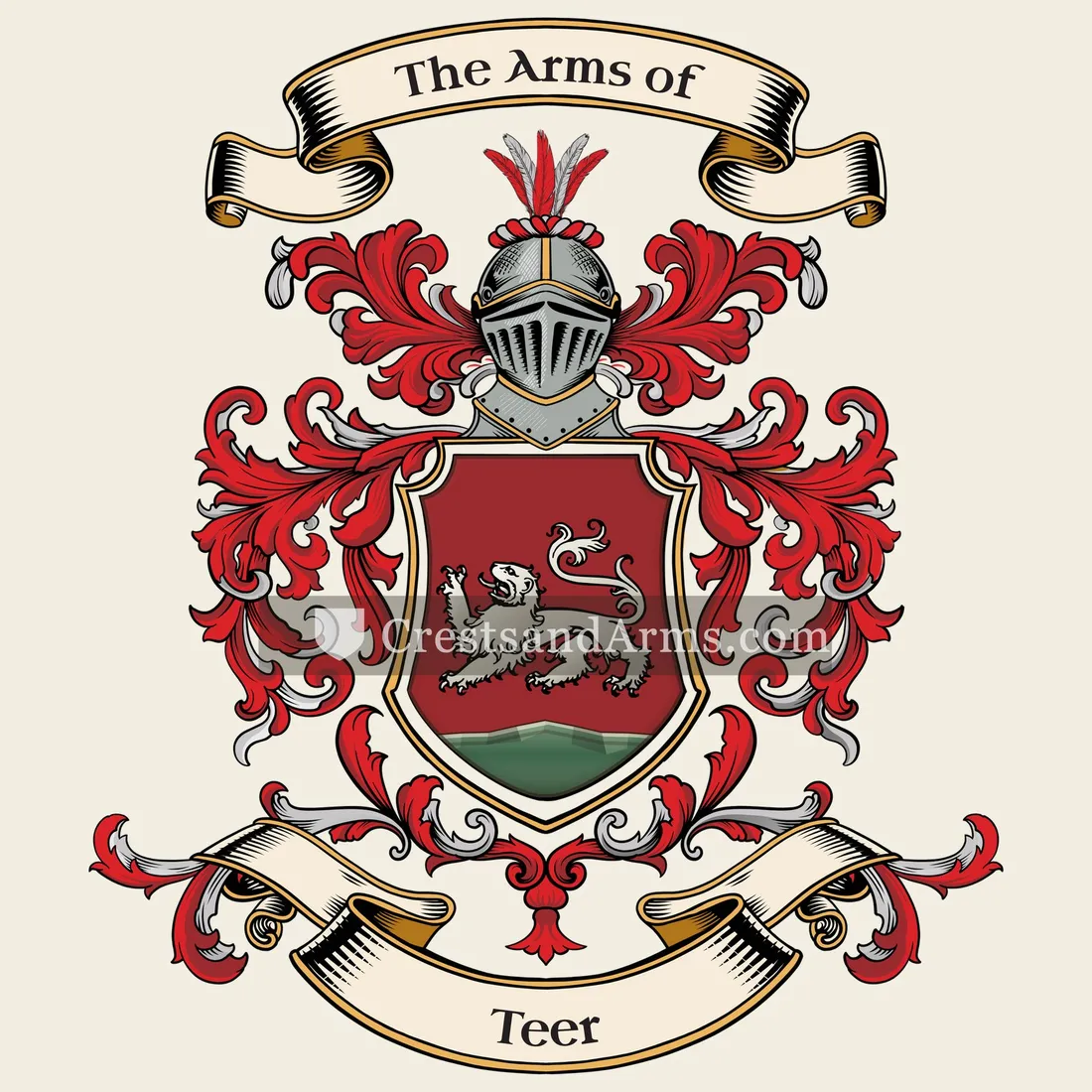
 mountThe ground held, and steadfastness upon it
 lionCourage, strength and royalty
 mountThe ground held, and steadfastness upon it
 lionCourage, strength and royalty