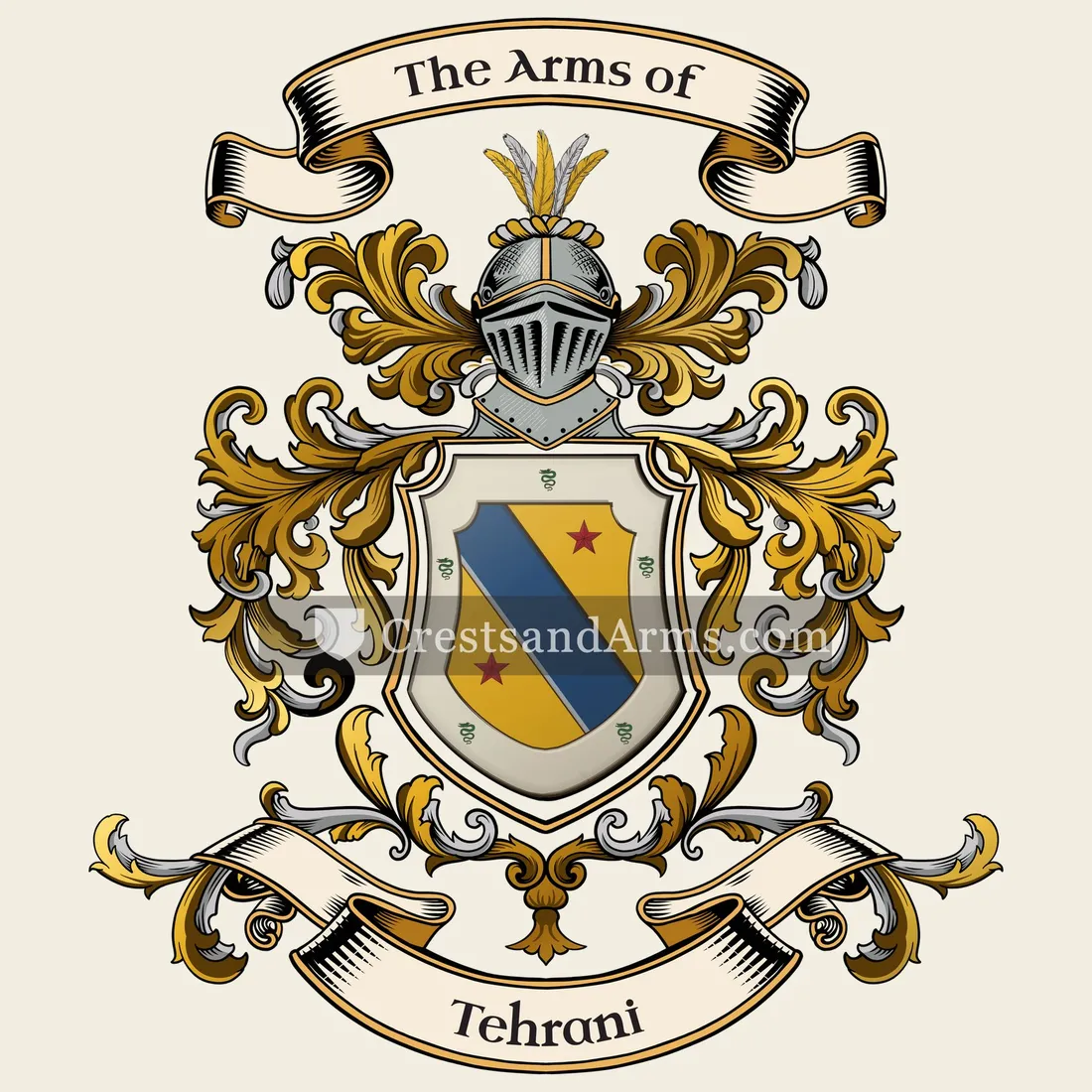
A record of documented arms, meaning and origin, researched for the Tehrani family of Spain.
Reg. 7339 · Spanish, T–V
Meaning of the Tehrani family crest colors & symbols
Symbols on this shield
bendDefence, and the scarf of a commander
mulletThe third son, and a divine quality from above
serpentWisdom, healing and prudence
Colours
Gold (Or)Means: Generosity
Blue (Azure)Means: Loyalty and truth
Silver (Argent)Means: Peace and sincerity
Red (Gules)Means: Military strength
Green (Vert)Means: Hope
Historical info
Source
J. B. Rietstap, Armorial Général, Gouda: G. B. van Goor Zonen, 1884–87
Blazon (the actual original written record)
“D'or à trois bandes d'azur, acc. de deux étoiles de gu., l'une au canton sen. du chef et l'autre au canton dextre de la p.; à la bord. d'arg., ch. de cinq têtes de serpent de sin., languées de gu., posées en fasces, quatre dans les cantons de la bord. et la cinquième en p.”
SpainAsturies, c. 1722
Digital archive packCoat of arms PNG, gold border print PDF, vector SVG and the certificate of authenticity. Sent to your email in minutes.
Map of Spain showing where the Tehrani arms are recorded
The Tehrani arms were recorded in Asturies, c. 1722.
This is where the arms were entered in the register. Families often moved to other parts of the country, so the same name can turn up in more than one region.
The body that granted and recorded arms in Spain in this period.
Philip V of Spain
Sovereign of the period
Philip V of Spain
1714–1724
Reigning in Spain when the Tehrani arms are first recorded.
How Arms Worked in Spain
In Spain, a coat of arms was considered a form of property that belonged to the entire family line. These arms were passed down from a father to all his children equally. Younger branches of the family usually kept the original design without needing to add any special marks to distinguish their specific line.
Granting authority
The Cronista Rey de Armas was the official body that regulated and granted coats of arms throughout Spain.
How they got arms
Families often obtained their arms through royal grants or by proving their noble status to the official heraldic authority.
Where arms were recorded
Coats of arms were officially recorded in the registers of the Cronista Rey de Armas starting in 1496.
The family's standing
Recorded among the armigerous families of Spain.
Origin & History of the Tehrani Family in Spain
The history of the Tehrani family name in the region of Asturias, Spain, traces back to at least 1722, marking a significant presence in the northern Iberian Peninsula during the eighteenth century. While the name is often associated with the city of Tehran in modern-day Iran, its appearance in Asturian parish records suggests a distinct local lineage or a unique migration pattern that integrated the name into the Spanish cultural landscape. During this era, families in Asturias were often deeply connected to the land and local trade, and the Tehrani name likely became established through these community ties. By documenting their presence in baptismal and marriage registers, early family members secured their place in the social fabric of the region. This historical footprint shows how a name can travel across vast distances and take root in a new environment, eventually becoming a permanent part of local history.
Tehrani Meaning & Related Branches
Root word
Tehran
A Persian toponym referring to the capital city of Iran.
This name
TehraniAn occupational or locative surname denoting someone who originates from the city of Tehran.
Documented Sources
J. B. Rietstap, Armorial Général, Gouda: G. B. van Goor Zonen, 1884–87
Archivo Histórico Diocesano de Oviedo, Libros Sacramentales de la Parroquia de San Juan de Amandi, 1722
Fernández, M., Historia de los linajes asturianos en el siglo XVIII, 1995
Digital archive packCoat of arms PNG, gold border print PDF, vector SVG and the certificate of authenticity. Sent to your email in minutes.


 bendDefence, and the scarf of a commander
 mulletThe third son, and a divine quality from above
 serpentWisdom, healing and prudence
 bendDefence, and the scarf of a commander
 mulletThe third son, and a divine quality from above
 serpentWisdom, healing and prudence