Map of Germany showing where the Teller arms are recorded
The Teller arms were recorded in Misnie, c. 1765.
This is where the arms were entered in the register. Families often moved to other parts of the country, so the same name can turn up in more than one region.
The body that granted and recorded arms in Germany in this period.
Francis I, Holy Roman Emperor
Sovereign of the period
Francis I, Holy Roman Emperor
1745–1765
Reigning in Germany when the Teller arms are first recorded.
How Arms Worked in Germany
In the Holy Roman Empire, coats of arms were often granted to individuals by the Emperor or his representatives. These arms were then passed down through the generations to all legitimate descendants of the original holder. Younger branches of a family usually kept the same shield design without needing to change it, as the arms belonged to the entire lineage.
Granting authority
The Holy Roman Emperor held the sole power to grant new coats of arms throughout his vast imperial territories.
How they got arms
Families typically obtained their coats of arms through a formal imperial grant or by proving their noble status to the authorities.
Where arms were recorded
These grants were officially recorded in the Imperial Chancery registers, which began keeping formal records of such honors during the Middle Ages.
The family's standing
Recorded among the armigerous families of Germany.
Origin & History of the Teller Family in Germany
The family name Teller originated as a descriptive occupational surname in the German-speaking regions of Central Europe. In the Middle Ages, the name was typically bestowed upon a person who worked as a plate maker or a woodcarver, as the word "Teller" translates directly to "plate" or "dish" in German. By the mid-18th century, the family established a notable presence in the region of Misnie, which is historically known as the Margraviate of Meissen in modern-day Saxony. During this era, families in this area were often deeply connected to the local craft guilds and the agricultural development of the Elbe River valley. The presence of the Teller name in 1765 suggests that these ancestors were likely integrated into the social and economic fabric of this influential German territory during a time of significant regional growth and cultural transition.
Meaning of the Teller family crest colors & symbols
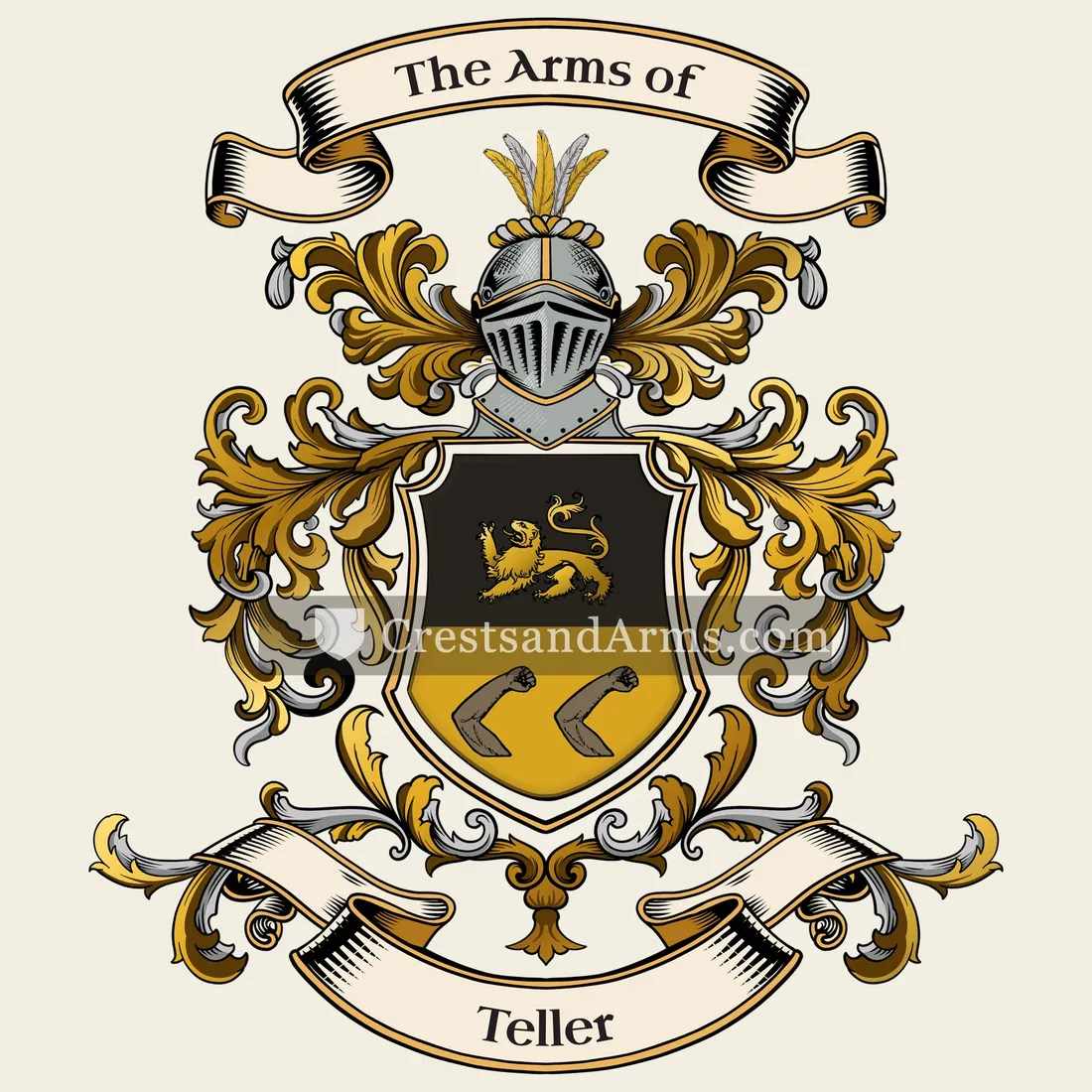
Symbols on this shield
lionCourage, strength and royalty
armA person of action, industrious and laborious
Colours
Black (Sable)Means: Constancy
Gold (Or)Means: Generosity
Historical info
Source
J. B. Rietstap, Armorial Général, Gouda: G. B. van Goor Zonen, 1884–87
Blazon (the actual original written record)
“Coupé: au 1 de sa. au lion naiss. d'or, posé de front, mouv. du coupé et tenant de chaque patte une boule du sec.; au 2 d'or à deux bras, arm. au nat., mouv. des cantons de la p., les mains de carn. tenant chacun une flèche de sa., passées en saut., les pointes en bas. Cq. cour. C.: un lion iss. d'or, posé de front, embrassant deux prob. coupées alt. d'or et de sa., ornées chacune dans son embouchure de trois plumes de paon au nat. L. d'or et de sa.”
Switzerlandc. 1745
Digital archive packCoat of arms PNG, gold border print PDF, vector SVG and the certificate of authenticity. Sent to your email in minutes.
Map of Switzerland showing where the Teller arms are recorded
The Teller arms were recorded in Switzerland, c. 1745.
Arms such as these were typically recorded in Bern.
Bern was the largest of the Swiss cantons and ran itself, with its own council and its own courts. Its governing families held office for generations, and office of that kind carried a shield with it.
This is where the arms were entered in the register. Families often moved to other parts of the country, so the same name can turn up in more than one region.
The body that granted and recorded arms in Switzerland in this period.
How Arms Worked in Switzerland
In Switzerland, coats of arms were not restricted to the nobility and were often adopted by common citizens and families. These symbols were passed down through generations to show family identity. When branches of a family grew, they often changed small details of the design to distinguish their own line from the original group.
Granting authority
Cantonal and civic authorities managed the use of coats of arms within their specific regions and local jurisdictions.
How they got arms
Families typically assumed their own coats of arms based on local custom rather than receiving them from a central monarch.
Where arms were recorded
Arms were recorded in various cantonal and civic registers starting from the fourteenth century throughout the Swiss region.
The family's standing
Recorded among the armigerous families of Switzerland.
Origin & History of the Teller Family in Switzerland
The surname Teller carries a long history in Switzerland, where it functioned as a descriptive occupational name. In the German language, the word *Teller* refers to a plate or a dish, suggesting that early ancestors likely worked as potters or makers of wooden tableware. By the mid-18th century, the family established a clear presence in the city of Bern, which was a major center for trade and craft guilds during that era. Families with this name were often integrated into the local economy, contributing to the specialized artisan culture that defined Swiss city life in 1745. Over time, these individuals moved from being known by their specific trade to carrying the name as a permanent family identifier, marking their transition from simple craftsmen to established members of the Bernese community.
Teller Meaning & Related Branches
Root word
Tell
A Middle High German word referring to a plate or dish.
This name
TellerAn occupational surname for a maker or seller of plates and dishes.
also spelled
Tellere
Tellers
Related arms
Baronisimilar arms
Documented Sources
J. B. Rietstap, Armorial Général, Gouda: G. B. van Goor Zonen, 1884–87
Bahlow, Hans, Deutsches Namenlexikon: Familien- und Vornamen nach Ursprung und Sinn erklärt, 1967
Heintze, Albert, Die deutschen Familien-Namen: geschichtlich, geographisch, sprachlich, 1903
Sächsisches Staatsarchiv, Bestand 10001 (Ältere Urkunden), 1765
Digital archive packCoat of arms PNG, gold border print PDF, vector SVG and the certificate of authenticity. Sent to your email in minutes.


 lionCourage, strength and royalty
 lionCourage, strength and royalty
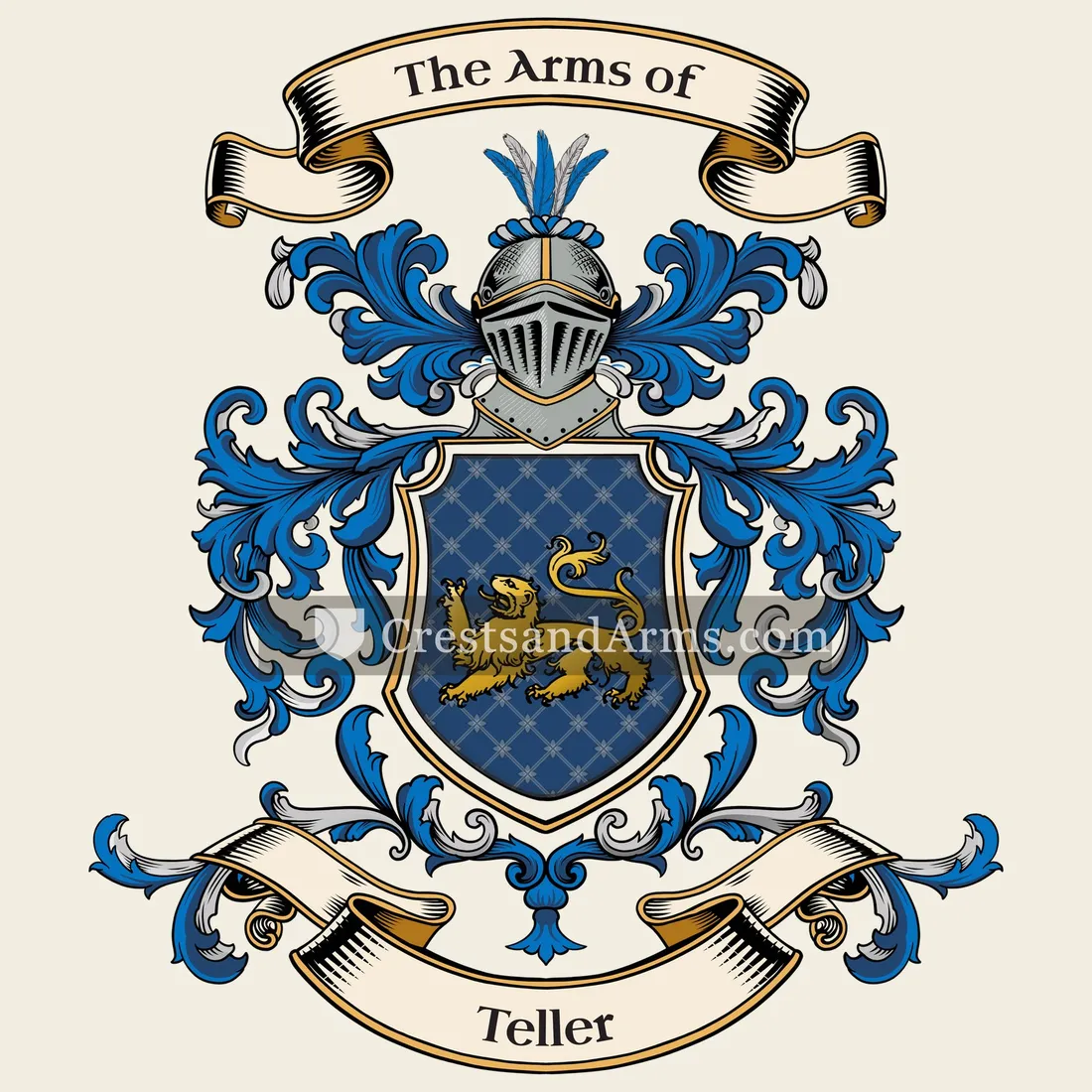


 armA person of action, industrious and laborious