A record of documented arms, meaning and origin, researched for the Teniente family lines. Documented in 2 countries.
Reg. 3523 · Irish, T–V
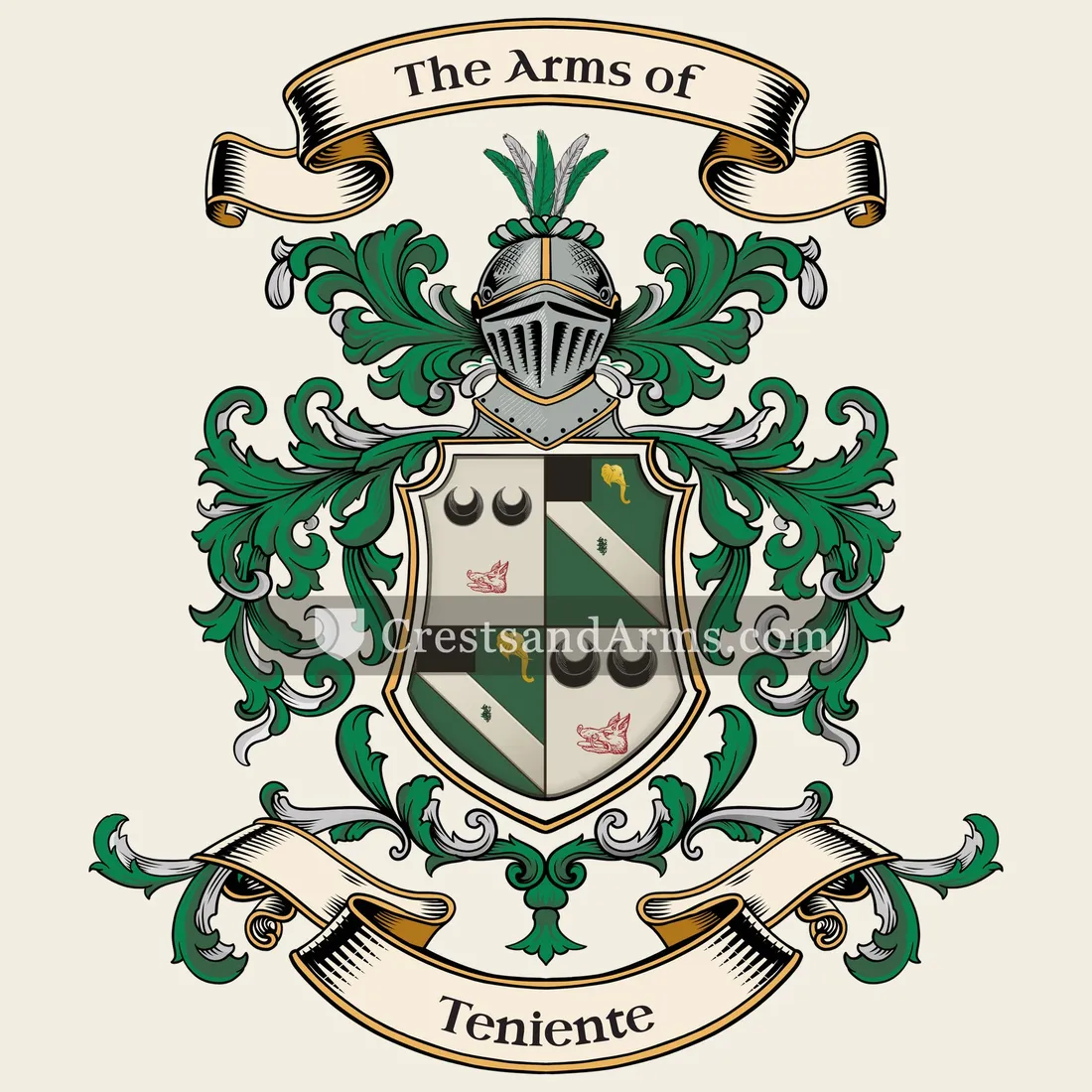
Meaning of the Teniente family crest colors & symbols
Symbols on this shield
cantonA mark of honour granted by the sovereign
bendDefence, and the scarf of a commander
boars headA fierce fighter who battles to the end
crescentHonour by the sovereign, and the second son
lionCourage, strength and royalty
elephantGreat strength, wit and ambition
Colours
Silver (Argent)Means: Peace and sincerity
Green (Vert)Means: Hope
Black (Sable)Means: Constancy
Red (Gules)Means: Military strength
Gold (Or)Means: Generosity
Historical info
Source
Sir Bernard Burke, The General Armory of England, Scotland, Ireland and Wales, London: Harrison & Sons, 1884
Blazon (the actual original written record)
“Quarterly, 1st and 4th, ar. a boar's head erased gu. betw. two crescents in pale sa. a canton of the last, for TENNENT; 2nd and 3rd, per fess indented vert and az. a bend engr. ar. charged with three lions pass. vert bezantée, in the sinister chief an elephant's head erased or, for EMERSON”
FermanaghTempo Manor · Fermanagh, c. 1877
Digital archive packCoat of arms PNG, gold border print PDF, vector SVG and the certificate of authenticity. Sent to your email in minutes.
Map of Ireland showing where the Teniente arms are recorded
The Teniente arms were recorded in Fermanagh, c. 1877.
Fermanagh was lake country in the north-west of Ireland, planted with settlers in the seventeenth century. The new landowners took formal grants of land, and those grants brought arms with them.
This is where the arms were entered in the register. Families often moved to other parts of the country, so the same name can turn up in more than one region.
The body that granted and recorded arms in Ireland in this period.
Victoria
Sovereign of the period
Victoria
1837–1901
Reigning in Ireland when the Teniente arms are first recorded.
How Arms Worked in Ireland
The Ulster King of Arms granted coats of arms to individuals who proved their social standing and good character. These symbols were typically inherited by all legitimate descendants of the original holder. If a family branch wanted a unique look, they could apply for a specific change to their design through the office to ensure their identity remained distinct.
Granting authority
The Ulster King of Arms acted as the official body that regulated and issued all coats of arms throughout Ireland.
How they got arms
Families obtained their arms through formal grants issued by the office after proving their eligibility and paying the required fees.
Where arms were recorded
All official grants were recorded in the registers held by the Ulster King of Arms starting from the year 1552.
The family's standing
Recorded among the armigerous families of Fermanagh.
Origin & History of the Teniente Family in Ireland
The surname Teniente is historically rooted in the Spanish language, where it functions as a title meaning lieutenant or a deputy. While the name is not of Gaelic origin, historical records confirm that a branch of the family was established in County Fermanagh, Ireland, by 1877. During this period, Fermanagh was a region defined by agricultural shifts and the lingering effects of the Great Famine, which had significantly altered the local population. Families with non-native surnames often arrived in rural Irish counties through military service, trade connections, or colonial administrative roles. By the late nineteenth century, the presence of the Teniente name in Fermanagh suggests that these individuals had integrated into the local community, likely participating in the social and economic life of the Ulster province during a time of great transition in Irish history.
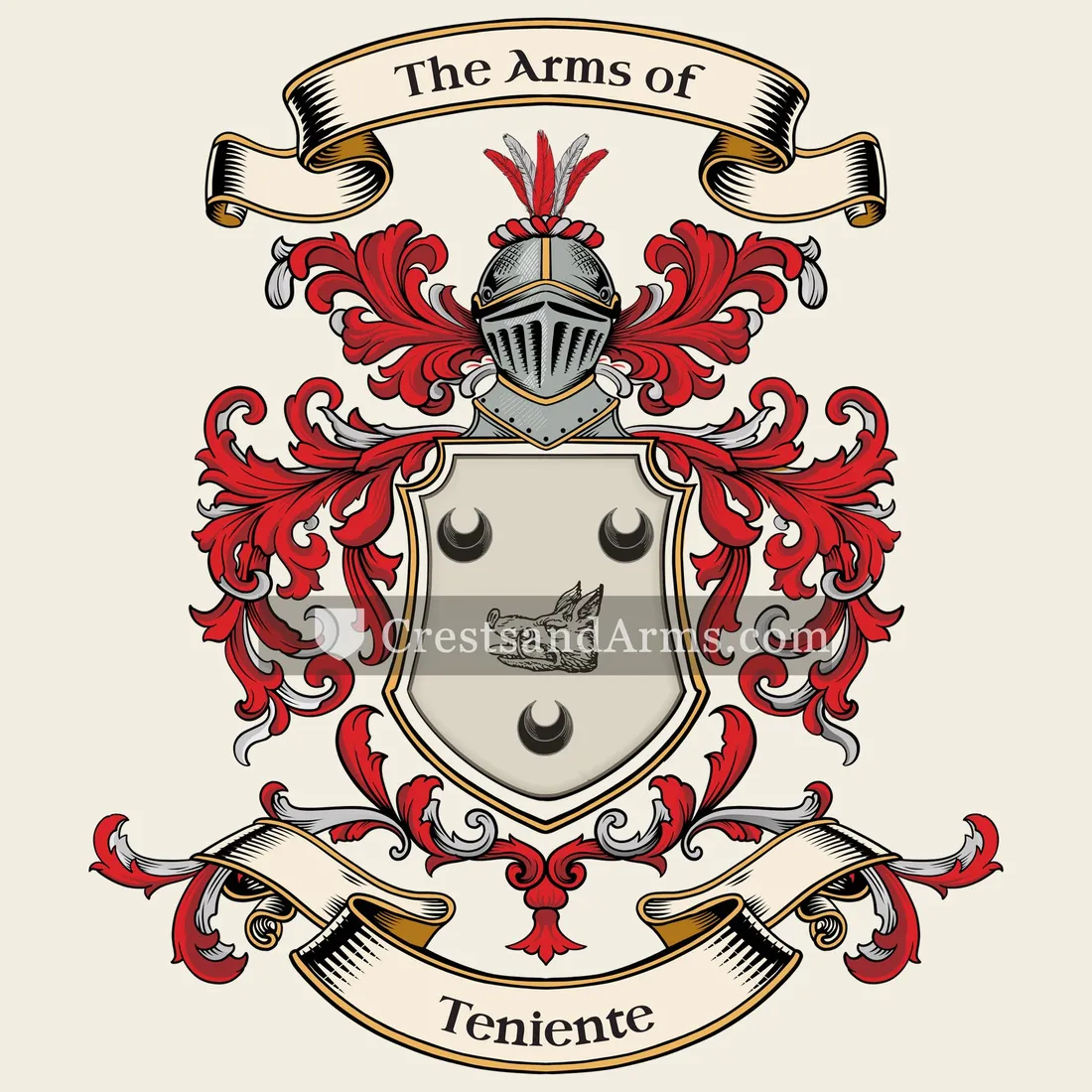
Meaning of the Teniente family crest colors & symbols
Symbols on this shield
boars headA fierce fighter who battles to the end
crescentHonour by the sovereign, and the second son
Colours
Silver (Argent)Means: Peace and sincerity
Black (Sable)Means: Constancy
Historical info
Source
Sir Bernard Burke, The General Armory of England, Scotland, Ireland and Wales, London: Harrison & Sons, 1884
Blazon (the actual original written record)
“Ar. a boar's head couped betw. three crescents sa”
ScotlandCairnes, c. 1748
Digital archive packCoat of arms PNG, gold border print PDF, vector SVG and the certificate of authenticity. Sent to your email in minutes.
Map of Scotland showing where the Teniente arms are recorded
The Teniente arms were recorded in Cairnes, c. 1748.
Arms such as these were typically recorded in Edinburgh.
Edinburgh was the seat of Scotland's government, its courts and its heralds. Families with business there settled nearby, and being close to where arms were recorded is exactly why so many of them appear.
This is where the arms were entered in the register. Families often moved to other parts of the country, so the same name can turn up in more than one region.
The body that granted and recorded arms in Scotland in this period.
George II of Great Britain
Sovereign of the period
George II of Great Britain
1727–1760
Reigning in Ireland when the Teniente arms are first recorded.
How Arms Worked in Scotland
Scottish heraldry is unique because it treats a coat of arms as a piece of personal property protected by law. Only one person can own a specific design at any given time. When a family grows, the head keeps the original shield while other relatives must apply for their own distinct version with slight changes to prove their specific identity.
Granting authority
The Court of the Lord Lyon acts as the official body that regulates and controls all heraldic matters throughout Scotland.
How they got arms
Individuals obtain a legal right to their arms through a formal petition process that confirms their identity and family connection.
Where arms were recorded
All valid coats of arms are officially entered into the Public Register of All Arms and Bearings starting from 1672.
The family's standing
Recorded among the armigerous families of Scotland.
Origin & History of the Teniente Family in Scotland
The name Teniente is deeply rooted in the historical landscape of Edinburgh, where records confirm the family was established by at least 1748. While the name itself carries linguistic ties to administrative and military roles in other parts of Europe, its presence in Scotland suggests a family that likely integrated into the professional or mercantile circles of the city during the mid-eighteenth century. At this time, Edinburgh was undergoing a period of intense intellectual and social growth known as the Scottish Enlightenment. Families like the Tenientes living in the capital would have navigated a society defined by rapid urban expansion and the rise of new trade networks. By settling in such a prominent cultural hub, early members of the family became part of the long tradition of diverse lineages contributing to the unique social fabric of Scotland. Their presence in the city records provides a clear window into the lives of families who helped shape the local community during this transformative era of Scottish history.
Teniente Meaning & Related Branches
Root word
tenens
Latin word meaning holding or occupying a position.
This name
TenienteA title denoting a deputy or an officer holding a specific rank.
also spelled
Tennant
Tennand
Tenant
Documented Sources
Sir Bernard Burke, The General Armory of England, Scotland, Ireland and Wales, London: Harrison & Sons, 1884
General Register Office for Northern Ireland, Civil Registration of Births, Marriages and Deaths, 1877
Vaughan, W.E., A New History of Ireland, Volume V: Ireland Under the Union, I, 1801–70, 1989
Digital archive packCoat of arms PNG, gold border print PDF, vector SVG and the certificate of authenticity. Sent to your email in minutes.


 cantonA mark of honour granted by the sovereign
 bendDefence, and the scarf of a commander
 boars headA fierce fighter who battles to the end
 crescentHonour by the sovereign, and the second son
 lionCourage, strength and royalty
 elephantGreat strength, wit and ambition
 cantonA mark of honour granted by the sovereign
 bendDefence, and the scarf of a commander
 boars headA fierce fighter who battles to the end
 crescentHonour by the sovereign, and the second son
 lionCourage, strength and royalty
 elephantGreat strength, wit and ambition