Map of England showing where the Terhune arms are recorded
The Terhune arms were recorded in London, c. 1620.
This is where the arms were entered in the register. Families often moved to other parts of the country, so the same name can turn up in more than one region.
The body that granted and recorded arms in England in this period.
James VI and I
Sovereign of the period
James VI and I
1603–1625
Reigning in England when the Terhune arms are first recorded.
How Arms Worked in England
English heraldry allowed arms to be shared by all legitimate descendants of the original owner. These symbols were treated as personal property that moved through the generations to all children. While the eldest son kept the original design, other family members could use the same shield without needing to change it or register their own unique versions.
Granting authority
The College of Arms in London has regulated the use of coats of arms throughout England and Wales since 1484.
How they got arms
Families typically obtained their coats of arms through a formal grant from the Crown or by proving their ancient right to them.
Where arms were recorded
All official coats of arms are recorded in the registers kept at the College of Arms, which date back to the fifteenth century.
The family's standing
Recorded among the armigerous families of England.
Origin & History of the Terhune Family in England
The Terhune family name is believed to have roots in the Low Countries, specifically within the regions that now make up the Netherlands and Belgium. The name is often interpreted as a topographic surname, likely derived from the Dutch phrase "ter hune," which refers to someone who lived near a specific piece of land or a communal area known as a "hune." By 1620, records indicate that members of the family had established a presence in London, likely as part of the movement of refugees and merchants fleeing religious and political instability in mainland Europe. These early settlers were part of a larger network of families who moved across the English Channel to seek new opportunities in the growing trade hubs of England. From London, the family eventually participated in the broader migration to the American colonies, where they became prominent figures in the development of early settlements in New Jersey and New York.
Related Branches & Arms
Root word
ten hurne
Middle Dutch for at the corner or at the horn of land
This name
TerhuneA topographic surname for someone who lived near a corner of land or a river bend
Documented Sources
Sir Bernard Burke, The General Armory of England, Scotland, Ireland and Wales, London: Harrison & Sons, 1884
Bergen, Teunis G. Register in Alphabetical Order, of the Early Settlers of Kings County, Long Island, N.Y. 1881
Hoff, Henry B. "The Terhune Family of New Jersey." The Genealogical Magazine of New Jersey, 1980
New York State Archives, Records of the Reformed Protestant Dutch Church of Flatbush, Kings County, New York
Digital archive packCoat of arms PNG, gold border print PDF, vector SVG and the certificate of authenticity. Sent to your email in minutes.


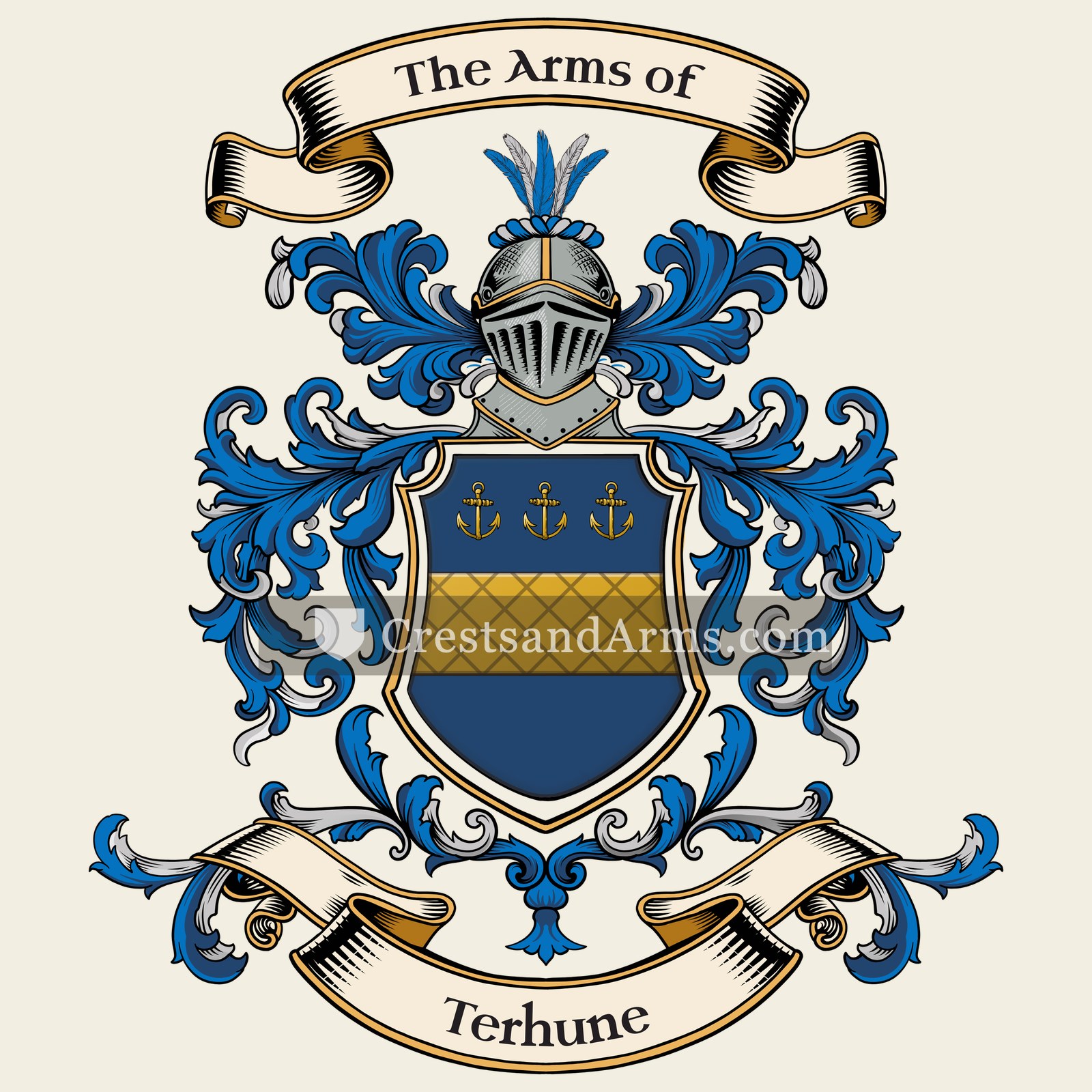
 fessThe military belt, and readiness to serve
 anchorHope, and steadfastness in trouble
 fessThe military belt, and readiness to serve
 anchorHope, and steadfastness in trouble