Map of Italy showing where the Testa arms are recorded
The Testa arms were recorded in Padoue, c. 1775.
This is where the arms were entered in the register. Families often moved to other parts of the country, so the same name can turn up in more than one region.
The body that granted and recorded arms in Italy in this period.
Alvise Giovanni Mocenigo
Sovereign of the period
Alvise Giovanni Mocenigo
1763–1778
Reigning in Italy when the Testa arms are first recorded.
How Arms Worked in Italy
In the Italian states, coats of arms were often used by noble families to show their status and history. These symbols were passed down through the generations to all legitimate male descendants. Younger branches of a family usually kept the original design but sometimes added small changes to distinguish their specific line from the main branch.
Granting authority
Various local rulers and city governments controlled the use of coats of arms across the different Italian states.
How they got arms
Families often assumed their own arms or received them as official grants from local lords, popes, or city councils.
Where arms were recorded
Arms were recorded in local city archives or private family books rather than in one single national register.
The family's standing
Recorded among the armigerous families of Italy.
Origin & History of the Testa Family in Italy
The surname Testa has deep roots in the Italian peninsula, where it originated as a descriptive nickname. In the medieval period, Italians often gave people names based on their physical features or personality traits, and the word *testa* simply means head. It was likely used to describe someone with a large head, a stubborn nature, or perhaps a person who held a position of authority. By the time the family was firmly established in the city of Padua by 1775, the name had transitioned from a simple nickname into a formal hereditary surname. Families with this name were often found in northern Italy, where they participated in the local social and economic life of cities like Padua. Over many generations, the name became a permanent marker of their identity, linking the family to the rich urban history of the Veneto region.
Coat of Arms & Family Crest Details
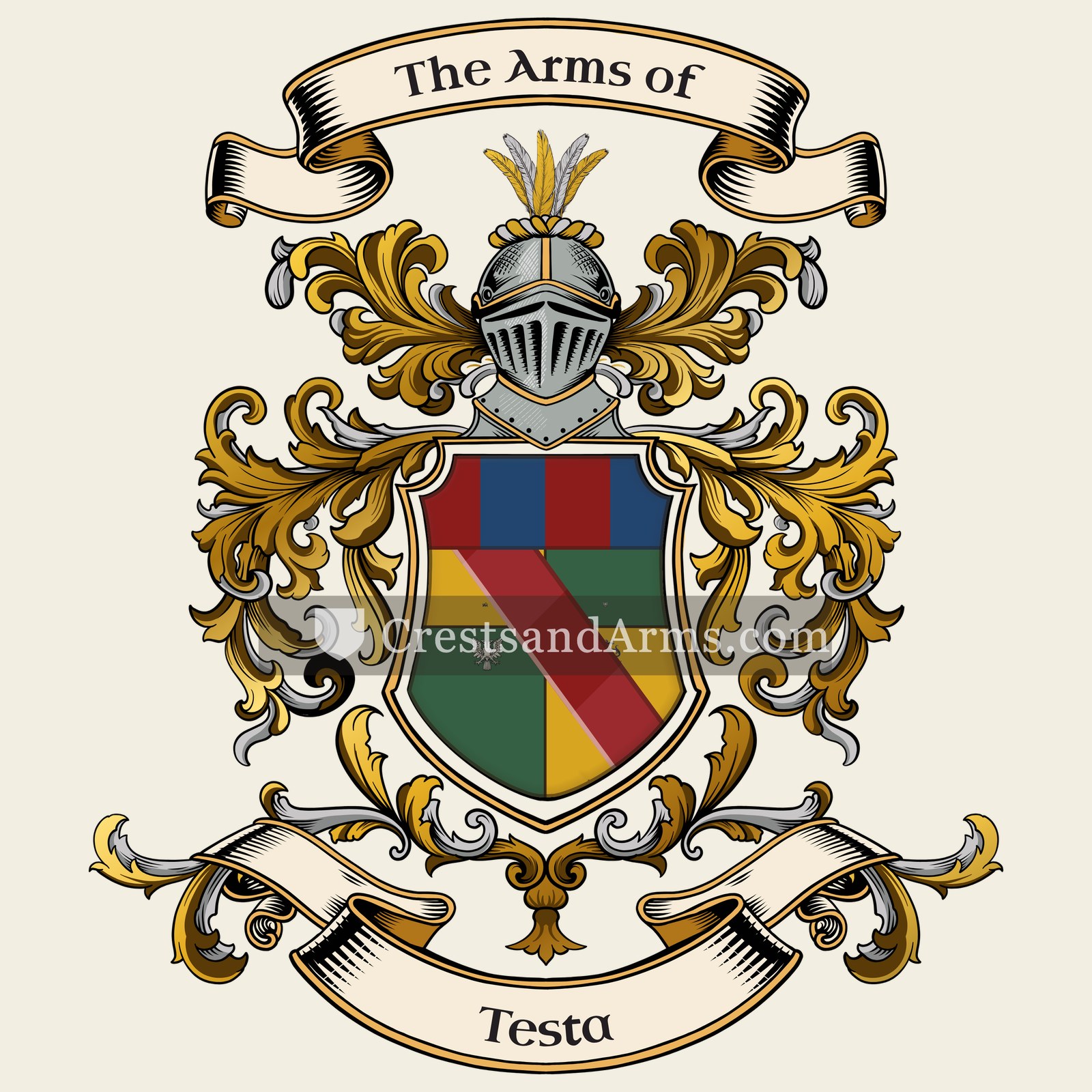
Symbols on this shield
bendDefence, and the scarf of a commander
chiefAuthority, wisdom and dominion
lionCourage, strength and royalty
Colours
Gold (Or)Means: Generosity
Red (Gules)Means: Military strength
Blue (Azure)Means: Loyalty and truth
Historical info
Source
J. B. Rietstap, Armorial Général, Gouda: G. B. van Goor Zonen, 1884–87
Blazon (the actual original written record)
“D'or à trois bandes de gu.; au chef d'azur, ch. d'une tête et col de lion d'or, lamp. de gu. Trois cq. cour. C.: 1° la tête de lion; 2° une aigle de sa., cour d'or; 3° trois bâtons d'or, traversant chacun une boule de gu. L.: à dextre d'or et d'azur, à sen. d'or et de gu.”
Austriac. 1783
Digital archive packCoat of arms PNG, gold border print PDF, vector SVG and the certificate of authenticity. Sent to your email in minutes.
Map of Austria showing where the Testa arms are recorded
The Testa arms were recorded in Austria, c. 1783.
Arms such as these were typically recorded in Tyrol.
Tyrol was mountain country in western Austria, where the valleys were held by families who had been there a very long time. Old tenure counted for more than money, and old families carried arms.
This is where the arms were entered in the register. Families often moved to other parts of the country, so the same name can turn up in more than one region.
Region
Tyrol
First recorded
1783
Granting Authority for the Testa Arms
Imperial and Royal chancery
Sodacan · CC BY-SA 3.0
The body that granted and recorded arms in Austria in this period.
Joseph II, Holy Roman Emperor
Sovereign of the period
Joseph II, Holy Roman Emperor
1765–1790
Reigning in Italy when the Testa arms are first recorded.
How Arms Worked in Austria
Austrian coats of arms were often linked directly to noble titles granted by the Emperor. These symbols belonged to the entire family line rather than just one individual. When a family grew, new branches kept the original design without needing to change it. This system allowed all members of a noble house to share the same identity across many generations.
Granting authority
The Imperial and Royal chancery managed all heraldic matters and controlled the official granting of arms throughout the Austrian lands.
How they got arms
Families typically received their arms through a formal imperial decree that often accompanied the elevation of a person to noble status.
Where arms were recorded
Official records of these grants were kept in the Imperial Register of Nobility which began its formal documentation process in 1453.
The family's standing
Recorded among the armigerous families of Austria.
Origin & History of the Testa Family in Austria
The surname Testa carries a rich history that reflects the movement of people across the mountainous landscapes of Central Europe. While the name originates from Italian roots meaning head or intellect, its presence in the Austrian region of Tyrol by 1783 suggests a long-standing connection to the alpine borderlands. Families bearing this name were often integrated into the local social fabric of the Tyrol province, which served as a vital crossroads for trade and cultural exchange between the Germanic north and the Italian south. By the late 18th century, these individuals were already established members of the community, likely participating in the agricultural and craft-based economy that defined the region. Their documented presence in this area highlights how families moved and adapted to new environments while maintaining their ancestral identity throughout the centuries.
Coat of Arms & Family Crest Details
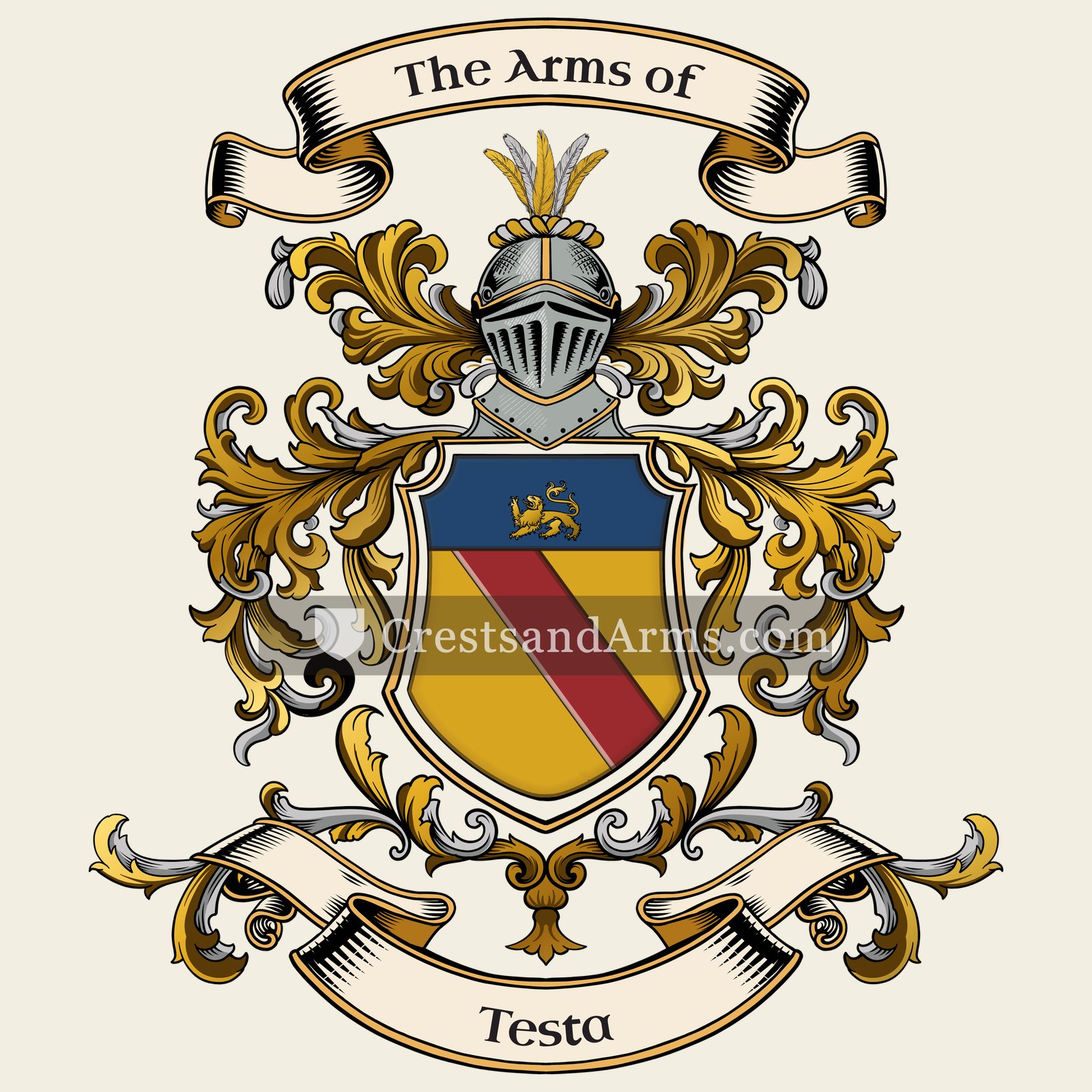
Symbols on this shield
bendDefence, and the scarf of a commander
chiefAuthority, wisdom and dominion
lionCourage, strength and royalty
eagleNobility, strength and a keen mind
Colours
Gold (Or)Means: Generosity
Red (Gules)Means: Military strength
Blue (Azure)Means: Loyalty and truth
Silver (Argent)Means: Peace and sincerity
Historical info
Source
J. B. Rietstap, Armorial Général, Gouda: G. B. van Goor Zonen, 1884–87
Blazon (the actual original written record)
“Ec.: aux 1 et 4 d'or à trois bandes de gu.; au chef d'azur, ch. d'une tête de lion d'or, lamp. de gu., celle du 1 cont.; aux 2 et 3 de sin., au chef d'or ch. d'une aigle iss. d'arg., languée de gu., celle du 3 cont. Deux cq. cour. C.: 1° la”
Netherlandsc. 1817
Digital archive packCoat of arms PNG, gold border print PDF, vector SVG and the certificate of authenticity. Sent to your email in minutes.
Map of Netherlands showing where the Testa arms are recorded
The Testa arms were recorded in Netherlands, c. 1817.
Arms such as these were typically recorded in Friesland.
Friesland was low, wet country on the northern coast of the Netherlands, farmed by families who had held the same land for centuries. Free landholders were unusually common there, and a free landholder could carry arms.
This is where the arms were entered in the register. Families often moved to other parts of the country, so the same name can turn up in more than one region.
Region
Friesland
First recorded
1817
Granting Authority for the Testa Arms
Hoge Raad van Adel
Photograph made by me · CC BY-SA 3.0
The body that granted and recorded arms in Netherlands in this period.
William I of the Netherlands
Sovereign of the period
William I of the Netherlands
1815–1840
Reigning in Italy when the Testa arms are first recorded.
How Arms Worked in Netherlands
In the Netherlands, coats of arms were often used by noble families and those who held specific public offices. These arms were passed down through the generations to legitimate descendants. Younger branches of a family usually kept the original design without needing to add special marks. This system ensured that the family identity remained clear and consistent over many years.
Granting authority
The Hoge Raad van Adel is the official body that regulates and manages noble titles and coats of arms in the Netherlands.
How they got arms
Families typically obtained their coats of arms through official royal grants or by proving their long-standing historical use of the symbols.
Where arms were recorded
Coats of arms are officially recorded in the registers held by the Hoge Raad van Adel, which began its work in 1814.
The family's standing
Recorded among the armigerous families of Netherlands.
Origin & History of the Testa Family in Netherlands
The surname Testa carries a history rooted in the linguistic traditions of Europe, often associated with the Latin word for head or earthen pot. While the name is frequently linked to Mediterranean regions, its presence in the Netherlands highlights the movement of families across borders during the early nineteenth century. By 1817, records confirm that members of the Testa family were established in the northern province of Friesland. This period was a time of significant administrative change in the Netherlands, as the government began to formalize civil registrations and standardize family names for tax and census purposes. The arrival of the family in this region suggests they were part of the broader social shifts occurring during the post-Napoleonic era. As they settled into Frisian life, they integrated into the local community while maintaining a name that reflected a distinct ancestral identity. Their presence in the official registers of the time serves as a clear starting point for tracing their specific lineage within Dutch history.
Testa Meaning & Related Branches
Root word
Testa
Latin word for an earthen pot, jug, or brick.
This name
TestaA nickname for a person with a large or stubborn head.
also spelled
Testas
Testi
Testo
Related arms
Testivariant spelling
Documented Sources
J. B. Rietstap, Armorial Général, Gouda: G. B. van Goor Zonen, 1884–87
De Felice, Emidio. Dizionario dei cognomi italiani. 1978
Padua State Archive (Archivio di Stato di Padova). Stato Civile della Restaurazione, 1775
Digital archive packCoat of arms PNG, gold border print PDF, vector SVG and the certificate of authenticity. Sent to your email in minutes.


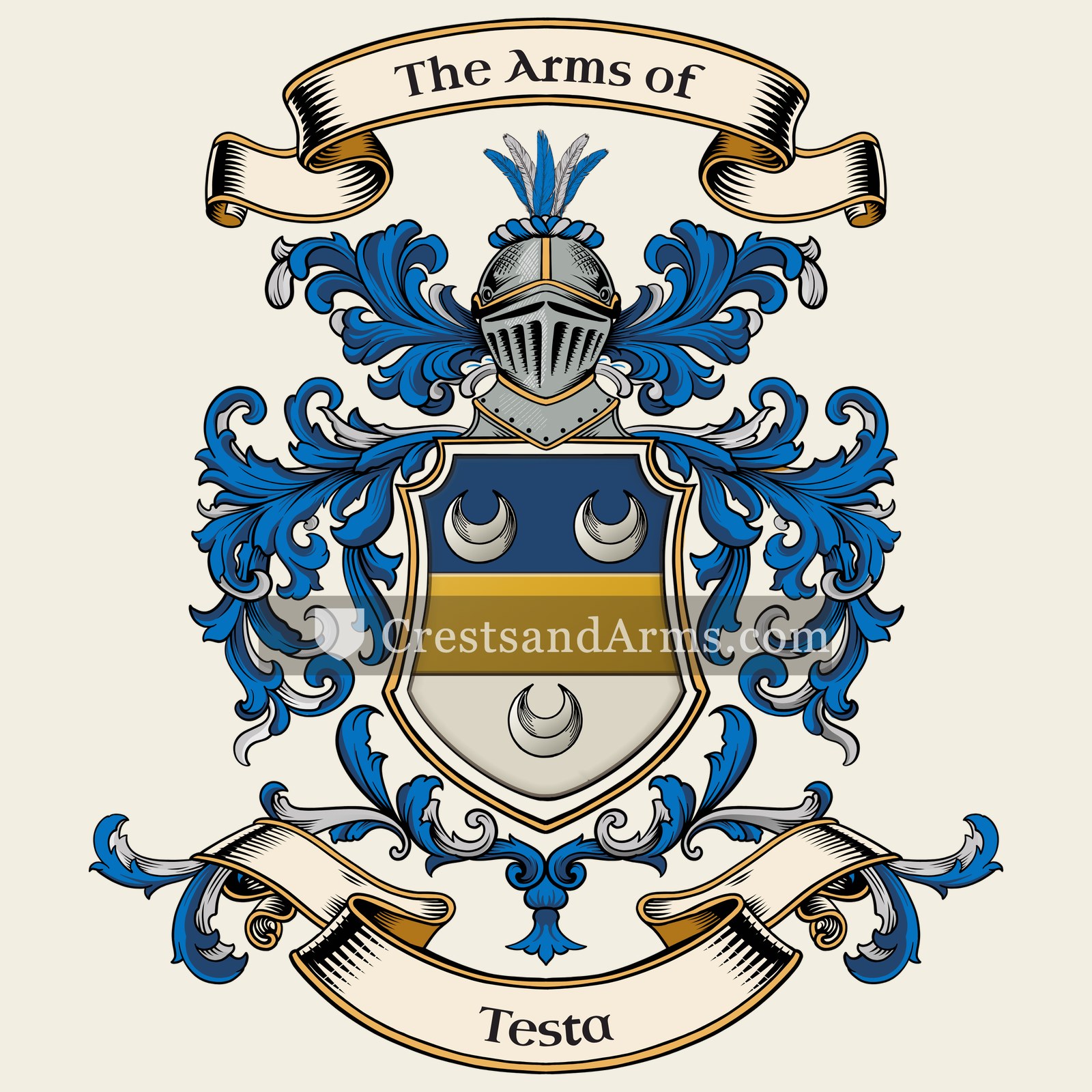
 fessThe military belt, and readiness to serve
 crescentHonour by the sovereign, and the second son
 fessThe military belt, and readiness to serve
 crescentHonour by the sovereign, and the second son


 bendDefence, and the scarf of a commander
 chiefAuthority, wisdom and dominion
 lionCourage, strength and royalty


 eagleNobility, strength and a keen mind