Map of Belgium showing where the Texidor arms are recorded
The Texidor arms were recorded in Liege, c. 1737.
Liege was a prosperous town and its surrounding country, living on metalworking and trade. Merchant families grew rich, bought land outside the walls, and took arms as landowners rather than tradesmen.
This is where the arms were entered in the register. Families often moved to other parts of the country, so the same name can turn up in more than one region.
The body that granted and recorded arms in Belgium in this period.
Charles VI, Holy Roman Emperor
Sovereign of the period
Charles VI, Holy Roman Emperor
1711–1740
Reigning in Belgium when the Texidor arms are first recorded.
How Arms Worked in Belgium
In Belgium, a coat of arms is considered personal property that is passed down through the male line to legitimate descendants. Families often use the same shield design across generations to show their shared heritage. If a branch of the family wants to change the design, they must apply for an official update to their specific version of the arms.
Granting authority
The Conseil héraldique is the official body that regulates and approves all coats of arms in Belgium.
How they got arms
Families obtain their coats of arms through formal royal grants or by confirming their historical right to use existing designs.
Where arms were recorded
All approved coats of arms are officially recorded in the public registers of the Conseil héraldique since 1844.
The family's standing
Recorded among the armigerous families of Liege.
Origin & History of the Texidor Family in Belgium
The history of the Texidor family in Belgium begins with their documented presence in the city of Liège by 1737. During this era, Liège was a major industrial hub known for its metalworking and coal mining, which likely influenced the lives of early family members. The name itself is of Catalan origin, traditionally linked to the profession of weaving. It is probable that ancestors moved from southern regions toward the Low Countries to participate in the growing trade networks of the eighteenth century. By settling in Liège, the family integrated into a vibrant urban environment that served as a crossroads for European commerce and craftsmanship. This transition from a Mediterranean background to the heart of the Prince-Bishopric of Liège highlights the mobility of skilled workers during the Enlightenment period. Their presence in the city records suggests they were part of a growing class of laborers and artisans who helped shape the local economy of the region.
Meaning of the Texidor family crest colors & symbols
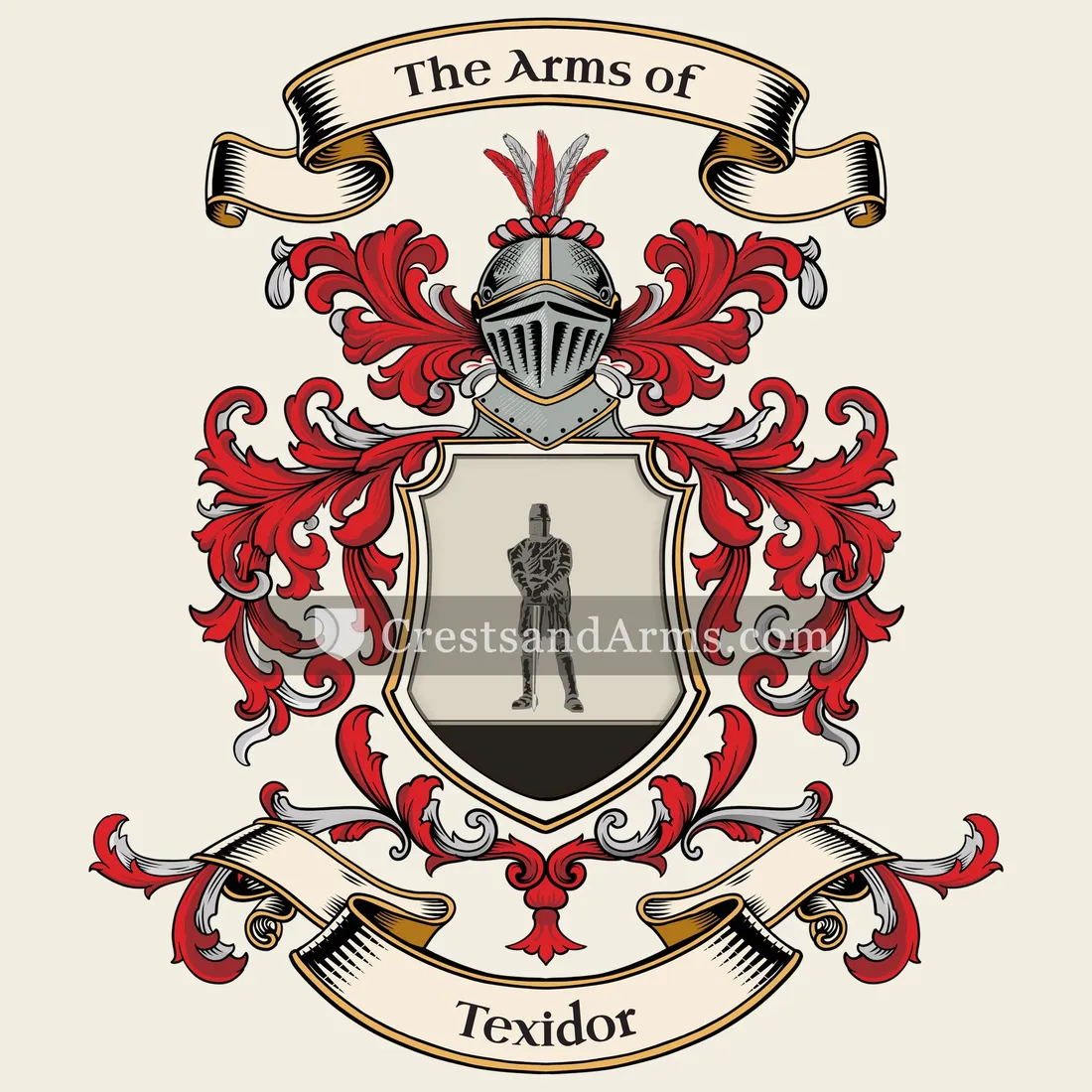
Symbols on this shield
knightChivalry and service in arms
Colours
Silver (Argent)Means: Peace and sincerity
Black (Sable)Means: Constancy
Historical info
Source
J. B. Rietstap, Armorial Général, Gouda: G. B. van Goor Zonen, 1884–87
Blazon (the actual original written record)
“D'arg. à la champagne crén. de sa.; l'arg. ch. d'un homme iss., arm. d'azur, tenant une épée et mouv. de la champagne. C.: l'homme, iss.”
GermanyAltdorf Bav, c. 1765
Digital archive packCoat of arms PNG, gold border print PDF, vector SVG and the certificate of authenticity. Sent to your email in minutes.
Map of Germany showing where the Texidor arms are recorded
The Texidor arms were recorded in Altdorf Bav, c. 1765.
This is where the arms were entered in the register. Families often moved to other parts of the country, so the same name can turn up in more than one region.
The body that granted and recorded arms in Germany in this period.
Francis I, Holy Roman Emperor
Sovereign of the period
Francis I, Holy Roman Emperor
1745–1765
Reigning in Belgium when the Texidor arms are first recorded.
How Arms Worked in Germany
In the Holy Roman Empire, coats of arms were often granted to individuals by the Emperor or his representatives. These arms were then passed down through the generations to all legitimate descendants of the original holder. Younger branches of a family usually kept the same shield design without needing to change it, as the arms belonged to the entire lineage.
Granting authority
The Holy Roman Emperor held the sole power to grant new coats of arms throughout his vast imperial territories.
How they got arms
Families typically obtained their coats of arms through a formal imperial grant or by proving their noble status to the authorities.
Where arms were recorded
These grants were officially recorded in the Imperial Chancery registers, which began keeping formal records of such honors during the Middle Ages.
The family's standing
Recorded among the armigerous families of Germany.
Origin & History of the Texidor Family in Germany
The history of the Texidor family in Germany is rooted in the small town of Altdorf, where records confirm their presence by 1765. During the eighteenth century, Altdorf was a center of academic life due to its famous university, which attracted scholars and skilled tradespeople from across the region. Families like the Texidors often integrated into these local communities by working in specialized crafts or administrative roles that supported the growing town. While the name itself suggests a potential connection to weaving or textile production, the family members in Altdorf became part of the local social fabric during a time of significant transition in the Holy Roman Empire. Their presence in the town archives provides a window into the lives of families who settled in central Europe, balancing their unique heritage with the daily demands of eighteenth-century German life.
Meaning of the Texidor family crest colors & symbols
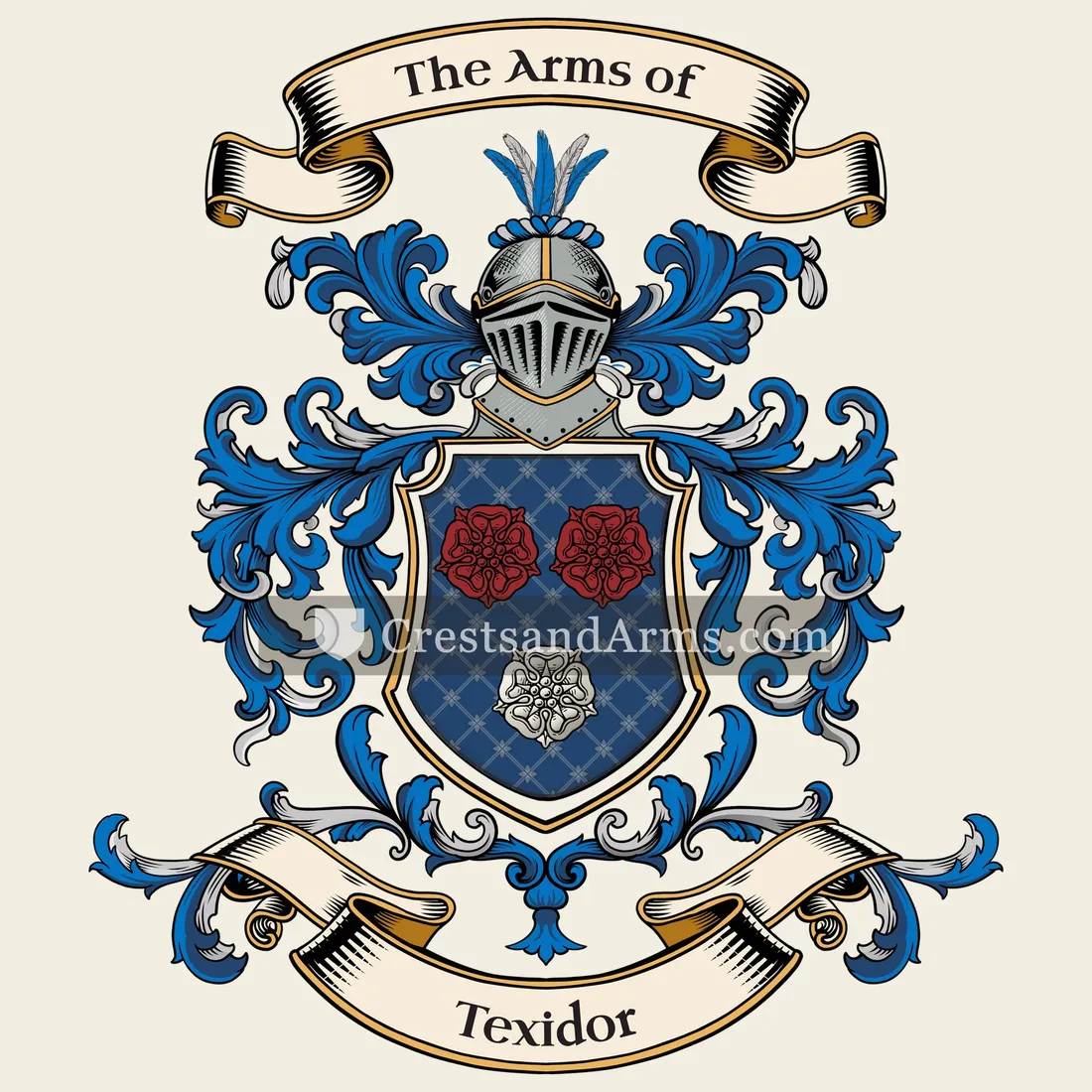
Symbols on this shield
roseThe seventh son, and beauty with grace
Colours
Blue (Azure)Means: Loyalty and truth
Red (Gules)Means: Military strength
Silver (Argent)Means: Peace and sincerity
Historical info
Source
J. B. Rietstap, Armorial Général, Gouda: G. B. van Goor Zonen, 1884–87
Blazon (the actual original written record)
“Taillé d'azur sur gu.; à trois roses, 2 et 1, les deux en chef de gu., la troisième en p. d'arg. Cq. cour. C.: trois pl. d'aut.: de gu., d'arg. et d'azur. L. d'azur et de gu.”
Switzerlandc. 1745
Digital archive packCoat of arms PNG, gold border print PDF, vector SVG and the certificate of authenticity. Sent to your email in minutes.
Map of Switzerland showing where the Texidor arms are recorded
The Texidor arms were recorded in Switzerland, c. 1745.
Arms such as these were typically recorded in Bern.
Bern was the largest of the Swiss cantons and ran itself, with its own council and its own courts. Its governing families held office for generations, and office of that kind carried a shield with it.
This is where the arms were entered in the register. Families often moved to other parts of the country, so the same name can turn up in more than one region.
The body that granted and recorded arms in Switzerland in this period.
How Arms Worked in Switzerland
In Switzerland, coats of arms were not restricted to the nobility and were often adopted by common citizens and families. These symbols were passed down through generations to show family identity. When branches of a family grew, they often changed small details of the design to distinguish their own line from the original group.
Granting authority
Cantonal and civic authorities managed the use of coats of arms within their specific regions and local jurisdictions.
How they got arms
Families typically assumed their own coats of arms based on local custom rather than receiving them from a central monarch.
Where arms were recorded
Arms were recorded in various cantonal and civic registers starting from the fourteenth century throughout the Swiss region.
The family's standing
Recorded among the armigerous families of Switzerland.
Origin & History of the Texidor Family in Switzerland
The history of the Texidor family in Switzerland begins with established records of their presence in the city of Bern by 1745. During this period, Bern was a powerful center of trade and politics, and families like the Texidors often integrated into the urban fabric as skilled workers or merchants. The name itself suggests a connection to the craft of weaving, as it derives from roots related to textile production. By settling in the Swiss Confederation during the mid-eighteenth century, the family became part of a diverse group of residents who contributed to the local economy and social life of the capital. While the name is not native to the German-speaking regions of Switzerland, the family successfully navigated the strict citizenship and residency laws of the time to maintain a stable life in the canton. Their presence in 1745 marks a significant point in their migration history, showing how they adapted to the unique cultural and political landscape of the Swiss Alps.
Texidor Meaning & Related Branches
Root word
Textor
Latin term for a weaver or one who constructs.
This name
TexidorAn occupational surname denoting a person who worked as a weaver or fabric maker.
also spelled
Textour
Weaver
Documented Sources
J. B. Rietstap, Armorial Général, Gouda: G. B. van Goor Zonen, 1884–87
Archives de l'État à Liège, Registres paroissiaux de la ville de Liège, 1737
Kupper, Jean-Louis, Liège et l'Église impériale, 1981
Stiennon, Jacques, Histoire de Liège, 1991
Digital archive packCoat of arms PNG, gold border print PDF, vector SVG and the certificate of authenticity. Sent to your email in minutes.


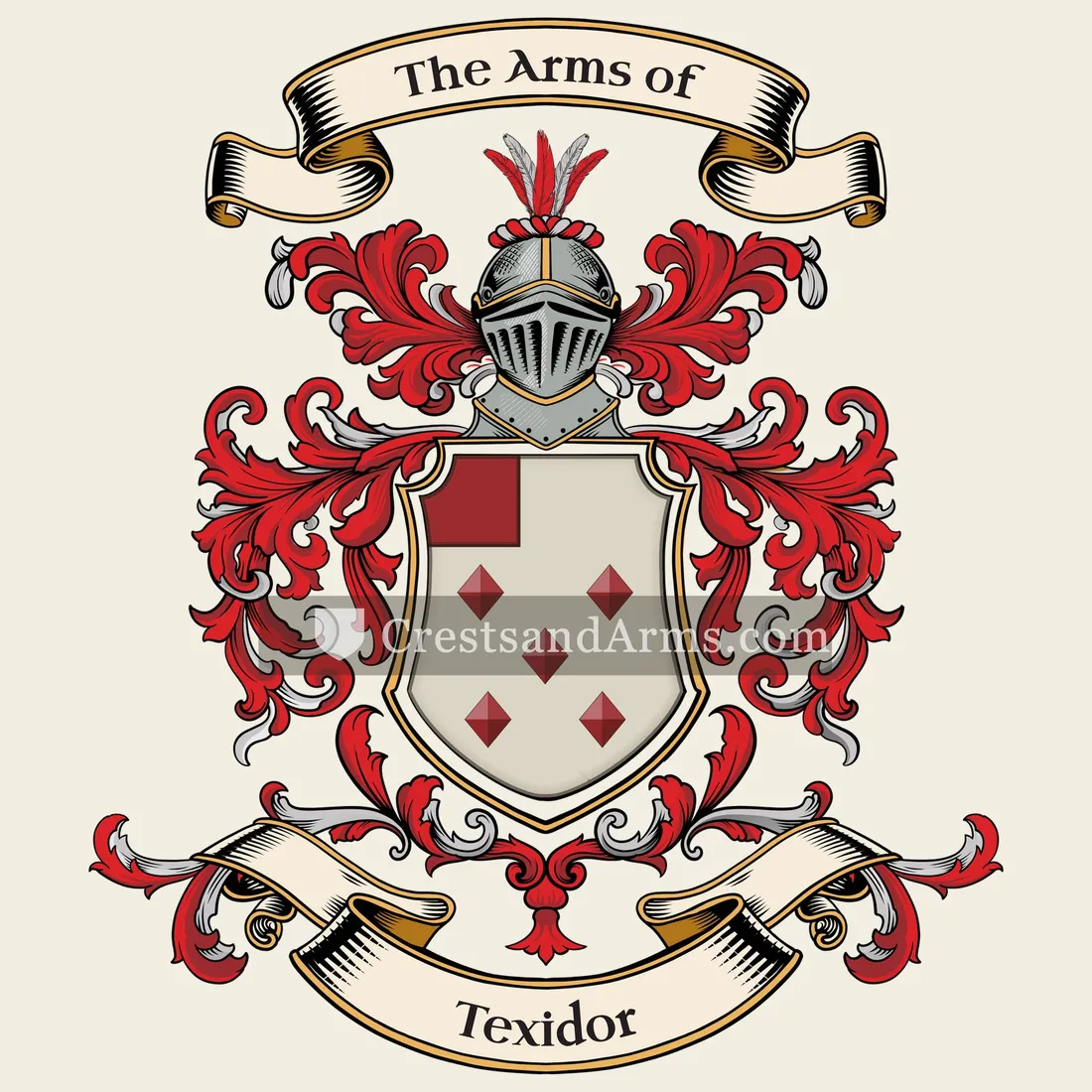
 lozengeHonour and nobility, and the arms of a woman
 spurKnighthood, and readiness to spur on
 lozengeHonour and nobility, and the arms of a woman
 spurKnighthood, and readiness to spur on


 knightChivalry and service in arms


 roseThe seventh son, and beauty with grace