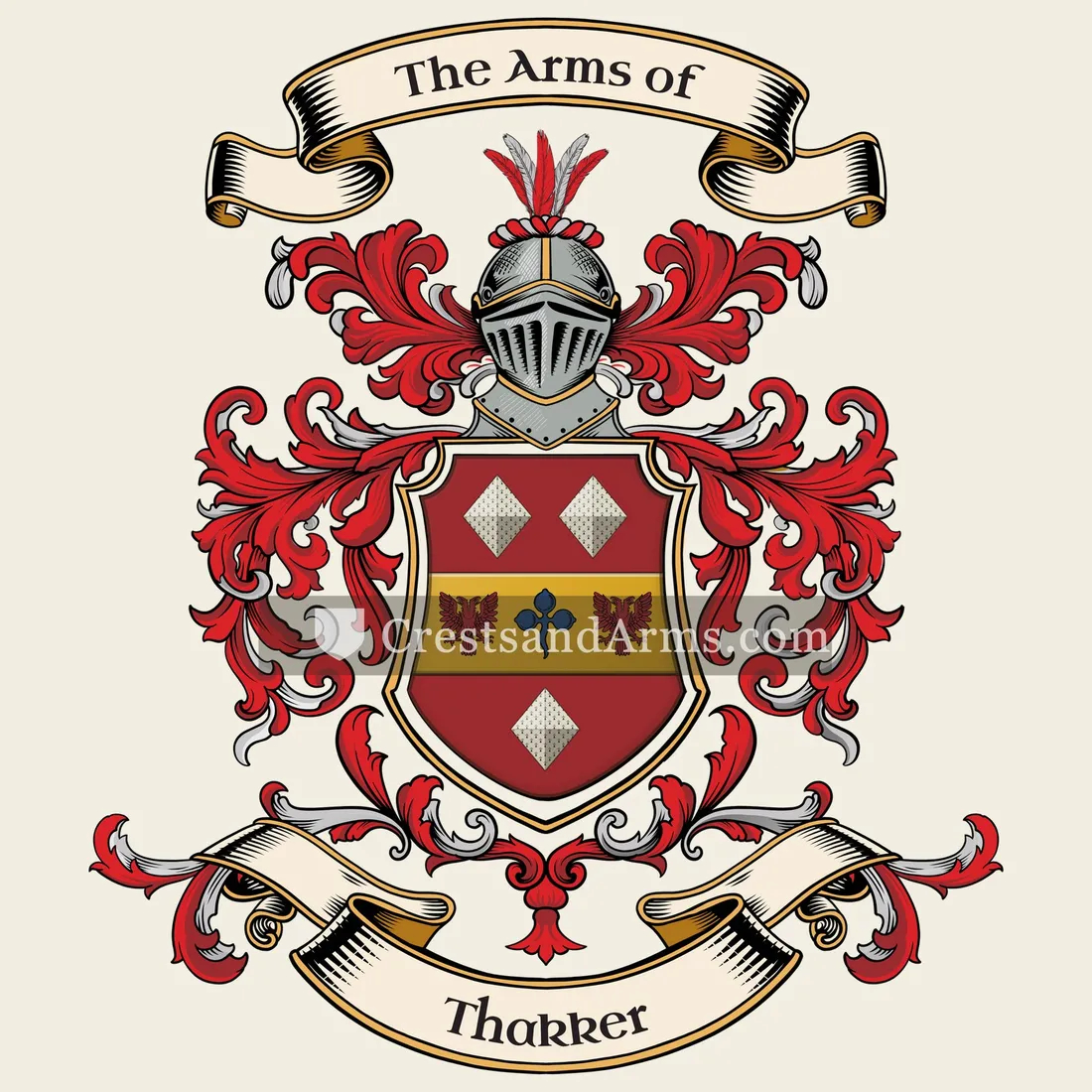
A record of documented arms, meaning and origin, researched for the Thakker family of England.
Reg. 1226 · English, T–V
Meaning of the Thakker family crest colors & symbols
Symbols on this shield
fessThe military belt, and readiness to serve
trefoilPerpetuity, and the Trinity
lozengeHonour and nobility, and the arms of a woman
eagleNobility, strength and a keen mind
Colours
Red (Gules)Means: Military strength
Gold (Or)Means: Generosity
Blue (Azure)Means: Loyalty and truth
ErmineMeans: Dignity
Historical info
Source
Sir Bernard Burke, The General Armory of England, Scotland, Ireland and Wales, London: Harrison & Sons, 1884
Blazon (the actual original written record)
“Gu. on a fess or, betw. three lozenges erm. a trefoil slipped az. betw. two eagles' heads erased of the field, beaked ar. and about their necks a leash of the last”
DerbyRepton Priory · Derby, c. 1540
Digital archive packCoat of arms PNG, gold border print PDF, vector SVG and the certificate of authenticity. Sent to your email in minutes.
Map of England showing where the Thakker arms are recorded
The Thakker arms were recorded in Derby, c. 1540.
Derbyshire had lead mines in its hills and good grazing in its valleys. Both made steady money, and families who made it bought manors, which is what put their names into the heraldic records.
This is where the arms were entered in the register. Families often moved to other parts of the country, so the same name can turn up in more than one region.
The body that granted and recorded arms in England in this period.
Henry VIII of England
Sovereign of the period
Henry VIII of England
1509–1547
Reigning in England when the Thakker arms are first recorded.
How Arms Worked in England
English heraldry allowed arms to be shared by all legitimate descendants of the original owner. These symbols were treated as personal property that moved through the generations to all children. While the eldest son kept the original design, other family members could use the same shield without needing to change it or register their own unique versions.
Granting authority
The College of Arms in London has regulated the use of coats of arms throughout England and Wales since 1484.
How they got arms
Families typically obtained their coats of arms through a formal grant from the Crown or by proving their ancient right to them.
Where arms were recorded
All official coats of arms are recorded in the registers kept at the College of Arms, which date back to the fifteenth century.
The family's standing
Recorded among the armigerous families of Derby.
Origin & History of the Thakker Family in England
The surname Thakker is an occupational name that originated in medieval England to describe a person who worked as a thatcher. During a time when most homes were built with timber frames and mud walls, these skilled workers were essential for applying straw or reeds to roofs to keep houses dry and warm. By the year 1540, records confirm that members of the Thakker family were already established in the town of Derby. Living in a bustling market town like Derby suggests that these early ancestors likely provided their services to a growing population of merchants and tradespeople. Over the centuries, the spelling of the name evolved from its descriptive roots into the family surname that is recognized today. This history reflects the transition of simple job titles into permanent family identities during the late Middle Ages and the early modern period.
Thakker Meaning & Related Branches
Root word
Thatcher
A person who covers roofs with straw or reeds.
This name
ThakkerAn occupational surname for someone who worked as a roof thatcher.
also spelled
Thacker
Thakkar
Documented Sources
Sir Bernard Burke, The General Armory of England, Scotland, Ireland and Wales, London: Harrison & Sons, 1884
Reaney, P.H., A Dictionary of English Surnames, 1991
Derbyshire Record Office, Derby St Alkmund Parish Registers, 1540
Digital archive packCoat of arms PNG, gold border print PDF, vector SVG and the certificate of authenticity. Sent to your email in minutes.


 fessThe military belt, and readiness to serve
 trefoilPerpetuity, and the Trinity
 lozengeHonour and nobility, and the arms of a woman
 eagleNobility, strength and a keen mind
 fessThe military belt, and readiness to serve
 trefoilPerpetuity, and the Trinity
 lozengeHonour and nobility, and the arms of a woman
 eagleNobility, strength and a keen mind