Map of England showing where the Thayer arms are recorded
The Thayer arms were recorded in Essex, c. 1620.
Essex lay close enough to London for City money to buy land there. Merchants who prospered moved out to estates within a day's ride, and a new landowner almost always wanted arms to go with the ground.
This is where the arms were entered in the register. Families often moved to other parts of the country, so the same name can turn up in more than one region.
The body that granted and recorded arms in England in this period.
James VI and I
Sovereign of the period
James VI and I
1603–1625
Reigning in England when the Thayer arms are first recorded.
How Arms Worked in England
English heraldry allowed arms to be shared by all legitimate descendants of the original owner. These symbols were treated as personal property that moved through the generations to all children. While the eldest son kept the original design, other family members could use the same shield without needing to change it or register their own unique versions.
Granting authority
The College of Arms in London has regulated the use of coats of arms throughout England and Wales since 1484.
How they got arms
Families typically obtained their coats of arms through a formal grant from the Crown or by proving their ancient right to them.
Where arms were recorded
All official coats of arms are recorded in the registers kept at the College of Arms, which date back to the fifteenth century.
The family's standing
Recorded among the armigerous families of Essex.
Origin & History of the Thayer Family in England
The surname Thayer is believed to have originated in England, where it functioned as a topographic name for someone who lived near a specific type of dwelling or land feature. Etymologists often link the name to the Old English word "tayer," which referred to a thatcher or a person who covered roofs with straw. By the early 17th century, the family had established a notable presence in the county of Essex. Records confirm that members of the Thayer family were living in this region by 1620, shortly before some of them embarked on the journey to the American colonies. These early ancestors were typically yeomen or tradespeople who played a steady role in the local economy of their English parishes. Their transition from Essex to the New World marked the beginning of the family's long history in North America, where they continued to document their lineage through meticulous church and civil records.
Related Branches & Arms
Root word
taegere
Old English term for a person who cuts or a tailor.
This name
ThayerAn occupational surname for someone who worked as a tailor or cutter of cloth.
also spelled
Thayre
Thair
Documented Sources
Sir Bernard Burke, The General Armory of England, Scotland, Ireland and Wales, London: Harrison & Sons, 1884
Bardsley, Charles Wareing, A Dictionary of English and Welsh Surnames, 1901
Thayer, Bezaleel, Memorial of the Thayer Name, from the Massachusetts Colony of Weymouth and Braintree, Embracing Genealogical and Biographical Sketches of Richard & Thomas Thayer, and their Descendants from 1636 to 1874, 1874
Essex Record Office, Parish Registers of Thornbury and surrounding Essex districts, 1600–1630
Digital archive packCoat of arms PNG, gold border print PDF, vector SVG and the certificate of authenticity. Sent to your email in minutes.


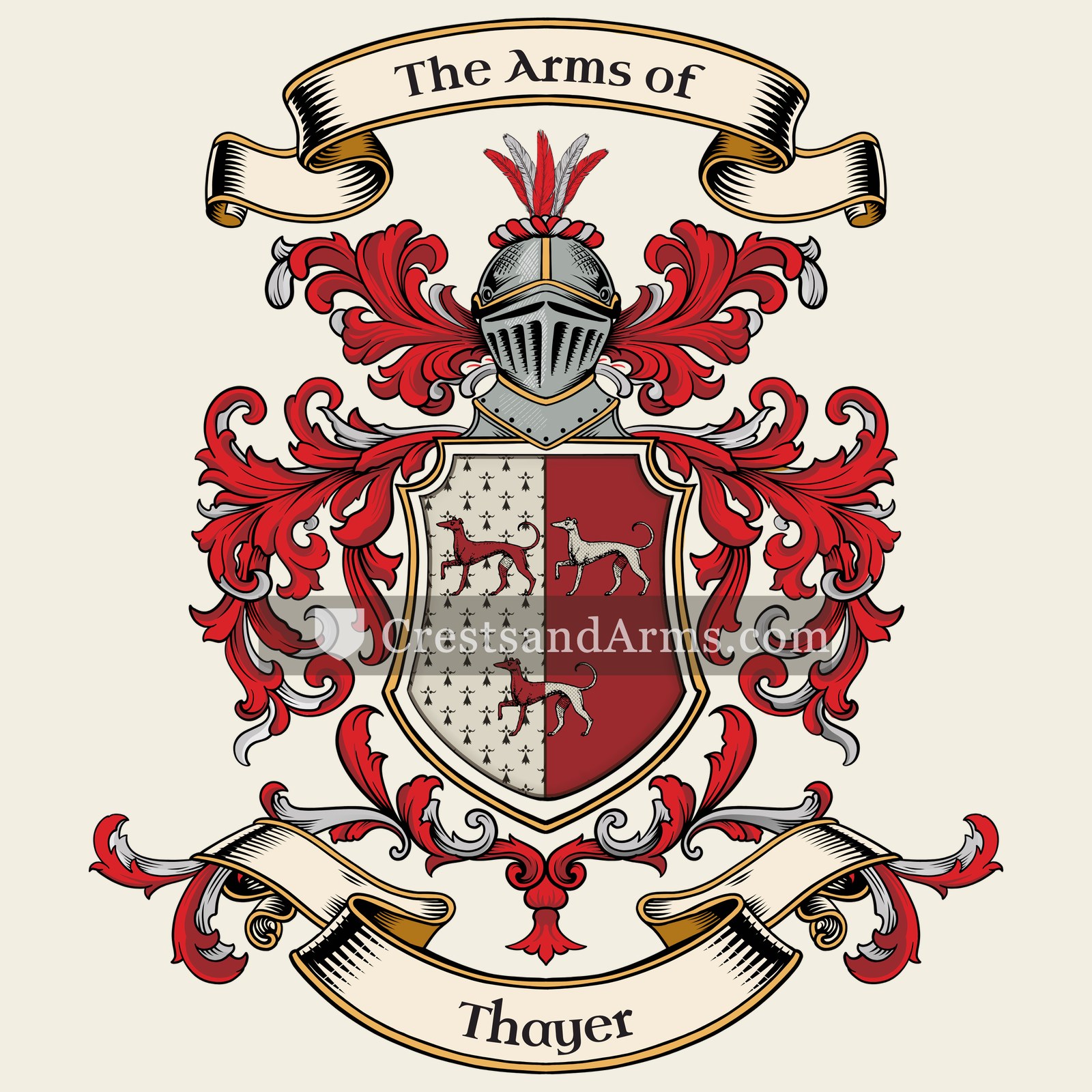
 paleMilitary strength, and a fortified defence
 greyhoundCourage, vigilance and loyalty
 paleMilitary strength, and a fortified defence
 greyhoundCourage, vigilance and loyalty