Map of Ireland showing where the Thede arms are recorded
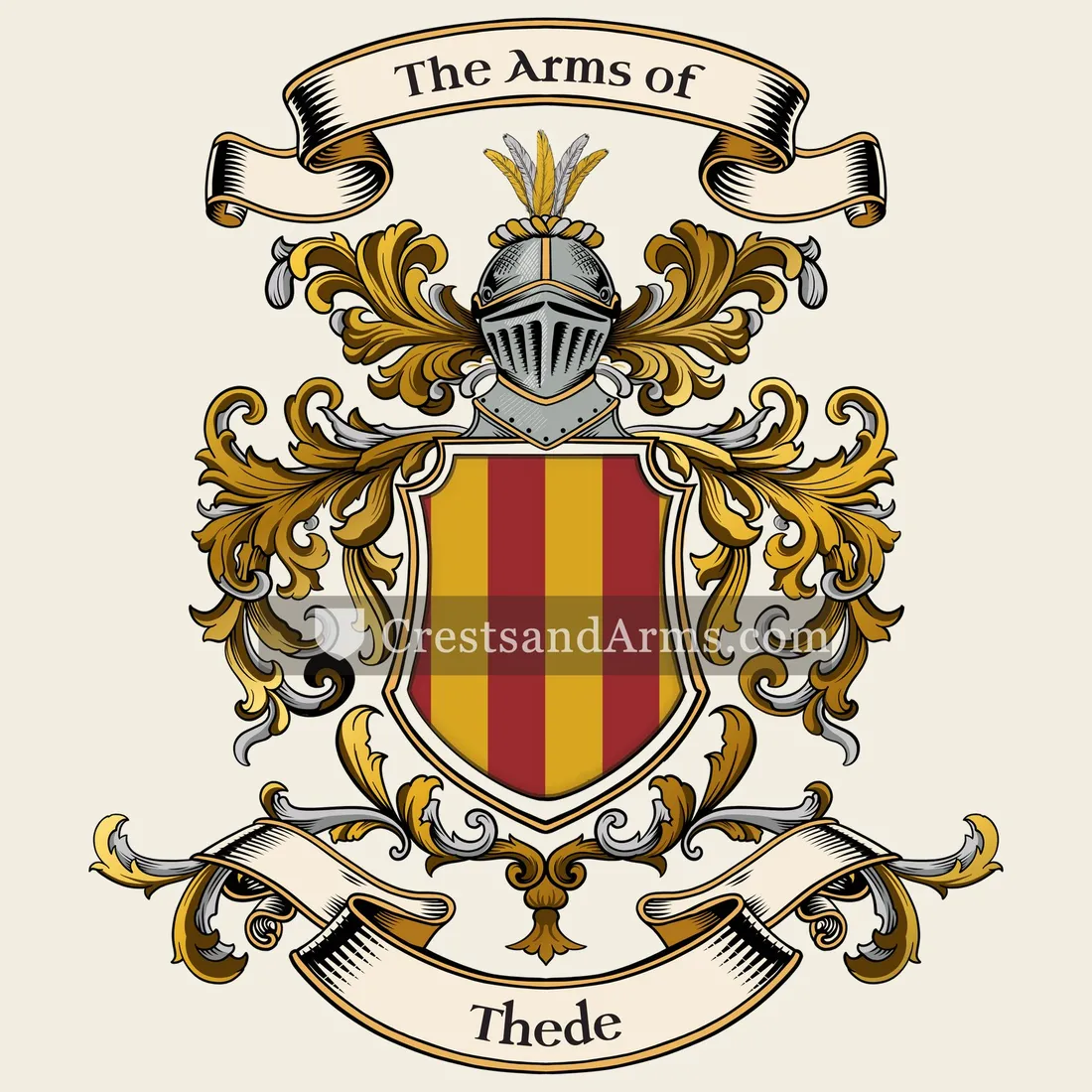
The Thede arms were recorded in Wexford, c. 1717.
Wexford was the corner of Ireland closest to Wales, settled early by Norman families. They held their land under arms and kept it for generations, which is why so many Wexford names carry recorded shields.
This is where the arms were entered in the register. Families often moved to other parts of the country, so the same name can turn up in more than one region.
The body that granted and recorded arms in Ireland in this period.
George I of Great Britain
Sovereign of the period
George I of Great Britain
1714–1727
Reigning in Ireland when the Thede arms are first recorded.
How Arms Worked in Ireland
The Ulster King of Arms granted coats of arms to individuals who proved their social standing and good character. These symbols were typically inherited by all legitimate descendants of the original holder. If a family branch wanted a unique look, they could apply for a specific change to their design through the office to ensure their identity remained distinct.
Granting authority
The Ulster King of Arms acted as the official body that regulated and issued all coats of arms throughout Ireland.
How they got arms
Families obtained their arms through formal grants issued by the office after proving their eligibility and paying the required fees.
Where arms were recorded
All official grants were recorded in the registers held by the Ulster King of Arms starting from the year 1552.
The family's standing
Recorded among the armigerous families of Wexford.
Origin & History of the Thede Family in Ireland
The family name Thede is a variation of the Germanic name Theod, which finds its roots in the Old High German word for people or nation. Historically, families carrying this name were often associated with the northern regions of Germany and the coastal areas of the Baltic Sea. By the early 18th century, members of the family had migrated to other parts of Europe, including the town of Wexford in Ireland by 1717. This relocation was likely part of a broader movement of people seeking new opportunities or fleeing regional instability during that era. Once in Wexford, these early settlers integrated into the local community and began to establish their roots in a new cultural environment. The survival of the name through these migrations highlights the resilience of the family as they adapted to different languages and social structures over several generations.
Thede Meaning & Related Branches
Root word
Theodoric
Derived from Germanic elements meaning ruler of the people.
This name
ThedeA patronymic surname originating from a short form of Germanic names containing the element meaning people.
also spelled
Thead
Documented Sources
Sir Bernard Burke, The General Armory of England, Scotland, Ireland and Wales, London: Harrison & Sons, 1884
Förstemann, Ernst. Altdeutsches Namenbuch. 1900
National Archives of Ireland. 1717 Wexford Census and Parish Records