Map of Ireland showing where the Thiede arms are recorded
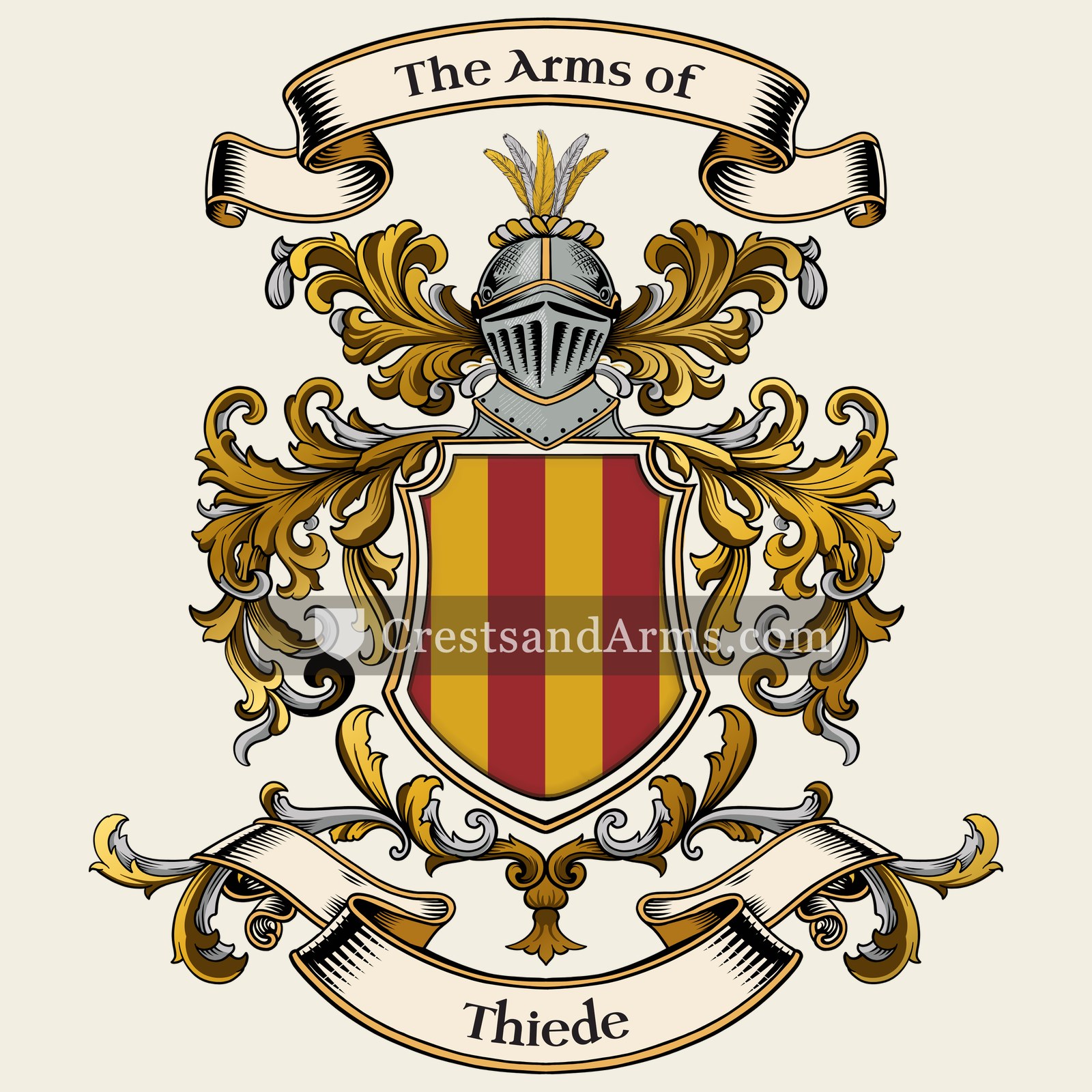
The Thiede arms were recorded in Wexford, c. 1717.
Wexford was the corner of Ireland closest to Wales, settled early by Norman families. They held their land under arms and kept it for generations, which is why so many Wexford names carry recorded shields.
This is where the arms were entered in the register. Families often moved to other parts of the country, so the same name can turn up in more than one region.
The body that granted and recorded arms in Ireland in this period.
George I of Great Britain
Sovereign of the period
George I of Great Britain
1714–1727
Reigning in Ireland when the Thiede arms are first recorded.
How Arms Worked in Ireland
The Ulster King of Arms granted coats of arms to individuals who proved their social standing and good character. These symbols were typically inherited by all legitimate descendants of the original holder. If a family branch wanted a unique look, they could apply for a specific change to their design through the office to ensure their identity remained distinct.
Granting authority
The Ulster King of Arms acted as the official body that regulated and issued all coats of arms throughout Ireland.
How they got arms
Families obtained their arms through formal grants issued by the office after proving their eligibility and paying the required fees.
Where arms were recorded
All official grants were recorded in the registers held by the Ulster King of Arms starting from the year 1552.
The family's standing
Recorded among the armigerous families of Wexford.
Origin & History of the Thiede Family in Ireland
The surname Thiede originates from Northern Germany and is a shortened form of the ancient Germanic name Dietrich, which translates to ruler of the people. Families carrying this name were historically tied to the regions of Pomerania and Prussia, where they often worked as landowners or skilled tradespeople. By the early 18th century, members of the Thiede family began to migrate across Europe in search of new opportunities. Records confirm that by 1717, individuals bearing the name had established a presence in Wexford, Ireland. This movement suggests that the family was part of a broader trend of European migration during the 1700s, as people moved to escape local conflicts or to pursue trade connections in developing port cities. Once in Ireland, the family integrated into the local community while maintaining their distinct linguistic heritage.
Related Branches & Arms
Root word
Theodoric
Derived from Germanic elements meaning ruler of the people.
This name
ThiedeA patronymic surname indicating descent from a person named Theodoric.
also spelled
Thead
Documented Sources
Sir Bernard Burke, The General Armory of England, Scotland, Ireland and Wales, London: Harrison & Sons, 1884
Bahlow, Hans, Deutsches Namenlexikon: Familien- und Vornamen nach Ursprung und Sinn erklärt, 1967
National Archives of Ireland, Wexford Census and Estate Records, 1717