Map of Britain showing where the Thirlwell arms are recorded
The Thirlwell arms were recorded in Essex, c. 1700.
Essex lay close enough to London for City money to buy land there. Merchants who prospered moved out to estates within a day's ride, and a new landowner almost always wanted arms to go with the ground.
This is where the arms were entered in the register. Families often moved to other parts of the country, so the same name can turn up in more than one region.
The body that granted and recorded arms in Britain in this period.
William III of England
Sovereign of the period
William III of England
1694–1702
Reigning in Britain when the Thirlwell arms are first recorded.
How Arms Worked in Britain
English heraldry allowed arms to be shared by all legitimate descendants of the original owner. These symbols were treated as personal property that moved through the generations to all children. While the eldest son kept the original design, other family members could use the same shield without needing to change it or register their own unique versions.
Granting authority
The College of Arms in London has regulated the use of coats of arms throughout England and Wales since 1484.
How they got arms
Families typically obtained their coats of arms through a formal grant from the Crown or by proving their ancient right to them.
Where arms were recorded
All official coats of arms are recorded in the registers kept at the College of Arms, which date back to the fifteenth century.
The family's standing
Recorded among the armigerous families of Essex.
Origin & History of the Thirlwell Family in Britain
The surname Thirlwell is rooted in the landscape of Northern England, specifically deriving from the Old Norse words for a narrow opening or a gap in a wall. Historically, the name is linked to a site near Hadrian’s Wall in Northumberland, where a castle of the same name once stood. While the family originated in the north, by the year 1700, records confirm that members of the Thirlwell family had established a presence in Essex. This migration likely occurred as individuals moved south in search of new economic opportunities or through marriage and local employment. During this period, families often moved across the country to work in emerging trade centers, and the presence of the Thirlwell name in Essex suggests that the family was part of this broader movement of people across England. Over time, the name evolved in spelling, but it remained a marker of a family that transitioned from the rugged northern frontier to the agricultural and developing regions of the southeast.
Related Branches & Arms
Root word
Thirl-well
Derived from Old Norse thyrill meaning hole and well meaning spring.
This name
ThirlwellA locational surname referring to a spring or stream near a gap.
also spelled
Thirlwal
Tirlwall
Thirlwell
Thirlwald
Thirwall
Documented Sources
J. B. Rietstap, Armorial Général, Gouda: G. B. van Goor Zonen, 1884–87
Reaney, P.H., A Dictionary of British Surnames, 1958
Ekwall, Eilert, The Concise Oxford Dictionary of English Place-Names, 1960
The National Archives, Parish registers for Essex, 1700
Digital archive packCoat of arms PNG, gold border print PDF, vector SVG and the certificate of authenticity. Sent to your email in minutes.


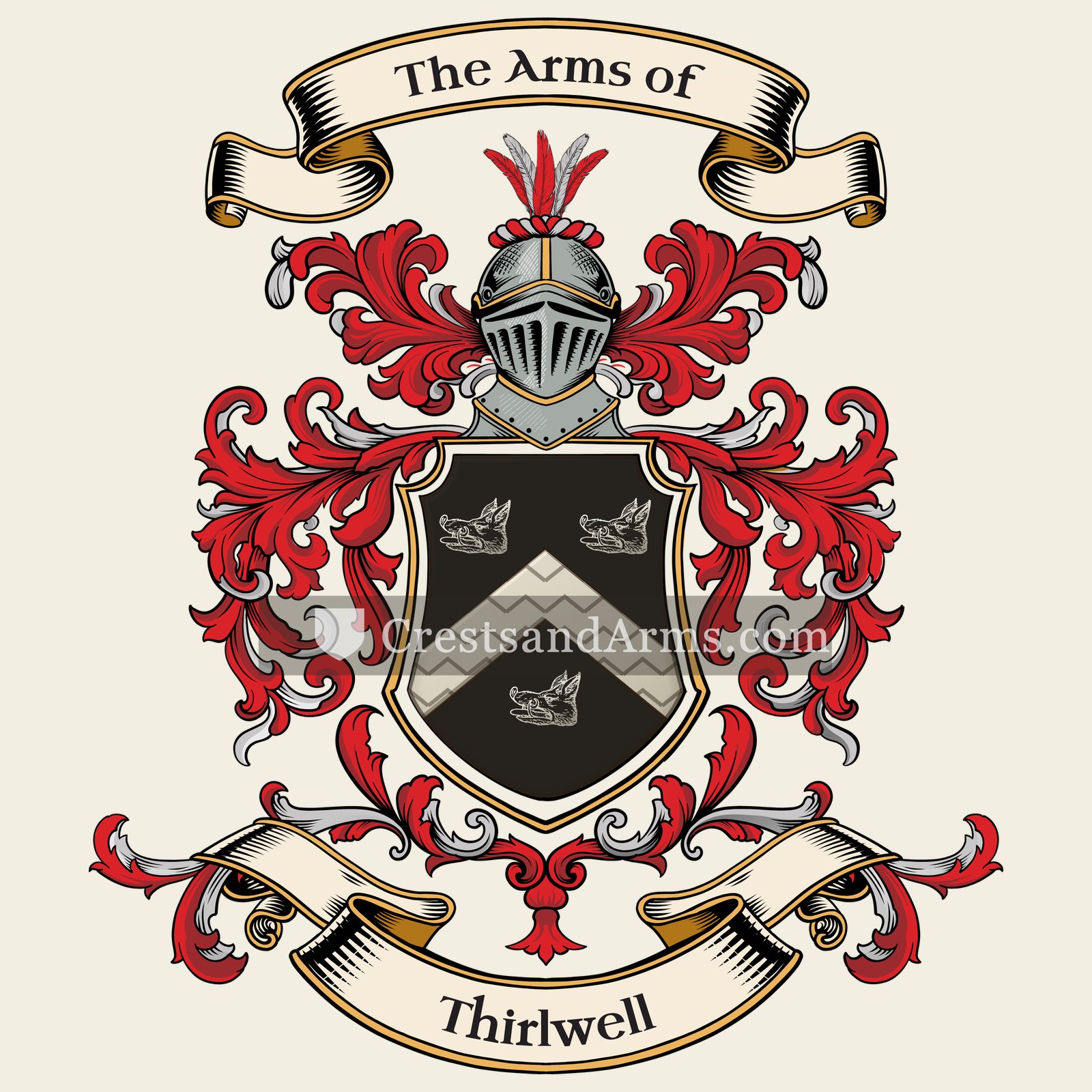
 chevronProtection, and faithful service completed
 boars headA fierce fighter who battles to the end
 chevronProtection, and faithful service completed
 boars headA fierce fighter who battles to the end