A record of documented arms, meaning and origin, researched for the Thomson family lines. Documented in 3 countries.
Reg. 7557 · Swedish, T–V
Coat of Arms & Family Crest Details
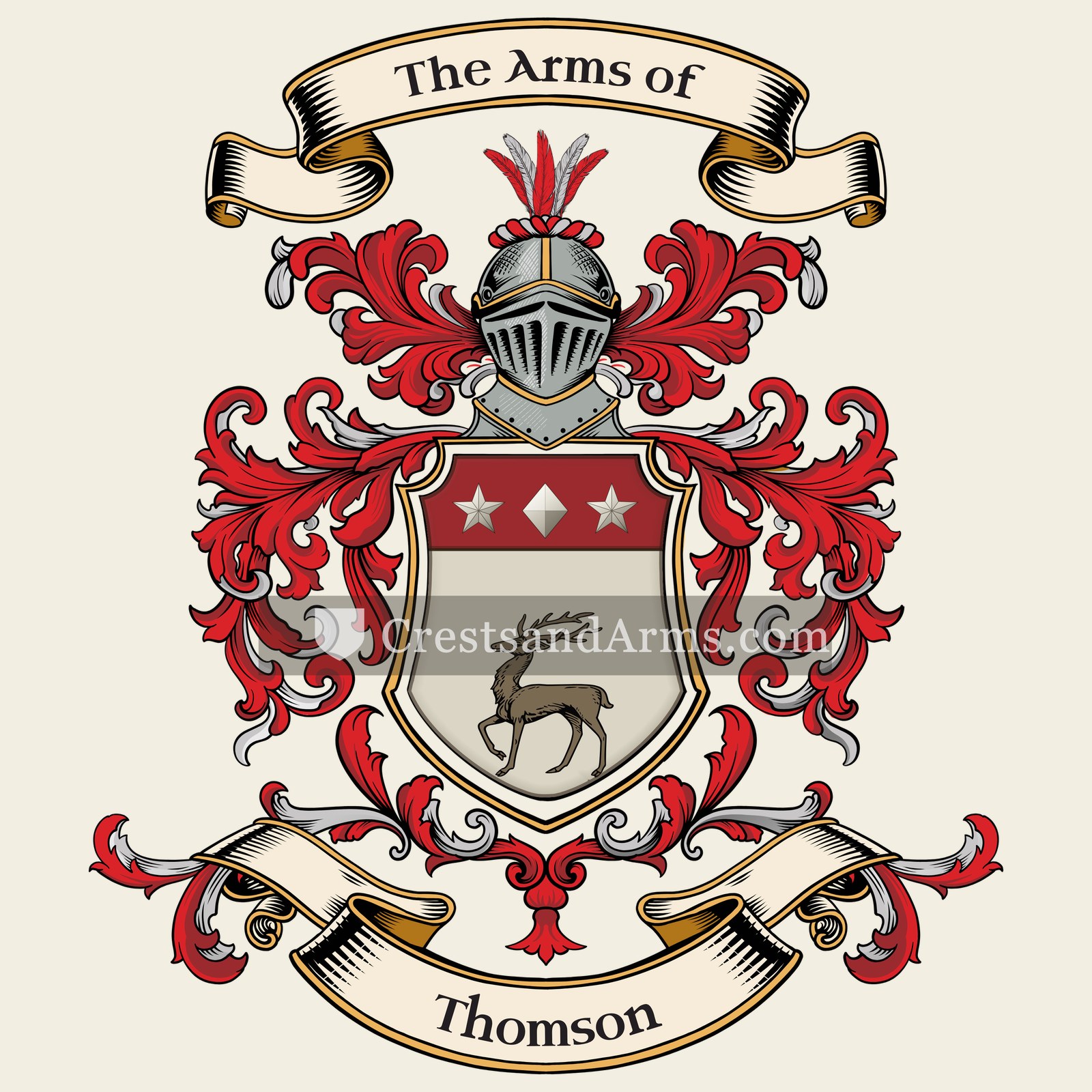
Symbols on this shield
chiefAuthority, wisdom and dominion
cross symbolChristian faith and service
stagPeace and harmony, and one who will not fight unprovoked
mulletThe third son, and a divine quality from above
Colours
Gold (Or)Means: Generosity
Blue (Azure)Means: Loyalty and truth
Red (Gules)Means: Military strength
Historical info
Source
J. B. Rietstap, Armorial Général, Gouda: G. B. van Goor Zonen, 1884–87
Blazon (the actual original written record)
“D'or à un rencontre de cerf de gu.; au chef d'azur, ch. d'une croix recr. au pied fiché d'or, accostée de deux molettes (5) du même. C.: un bras, arm. au nat., la main de carn. brandissant une épée d'arg., garnie d'or. L.: à dextre d'or et de gu., à sen. d'or et d'azur.”
Swedenc. 1700
Digital archive packCoat of arms PNG, gold border print PDF, vector SVG and the certificate of authenticity. Sent to your email in minutes.
Map of Sweden showing where the Thomson arms are recorded
The Thomson arms were recorded in Sweden, c. 1700.
Arms such as these were typically recorded in Stockholm.
Stockholm held the Swedish court and the House of Nobility, where every noble family's arms were entered and kept. Families ennobled for service registered there, which is why so many are recorded around the city.
This is where the arms were entered in the register. Families often moved to other parts of the country, so the same name can turn up in more than one region.
The body that granted and recorded arms in Sweden in this period.
Carl XII of Sweden
Sovereign of the period
Carl XII of Sweden
1697–1718
Reigning in Sweden when the Thomson arms are first recorded.
How Arms Worked in Sweden
In Sweden, a coat of arms belonged to a noble family as a whole rather than just one individual. These arms were passed down through the generations to all legitimate descendants. Younger branches of the family used the same shield without needing to change it. This system ensured that the entire lineage shared the same identity and status under the law.
Granting authority
The Riddarhuset, or House of Nobility, regulated all noble coats of arms in Sweden under royal authority.
How they got arms
Families received their coats of arms through royal grants of nobility which were then officially registered with the House.
Where arms were recorded
Coats of arms were officially recorded in the Swedish House of Nobility register starting in the year 1626.
The family's standing
Recorded among the armigerous families of Sweden.
Origin & History of the Thomson Family in Sweden
The family name Thomson first appeared in the Swedish capital of Stockholm during the early 1700s. At that time, Sweden was a major power in Northern Europe, and the city served as a busy hub for international trade and diplomacy. Many people with names like Thomson arrived in Sweden from Scotland or England to work as merchants, craftsmen, or military officers. These individuals often integrated into Swedish society by learning the local language and forming business partnerships with established families. Over the following decades, the name became a permanent part of the urban landscape as these settlers raised families and contributed to the growth of Stockholm. By settling in the city, they helped bridge the cultural gap between the British Isles and the Swedish Baltic region during a period of rapid economic change.
Coat of Arms & Family Crest Details
Symbols on this shield
lionCourage, strength and royalty
Colours
Blue (Azure)Means: Loyalty and truth
Gold (Or)Means: Generosity
Historical info
Source
Sir Bernard Burke, The General Armory of England, Scotland, Ireland and Wales, London: Harrison & Sons, 1884
Blazon (the actual original written record)
“Az. a lion pass. guard. or”
EssexShalfield · Essex, c. 1620
Digital archive packCoat of arms PNG, gold border print PDF, vector SVG and the certificate of authenticity. Sent to your email in minutes.
Map of England showing where the Thomson arms are recorded
The Thomson arms were recorded in Essex, c. 1620.
Essex lay close enough to London for City money to buy land there. Merchants who prospered moved out to estates within a day's ride, and a new landowner almost always wanted arms to go with the ground.
This is where the arms were entered in the register. Families often moved to other parts of the country, so the same name can turn up in more than one region.
The body that granted and recorded arms in England in this period.
James VI and I
Sovereign of the period
James VI and I
1603–1625
Reigning in Sweden when the Thomson arms are first recorded.
How Arms Worked in England
English heraldry allowed arms to be shared by all legitimate descendants of the original owner. These symbols were treated as personal property that moved through the generations to all children. While the eldest son kept the original design, other family members could use the same shield without needing to change it or register their own unique versions.
Granting authority
The College of Arms in London has regulated the use of coats of arms throughout England and Wales since 1484.
How they got arms
Families typically obtained their coats of arms through a formal grant from the Crown or by proving their ancient right to them.
Where arms were recorded
All official coats of arms are recorded in the registers kept at the College of Arms, which date back to the fifteenth century.
The family's standing
Recorded among the armigerous families of Essex.
Origin & History of the Thomson Family in England
The surname Thomson is a patronymic name, which means it was originally created to identify a person as the son of Thomas. This name became popular in England following the arrival of the Normans, as Saint Thomas of Canterbury became a highly revered figure across the country. By the early 17th century, the name was well-established among families living in the county of Essex. Records from 1620 show that members of the Thomson family were active in this region during a time of great social change. These early ancestors were often part of the growing middle class, working as farmers, tradespeople, or local officials. As the family settled into their communities, the spelling of the name sometimes shifted between Thomson and Thompson, but both versions remained rooted in the same long history of English naming traditions.
Coat of Arms & Family Crest Details
Symbols on this shield
chiefAuthority, wisdom and dominion
lozengeHonour and nobility, and the arms of a woman
stagPeace and harmony, and one who will not fight unprovoked
mulletThe third son, and a divine quality from above
Colours
Silver (Argent)Means: Peace and sincerity
Red (Gules)Means: Military strength
Historical info
Source
Sir Bernard Burke, The General Armory of England, Scotland, Ireland and Wales, London: Harrison & Sons, 1884
Blazon (the actual original written record)
“Ar. a stag's head cabossed ppr. on a chief wavy gu. a lozenge betw. two mullets of the field”
AberdeenAberdeen, c. 1630
Digital archive packCoat of arms PNG, gold border print PDF, vector SVG and the certificate of authenticity. Sent to your email in minutes.
Map of Scotland showing where the Thomson arms are recorded
The Thomson arms were recorded in Aberdeen, c. 1630.
Aberdeen was a granite trading town on the north-east coast with farming country behind it. Merchants who prospered bought estates inland, and buying an estate was what brought a family its arms.
This is where the arms were entered in the register. Families often moved to other parts of the country, so the same name can turn up in more than one region.
The body that granted and recorded arms in Scotland in this period.
Charles I of England
Sovereign of the period
Charles I of England
1625–1649
Reigning in Sweden when the Thomson arms are first recorded.
How Arms Worked in Scotland
Scottish heraldry is unique because it treats a coat of arms as a piece of personal property protected by law. Only one person can own a specific design at any given time. When a family grows, the head keeps the original shield while other relatives must apply for their own distinct version with slight changes to prove their specific identity.
Granting authority
The Court of the Lord Lyon acts as the official body that regulates and controls all heraldic matters throughout Scotland.
How they got arms
Individuals obtain a legal right to their arms through a formal petition process that confirms their identity and family connection.
Where arms were recorded
All valid coats of arms are officially entered into the Public Register of All Arms and Bearings starting from 1672.
The family's standing
Recorded among the armigerous families of Aberdeen.
Origin & History of the Thomson Family in Scotland
The surname Thomson is a patronymic name, which means it was originally created to identify a person as the son of Thomas. In Scotland, this name became very common because Thomas was a popular given name during the Middle Ages. By the early seventeenth century, the family had established a notable presence in the city of Aberdeen. Historical records confirm that members of the Thomson family were living and working in this bustling port city by 1630. During this period, Aberdeen was a center for trade and education, and families like the Thomsons often integrated into the local merchant class or the growing academic community. As the name spread across the Scottish Lowlands, it evolved from a simple description of parentage into a permanent family identity that was passed down through generations.
Related Branches & Arms
Root word
Thomas
Derived from the Aramaic word for twin.
This name
ThomsonA patronymic surname meaning son of Thomas.
also spelled
Tomson
Thompson
Related arms
Dicksonsame arms
Hillsame arms
Murraysame arms
Thompsonvariant spelling
Documented Sources
J. B. Rietstap, Armorial Général, Gouda: G. B. van Goor Zonen, 1884–87
Andersson, Ingvar, Sveriges historia, 1960
Stockholm City Archives (Stockholms stadsarkiv), Mantalslängder för Stockholms stad (Tax census records for the city of Stockholm), 1700–1750
Åberg, Alf, Skottar i Sverige, 1956
Digital archive packCoat of arms PNG, gold border print PDF, vector SVG and the certificate of authenticity. Sent to your email in minutes.


 chiefAuthority, wisdom and dominion
 cross symbolChristian faith and service
 stagPeace and harmony, and one who will not fight unprovoked
 mulletThe third son, and a divine quality from above
 chiefAuthority, wisdom and dominion
 cross symbolChristian faith and service
 stagPeace and harmony, and one who will not fight unprovoked
 mulletThe third son, and a divine quality from above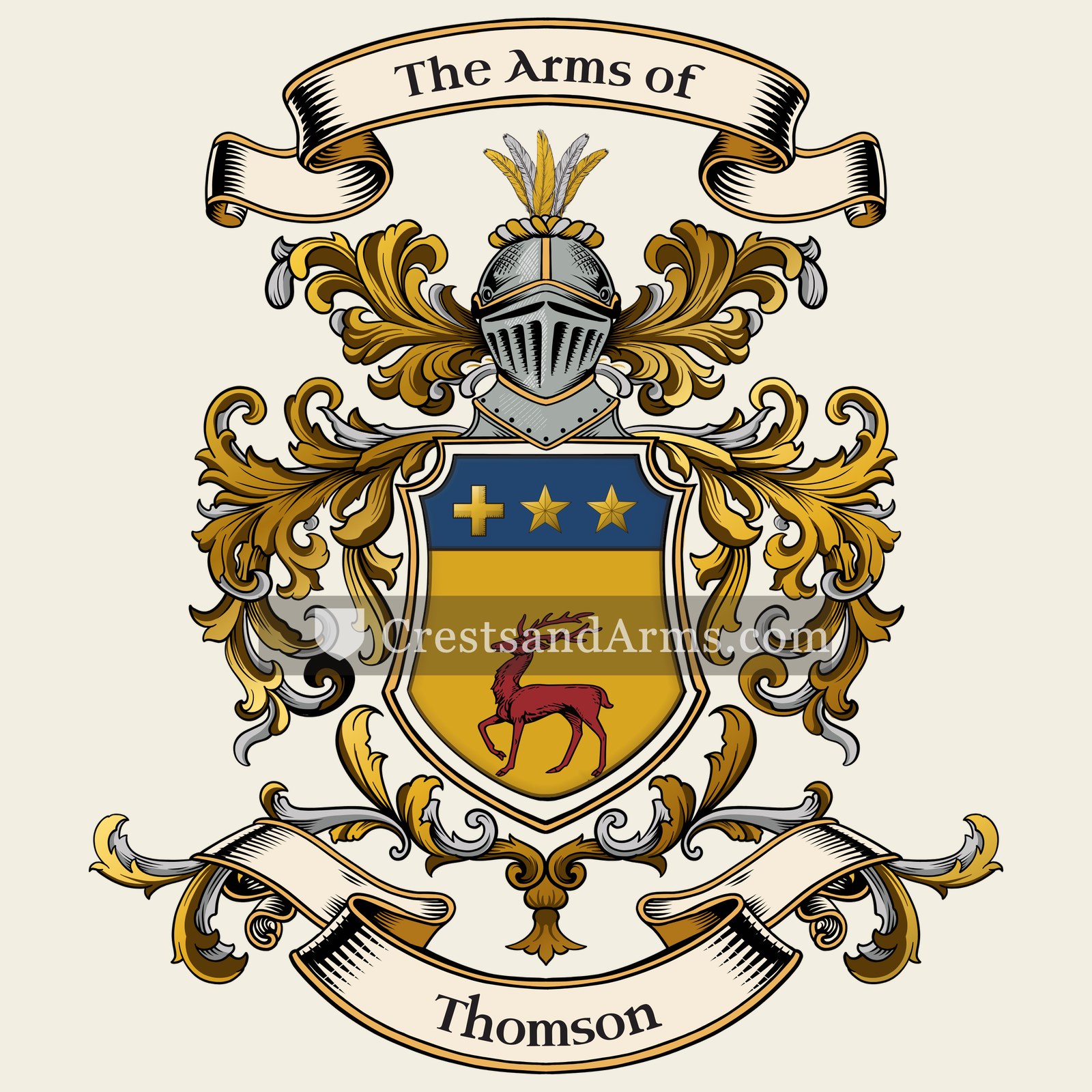


 lionCourage, strength and royalty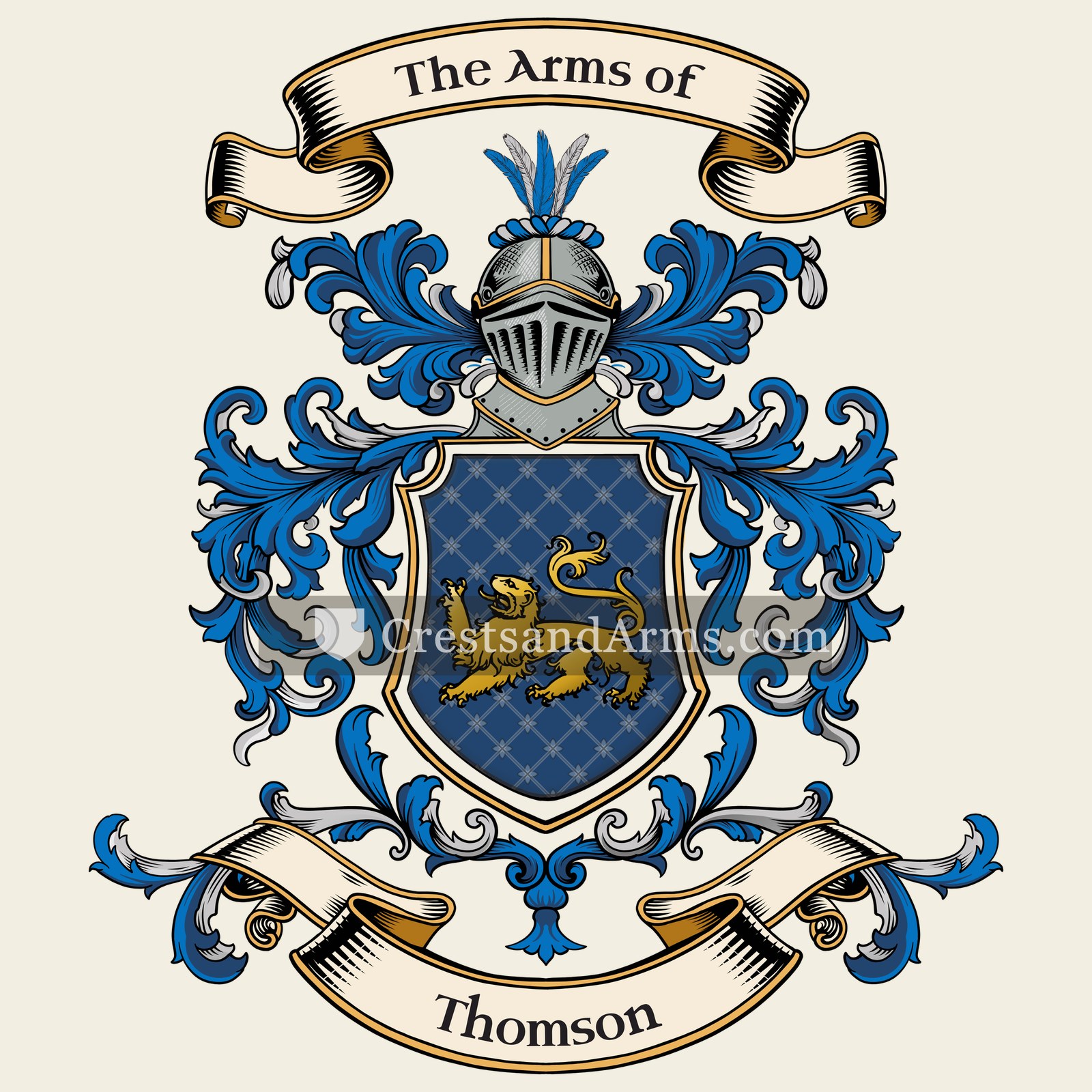


 lozengeHonour and nobility, and the arms of a woman