Map of Britain showing where the Thornhill arms are recorded
The Thornhill arms were recorded in Kent, c. 1682.
Kent sits between London and the short crossing to Europe, and the trade passing through made it wealthy. Merchant families bought land with that money, and it was landowners who took coats of arms.
This is where the arms were entered in the register. Families often moved to other parts of the country, so the same name can turn up in more than one region.
The body that granted and recorded arms in Britain in this period.
Charles II of England
Sovereign of the period
Charles II of England
1660–1685
Reigning in Britain when the Thornhill arms are first recorded.
How Arms Worked in Britain
English heraldry allowed arms to be shared by all legitimate descendants of the original owner. These symbols were treated as personal property that moved through the generations to all children. While the eldest son kept the original design, other family members could use the same shield without needing to change it or register their own unique versions.
Granting authority
The College of Arms in London has regulated the use of coats of arms throughout England and Wales since 1484.
How they got arms
Families typically obtained their coats of arms through a formal grant from the Crown or by proving their ancient right to them.
Where arms were recorded
All official coats of arms are recorded in the registers kept at the College of Arms, which date back to the fifteenth century.
The family's standing
Recorded among the armigerous families of Kent.
Origin & History of the Thornhill Family in Britain
The name Thornhill is a classic example of a locational surname, which means it was originally adopted by families living near a specific geographical feature. In Old English, the name combines the words for a thorn bush and a hill, suggesting that the earliest ancestors likely resided on or near a prominent, thorny slope. By the time the family was firmly established in Kent during the late seventeenth century, the name had already been in use across various parts of England for several hundred years. These early families were typically tied to the land, working as farmers or local tradespeople who became known to their neighbors by the landscape features that defined their homes. As the family grew and moved throughout the British Isles, the name remained a simple but descriptive marker of their deep connection to the rural English countryside.
Coat of Arms & Family Crest Details
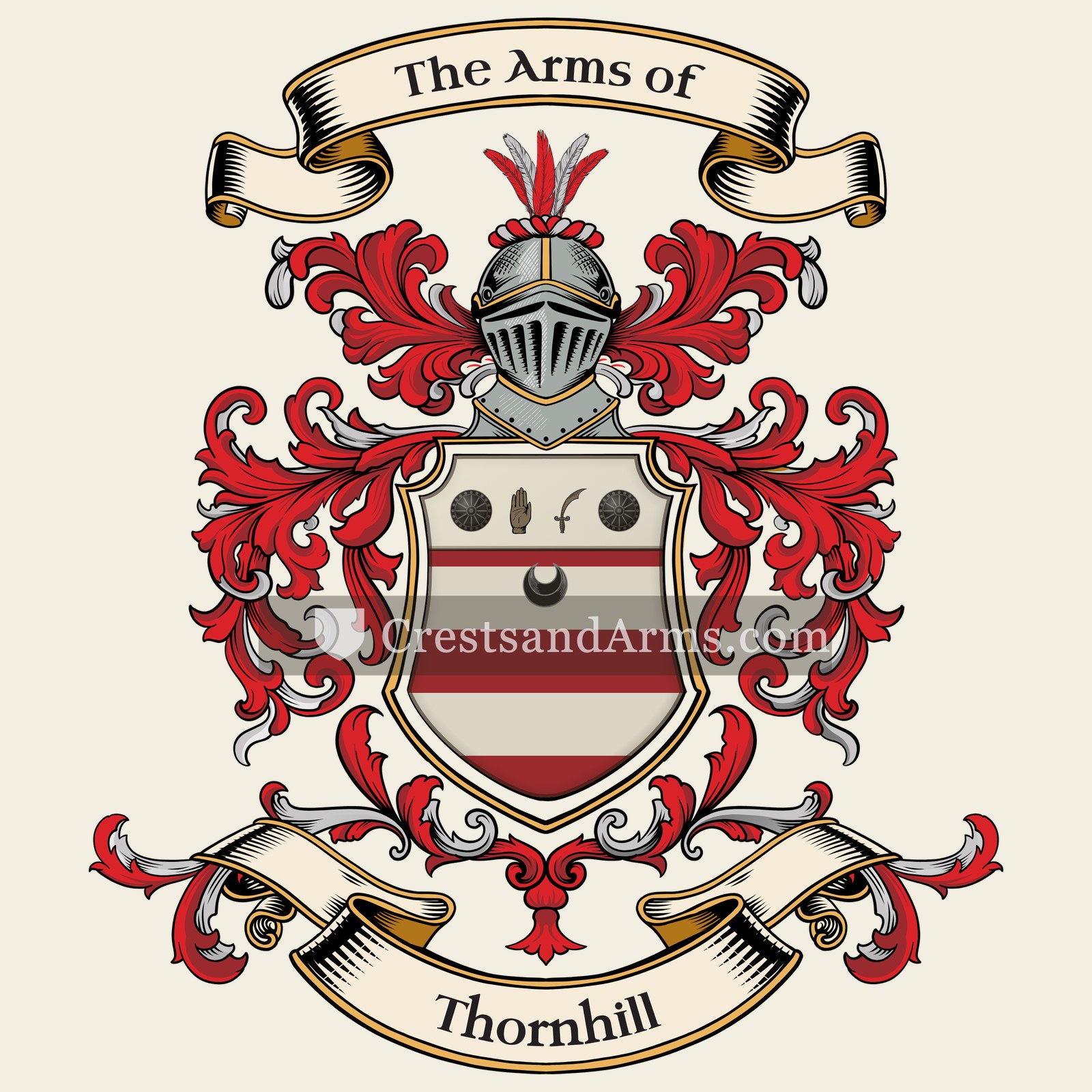
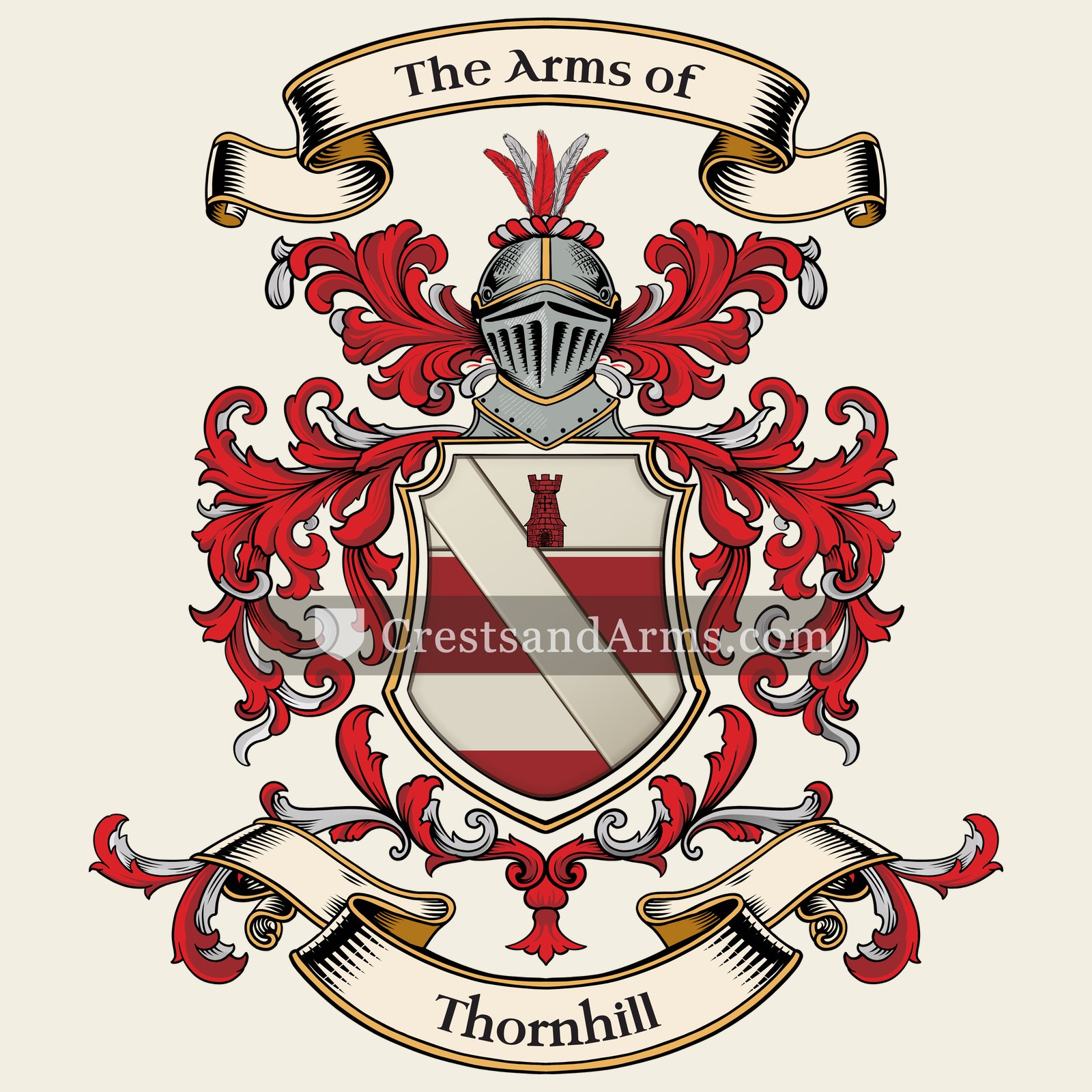
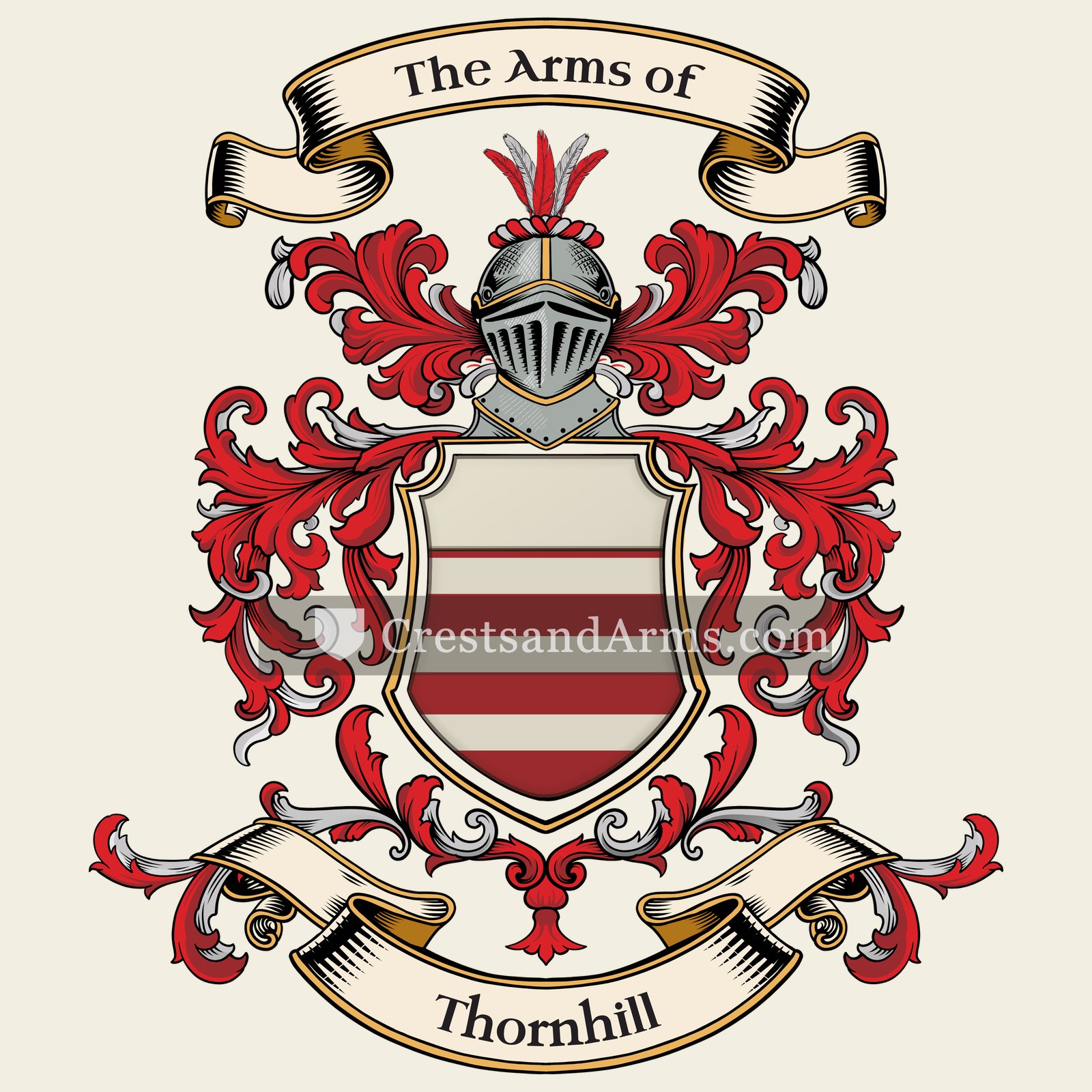
Symbols on this shield
chiefAuthority, wisdom and dominion
Colours
Red (Gules)Means: Military strength
Silver (Argent)Means: Peace and sincerity
Historical info
Source
Sir Bernard Burke, The General Armory of England, Scotland, Ireland and Wales, London: Harrison & Sons, 1884
Blazon (the actual original written record)
“Gu. four bars gemel ar. a chief of the last”
LincolnOwston · Lincoln, c. 1620
Digital archive packCoat of arms PNG, gold border print PDF, vector SVG and the certificate of authenticity. Sent to your email in minutes.
Map of England showing where the Thornhill arms are recorded
The Thornhill arms were recorded in Lincoln, c. 1620.
Lincolnshire was rich farming country, and its wealth was spread across many middling families. Households of that size bought land and took arms, and the county holds a large share of English names.
This is where the arms were entered in the register. Families often moved to other parts of the country, so the same name can turn up in more than one region.
The body that granted and recorded arms in England in this period.
James VI and I
Sovereign of the period
James VI and I
1603–1625
Reigning in Britain when the Thornhill arms are first recorded.
How Arms Worked in England
English heraldry allowed arms to be shared by all legitimate descendants of the original owner. These symbols were treated as personal property that moved through the generations to all children. While the eldest son kept the original design, other family members could use the same shield without needing to change it or register their own unique versions.
Granting authority
The College of Arms in London has regulated the use of coats of arms throughout England and Wales since 1484.
How they got arms
Families typically obtained their coats of arms through a formal grant from the Crown or by proving their ancient right to them.
Where arms were recorded
All official coats of arms are recorded in the registers kept at the College of Arms, which date back to the fifteenth century.
The family's standing
Recorded among the armigerous families of Lincoln.
Origin & History of the Thornhill Family in England
The surname Thornhill is a locational name that originated in England, typically referring to individuals who lived near a hill covered in thorny bushes. While the name appears in various regions across the country, historical records confirm that members of the Thornhill family were established in the city of Lincoln by 1620. During this period, Lincoln was a significant regional hub where families often settled near the cathedral or along the busy trade routes of the East Midlands. As the family became rooted in this area, they participated in the local economy and social life of the city. Over time, the name spread as descendants moved throughout England to pursue new opportunities in agriculture, trade, and civic life. This transition from a descriptive nickname to a formal family name reflects the way many English surnames were formed during the Middle Ages and solidified through local parish records in the early seventeenth century.
Coat of Arms & Family Crest Details
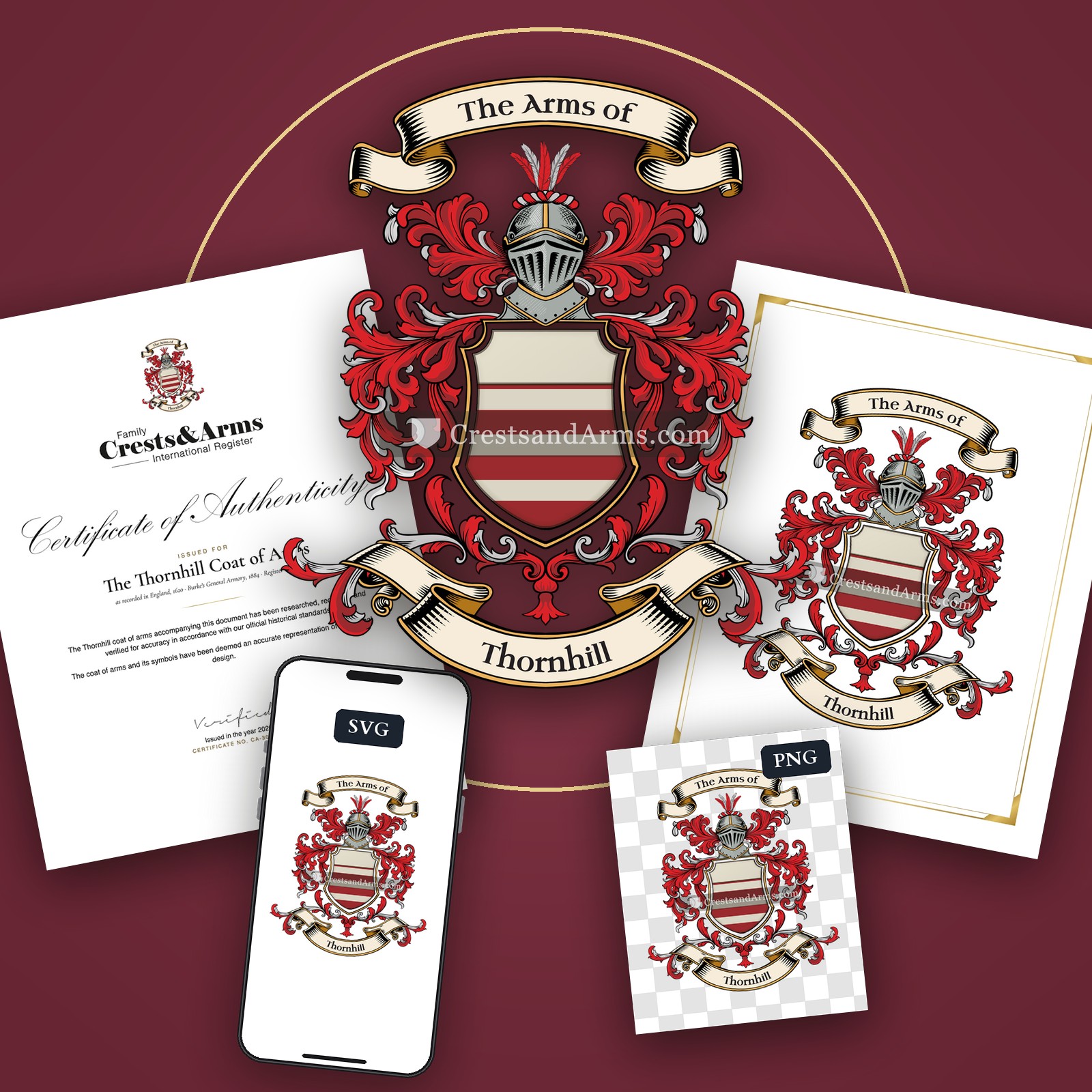
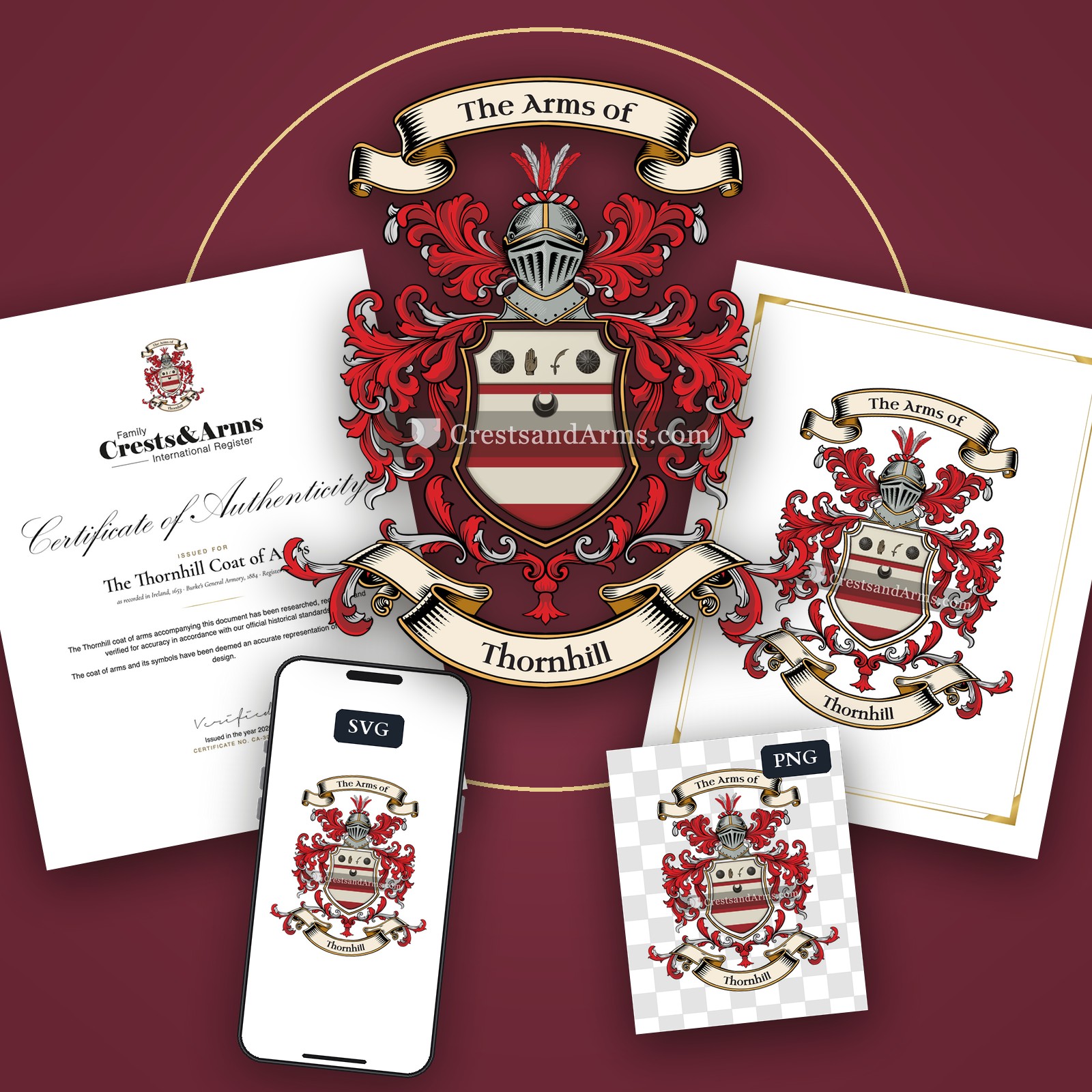
Symbols on this shield
chiefAuthority, wisdom and dominion
handFaith, sincerity and justice
swordJustice, and military honour
roundelA coin, and one who has been to the crusades
crescentHonour by the sovereign, and the second son
Colours
Red (Gules)Means: Military strength
Silver (Argent)Means: Peace and sincerity
Black (Sable)Means: Constancy
Historical info
Source
Sir Bernard Burke, The General Armory of England, Scotland, Ireland and Wales, London: Harrison & Sons, 1884
Blazon (the actual original written record)
“Barry of ten gu. and ar. on a chief of the second a hand and sword ppr. sleeved az. betw. two pellets, a crescent for diff”
CorkCork, c. 1653
Digital archive packCoat of arms PNG, gold border print PDF, vector SVG and the certificate of authenticity. Sent to your email in minutes.
Map of Ireland showing where the Thornhill arms are recorded
The Thornhill arms were recorded in Cork, c. 1653.
Cork was the largest county in Ireland, with a great harbour and a wide farming hinterland. Both English settlers and older Irish families held land there, and holding land is what brought a family into the records.
This is where the arms were entered in the register. Families often moved to other parts of the country, so the same name can turn up in more than one region.
The body that granted and recorded arms in Ireland in this period.
How Arms Worked in Ireland
The Ulster King of Arms granted coats of arms to individuals who proved their social standing and good character. These symbols were typically inherited by all legitimate descendants of the original holder. If a family branch wanted a unique look, they could apply for a specific change to their design through the office to ensure their identity remained distinct.
Granting authority
The Ulster King of Arms acted as the official body that regulated and issued all coats of arms throughout Ireland.
How they got arms
Families obtained their arms through formal grants issued by the office after proving their eligibility and paying the required fees.
Where arms were recorded
All official grants were recorded in the registers held by the Ulster King of Arms starting from the year 1552.
The family's standing
Recorded among the armigerous families of Cork.
Origin & History of the Thornhill Family in Ireland
The Thornhill family name in Ireland is deeply rooted in the history of County Cork, where records confirm their presence as early as 1653. During this period, the family became established in the region following the Cromwellian land settlements that reshaped Irish society. Many families who arrived or rose to prominence during the mid-seventeenth century were often involved in the administration of land or military service, which helped them secure a stable foothold in the local community. Over the following generations, the Thornhills integrated into the social and economic fabric of Munster, transitioning from newcomers to long-standing residents. Their history serves as a window into the complex patterns of migration and land ownership that defined seventeenth-century Ireland, marking the beginning of a multi-generational legacy in the southern part of the country.
Thornhill Meaning & Related Branches
Root word
Thorn and Hyll
A prickly shrub and a natural elevation of land.
This name
ThornhillRefers to a person who lived near a hill covered in thorn bushes.
also spelled
Tornhill
Thornhille
Thornhyll
Thornhull
Thornell
Related arms
Thornellvariant spelling
Thornhullvariant spelling
Adamsrecorded with Thornhill, same area
Bacherecorded with Thornhill, same area
Documented Sources
J. B. Rietstap, Armorial Général, Gouda: G. B. van Goor Zonen, 1884–87
Reaney, P.H., A Dictionary of English Surnames, 1991
Lower, Mark Antony, Patronymica Britannica: A Dictionary of the Family Names of the United Kingdom, 1860
Kent Archives, Quarter Sessions Records: Petitions and Orders, 1682
Digital archive packCoat of arms PNG, gold border print PDF, vector SVG and the certificate of authenticity. Sent to your email in minutes.


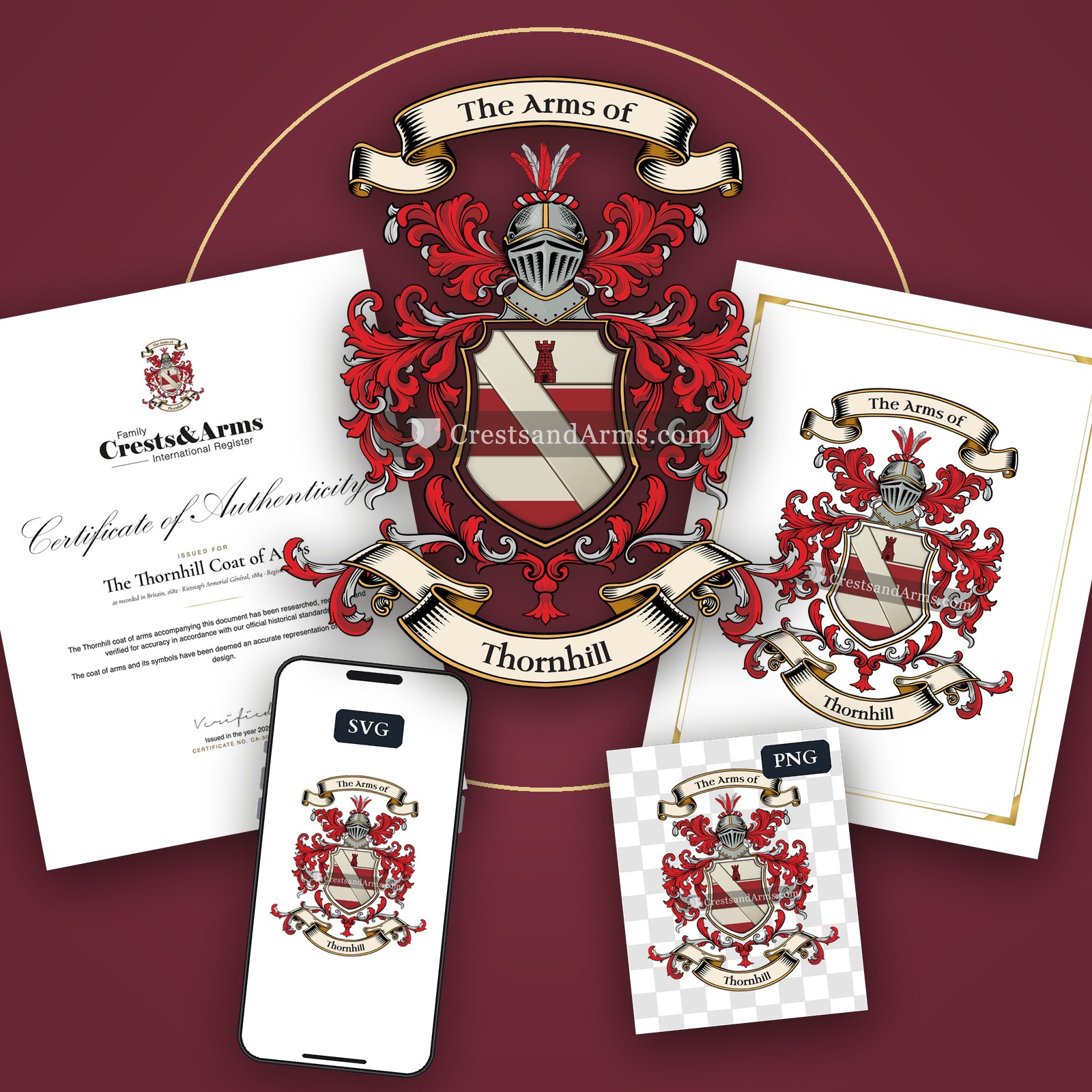
 bendDefence, and the scarf of a commander
 chiefAuthority, wisdom and dominion
 towerGrandeur and solidity, and a stronghold defended
 bendDefence, and the scarf of a commander
 chiefAuthority, wisdom and dominion
 towerGrandeur and solidity, and a stronghold defended



 handFaith, sincerity and justice
 swordJustice, and military honour
 roundelA coin, and one who has been to the crusades
 crescentHonour by the sovereign, and the second son