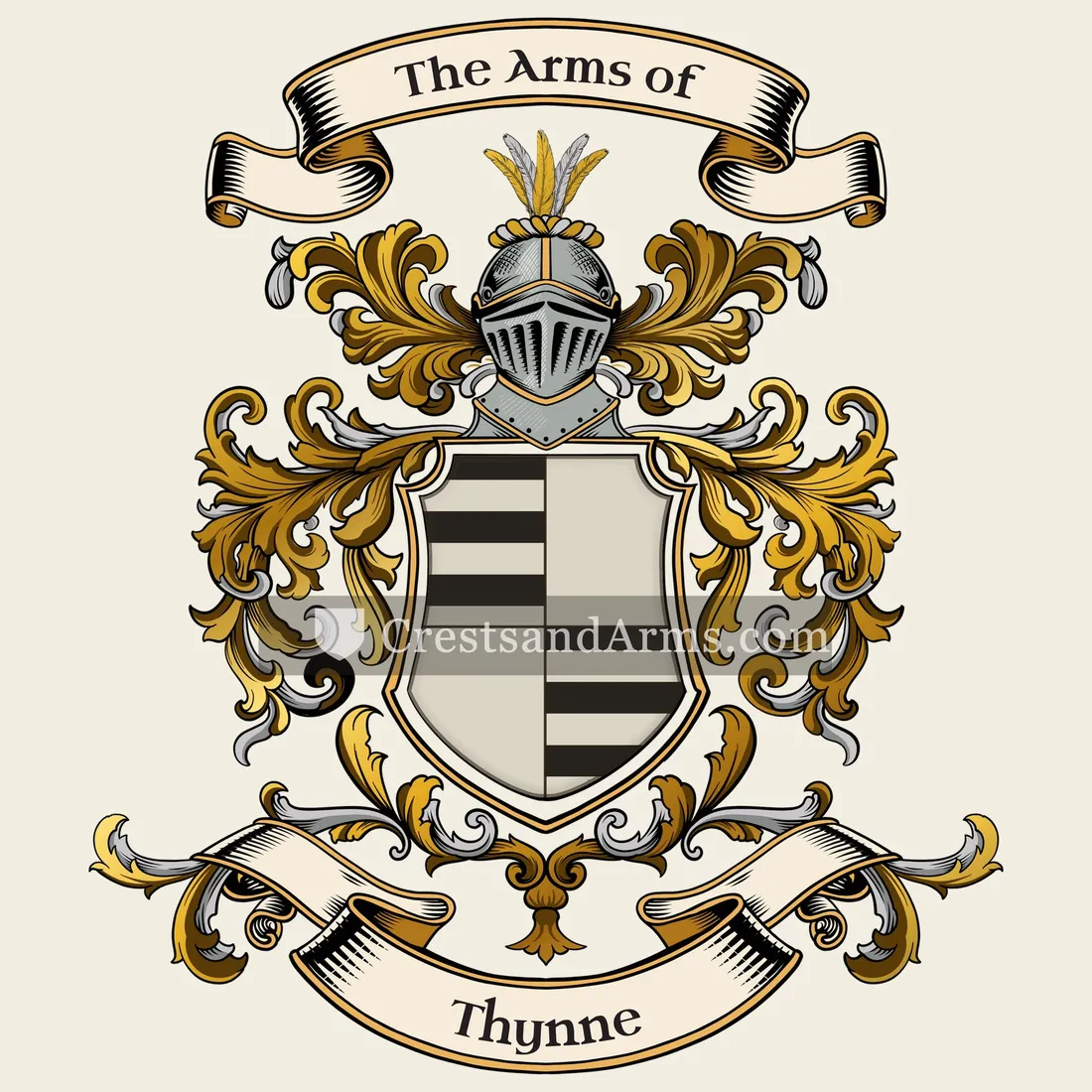
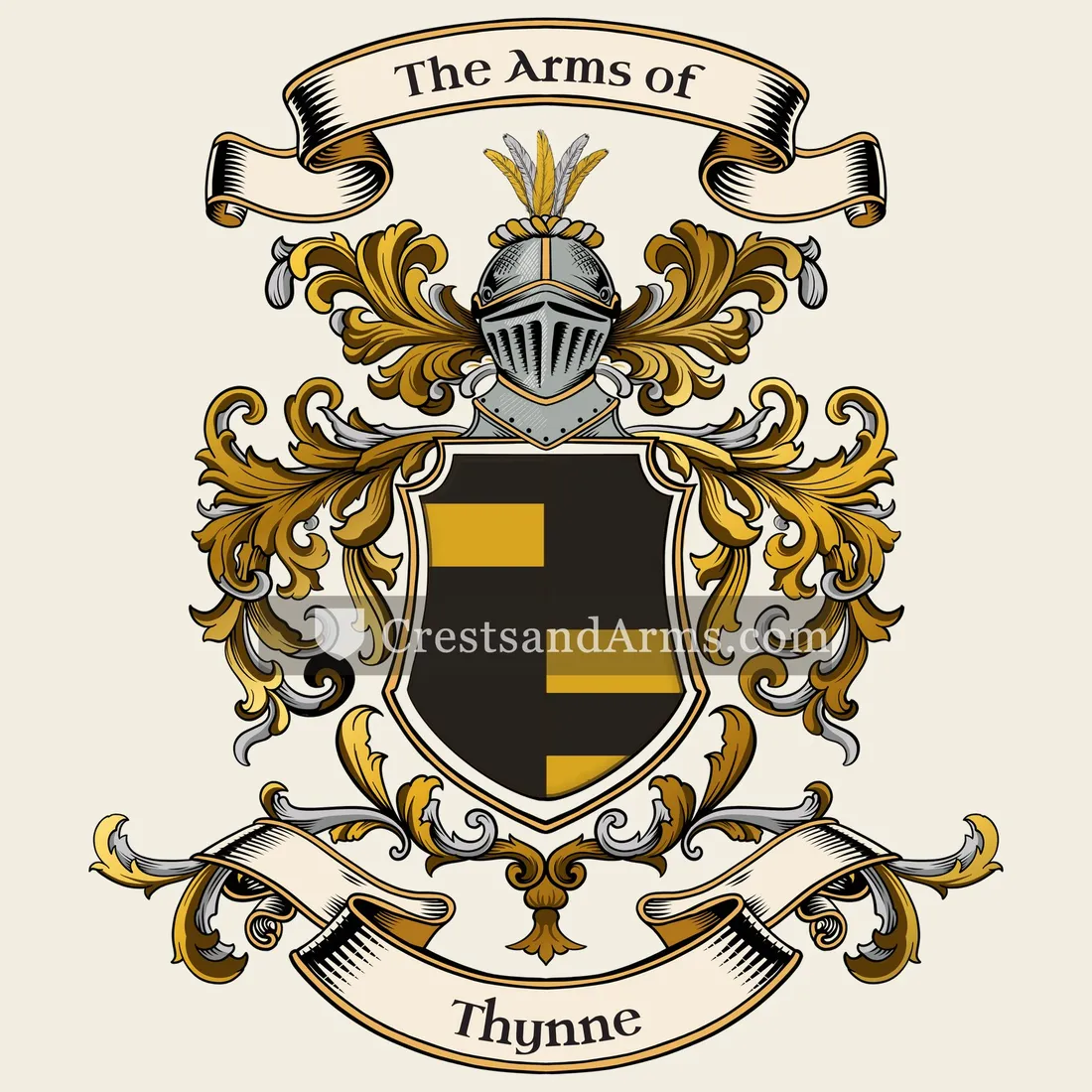
A record of documented arms, meaning and origin, researched for the Thynne family lines. Documented in 2 countries.
Reg. 9859 · French, T–V
Meaning of the Thynne family crest colors & symbols
Colours
Gold (Or)Means: Generosity
Silver (Argent)Means: Peace and sincerity
Black (Sable)Means: Constancy
Historical info
Source
J. B. Rietstap, Armorial Général, Gouda: G. B. van Goor Zonen, 1884–87
Blazon (the actual original written record)
“Ec.: aux 1 et 4 burelé d'or et de sa. (Thynne); aux 2 et 3 d'arg. au lion de gu. (Boteville). C.: un renne arrêté d'or. S.: à dextre un renne d'or, coll. de sa.; à sen. un lion de gu. D.: J'AI BONNE CAUSE.”
Francec. 1725
Digital archive packCoat of arms PNG, gold border print PDF, vector SVG and the certificate of authenticity. Sent to your email in minutes.
Map of France showing where the Thynne arms are recorded
The Thynne arms were recorded in France, c. 1725.
Arms such as these were typically recorded in Bretagne.
More families held coats of arms in Bretagne than anywhere else in France. The land was divided into many small estates rather than a few large ones, so far more households counted as gentry, and each needed a shield of its own to be told apart.
This is where the arms were entered in the register. Families often moved to other parts of the country, so the same name can turn up in more than one region.
The body that granted and recorded arms in France in this period.
Louis XV of France
Sovereign of the period
Louis XV of France
1715–1774
Reigning in France when the Thynne arms are first recorded.
How Arms Worked in France
In France, a coat of arms was a mark of honor that passed down through the male line to all legitimate descendants. Families often used the same shield without changes to show their shared heritage. If a branch wanted to stand out, they could add a small mark to their shield to show their specific place in the family tree.
Granting authority
The Juge d'armes de France acted as the official authority that regulated and verified coats of arms across the country.
How they got arms
Families typically inherited their arms from ancestors, though they could also receive them through royal grants or by proving their noble status.
Where arms were recorded
Coats of arms were officially recorded in the Armorial Général de France, which began its main collection in the year 1696.
The family's standing
Recorded among the armigerous families of France.
Origin & History of the Thynne Family in France
The history of the Thynne family in France is deeply connected to the cultural landscape of the Brittany region during the early eighteenth century. While the name is often associated with later British nobility, historical records confirm that members of the family were established in Bretagne by 1725. During this period, the family lived within a society defined by strict social hierarchies and the influence of the local Catholic Church. They likely integrated into the regional community through trade or land management, which was common for families of their standing at the time. Their presence in the area suggests they were part of a mobile class of people who moved across borders for economic or personal reasons. By settling in this coastal province, the family became part of the unique history of a region known for its distinct language and strong maritime traditions.
Meaning of the Thynne family crest colors & symbols
Colours
Gold (Or)Means: Generosity
Black (Sable)Means: Constancy
Historical info
Source
Sir Bernard Burke, The General Armory of England, Scotland, Ireland and Wales, London: Harrison & Sons, 1884
Blazon (the actual original written record)
“Quarterly, 1st and 4th, barry of ten or and sa.; 2nd and 3rd”
Englandc. 1620
Digital archive packCoat of arms PNG, gold border print PDF, vector SVG and the certificate of authenticity. Sent to your email in minutes.
Map of England showing where the Thynne arms are recorded
The Thynne arms were recorded in England, c. 1620.
Arms such as these were typically recorded in York.
Yorkshire is the largest of the English counties, and it held more gentry families than any other. Land there was split among a great many households rather than a few, so a great many of them carried arms.
This is where the arms were entered in the register. Families often moved to other parts of the country, so the same name can turn up in more than one region.
The body that granted and recorded arms in England in this period.
James VI and I
Sovereign of the period
James VI and I
1603–1625
Reigning in France when the Thynne arms are first recorded.
How Arms Worked in England
English heraldry allowed arms to be shared by all legitimate descendants of the original owner. These symbols were treated as personal property that moved through the generations to all children. While the eldest son kept the original design, other family members could use the same shield without needing to change it or register their own unique versions.
Granting authority
The College of Arms in London has regulated the use of coats of arms throughout England and Wales since 1484.
How they got arms
Families typically obtained their coats of arms through a formal grant from the Crown or by proving their ancient right to them.
Where arms were recorded
All official coats of arms are recorded in the registers kept at the College of Arms, which date back to the fifteenth century.
The family's standing
Recorded among the armigerous families of England.
Origin & History of the Thynne Family in England
The history of the Thynne family in England is deeply tied to the social and political shifts of the early modern period. While the name gained significant prominence through its association with the Longleat estate in Wiltshire, records confirm that members of the family were firmly established in the city of York by 1620. During this era, families often moved across the country to pursue opportunities in trade, law, or local government. The presence of the Thynne name in northern England suggests that the family was part of the rising professional class that helped manage the administrative affairs of regional hubs. By settling in urban centers like York, these individuals integrated themselves into the local merchant and civic networks that defined English life before the outbreak of the Civil War. This migration pattern highlights how a family name could spread from rural estates to bustling cities as the nation became more interconnected.
Thynne Meaning & Related Branches
Root word
tenuis
Latin term meaning thin, slender, or fine.
This name
ThynneA descriptive nickname for a person of thin or slender physical build.
also spelled
Thyn
Tynne
Thin
Thinne
Documented Sources
J. B. Rietstap, Armorial Général, Gouda: G. B. van Goor Zonen, 1884–87
Archives départementales d'Ille-et-Vilaine, Série B: Cours et juridictions
Archives départementales du Finistère, Série E: Familles et seigneuries
Le Moyne de La Borderie, Arthur, Histoire de Bretagne, 1896
Digital archive packCoat of arms PNG, gold border print PDF, vector SVG and the certificate of authenticity. Sent to your email in minutes.